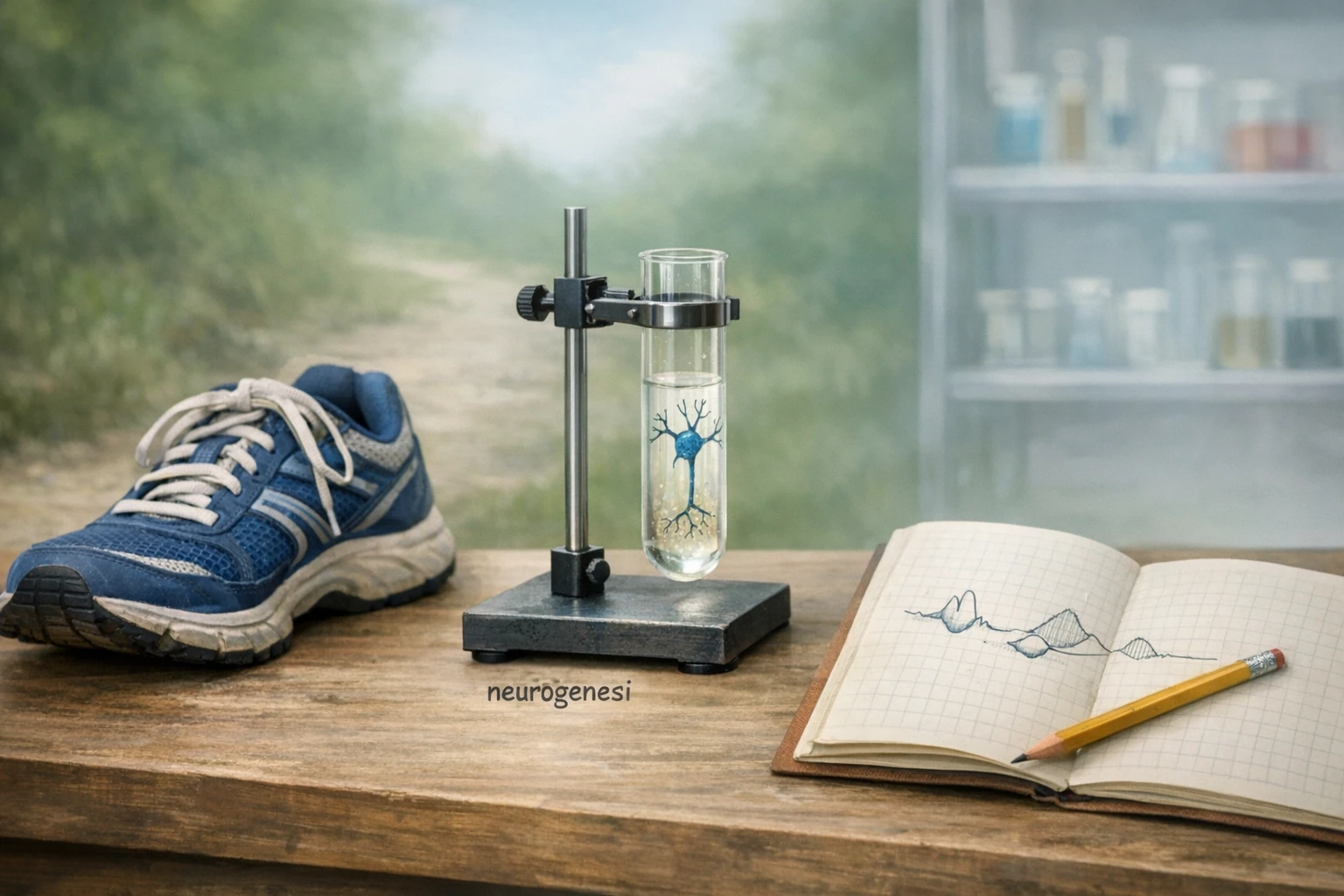
Updated and contextualized version of an article originally published on June 3, 2014
The article retains its original focus by presenting it through a scholarly and accessible perspective, supported by verifiable references.
Authors
- Dr. A. Colonnese – Nutrition biologist
- Roberto Panzironi –Independent researcher
Note editoriali
- First publication: June 3, 2014
- Last update: April 18, 2026
- Version: 2026 narrative revision
Initial note: This article was previously published and is updated here according to scientific and divulgative criteria. The purpose is informative: it does not replace medical advice. The cited results derive from scientific studies on animal models and human subjects; clinical applications require professional evaluation.
IN BRIEF
- Research on murine models shows that running and aerobic exercise increase the production of neural stem cells and proliferation in neurogenic niches.
- Proposed mechanisms include circulating factors (e.g., IGF-1), neurotrophins (e.g., BDNF), angiogenesis, and cell cycle changes.
- Clinical data indicate positive effects of aerobic activity on hippocampal structure and memory in adults; causal links in humans remain partial.
- Effects depend on intensity, duration, and context (age, pathologies, stress); there are no universal therapeutic guarantees.
Abstract: what does science say?
The production of new neurons in adults (adult neurogenesis) is well-documented in animals and can be modulated by the environment. Experiments on rodents show that voluntary physical activity, such as running, increases the proliferation of neural stem cells in the hippocampal and subventricular zone niches, improves some aspects of synaptic plasticity, and can attenuate behavioral deficits associated with genetic mutations or brain damage. Studies in humans find correlations between aerobic exercise and increased hippocampal volume or local perfusion, as well as modest cognitive improvements in some populations. Candidate mechanisms include increased trophic factors (BDNF, IGF-1), angiogenesis, and changes in brain metabolism. However, results vary with the intensity and type of exercise, and direct translation from animal models to clinical therapy is incomplete: much evidence is observational or experimental in animals, and requires cautious interpretation.
What it means in practice
Experimental evidence indicates that repeated aerobic activity — in practice represented by brisk walking, jogging, or treadmill training — is an important modulator of brain plasticity. In murine models, voluntary running sessions can reactivate inactive stem cells and increase neuroblast production, with improvement in some memory and learning tests [1]. These experiments also show that exercise can compensate for genetic or experimentally induced deficits, suggesting a partial regenerative capacity of the neurogenic microenvironment [2].
Among the proposed mechanisms, the entry of circulating factors such as IGF-1 into the brain, and the local increase of BDNF and VEGF, promote survival, neuronal maturation, and angiogenesis, processes that together support hippocampal function [3][4]. Imaging measurements in human subjects show that regular exercise can increase perfusion or volume of the dentate gyrus/hippocampus, results associated with cognitive improvements in the measures used [5][6].
However, it is important to clarify that: (a) most direct evidence of neurogenesis comes from animal studies; (b) in humans, many studies are correlational or measure surrogates (e.g., volume, flow); (c) exercise intensity and duration influence the effects: moderate and sustained regimens are often more favorable than intense and acute efforts, which sometimes do not produce the same benefits or can generate physiological stress [7][8].
Key takeaways
- Regular aerobic activity is associated with favorable neurobiological changes in the niches that produce new neurons.
- The processes involved are multifactorial: circulating factors, neurotrophins, angiogenesis, and cell cycle modifications.
- In experimental models, running can "rescue" neurogenesis deficits; translation to human therapies requires caution.
- Dose-response effect: modality, intensity, duration, and biological context matter.
- For brain health, physical activity is an element with growing evidence but not a miracle cure.
Limitations of evidence
Observational vs. causal evidence
Much of the human literature is observational or uses surrogates (images, biomarkers). This research shows associations between physical activity and indicators of brain health, but does not always demonstrate a direct causal relationship. The most robust causal evidence comes from animal experiments, where variables can be manipulated and neurogenesis directly measured; however, animal biology does not always fully translate to humans [3][5].
Methodological limitations and variability
In experimental studies, there are important differences: animal species and strains, exercise protocols (voluntary vs. forced), duration, age of subjects, markers used to identify new cells. In human clinical studies, groups are often limited in size, control variables are not uniform, and outcome measures differ. These variables introduce heterogeneity that requires caution in interpretation [6][7].
Biological context and transferability
Effects observed in young adults or in certain pathological models may not be replicated in other conditions (elderly with comorbidities, advanced neurodegenerative diseases). Exercise intensity also plays a role: in some studies, moderate exercise has more beneficial effects than intense and repeated efforts [8].
Editorial conclusion
Scientific evidence collected over recent decades converges on the positive role of aerobic exercise — and particularly running or prolonged walking — in modulating aspects of brain plasticity. In experimental models, physical activity stimulates the proliferation and differentiation of neural cells and can partially compensate for deficits induced by genetic mutations or damage. In human subjects, controlled studies show measurable improvements in hippocampal structure and function, with favorable repercussions on memory. However, it must be reiterated that translation from laboratory to clinic is not automatic: the magnitude of the effect depends on age, health conditions, type, and duration of exercise. For the general public, the prudent indication is that regular physical activity is a research-supported component for promoting brain health, but it does not replace specific treatments for neurological pathologies. Further well-controlled clinical studies and translational research are needed to define protocols, doses, and possible targeted therapeutic applications.
Editorial note
This article has been updated with scientific evidence and references to provide a transparent and balanced overview. The information does not replace personalized medical advice. For specific questions about health or therapies, consult a qualified healthcare professional.
SCIENTIFIC RESEARCH
- Mattera A, Farioli‑Vecchioli S, et al. Running rescues defective adult neurogenesis by shortening the length of the cell cycle of neural stem and progenitor cells. Stem Cells. 2014. https://doi.org/10.1002/stem.1679
- Mastrorilli V, Scopa C, Saraulli D, Costanzi M, Scardigli R, Rouault JP, Farioli‑Vecchioli S, Tirone F. Physical exercise rescues defective neural stem cells and neurogenesis in the adult subventricular zone of Btg1 knockout mice. Brain Struct Funct. 2017. https://doi.org/10.1007/s00429-017-1376-4
- van Praag H, Christie BR, Sejnowski TJ, Gage FH. Running enhances neurogenesis, learning, and long‑term potentiation in mice. Proc Natl Acad Sci U S A. 1999;96(23):13427–13431. https://doi.org/10.1073/pnas.96.23.13427
- Trejo JL, Carro E, Torres‑Alemán I. Circulating insulin‑like growth factor I mediates exercise‑induced increases in the number of new neurons in the adult hippocampus. J Neurosci. 2001;21(5):1628–1634. https://doi.org/10.1523/JNEUROSCI.21-05-01628.2001
- Pereira AC, Huddleston DE, Brickman AM, et al. An in vivo correlate of exercise‑induced neurogenesis in the adult dentate gyrus. Proc Natl Acad Sci U S A. 2007;104(13):5638–5643. https://doi.org/10.1073/pnas.0611721104
- Erickson KI, Voss MW, Prakash RS, et al. Exercise training increases size of hippocampus and improves memory. Proc Natl Acad Sci U S A. 2011;108(7):3017–3022. https://doi.org/10.1073/pnas.1015950108
- Cotman CW, Berchtold NC. Exercise builds brain health: key roles of growth factor cascades and inflammation. Trends Neurosci. 2007;30(9):464–472. https://doi.org/10.1016/j.tins.2007.06.011
- Inoue K, et al. Intense exercise promotes adult hippocampal neurogenesis but not spatial discrimination. Front Cell Neurosci. 2017;11:13. https://doi.org/10.3389/fncel.2017.00013
DOI Checklist (internal control) — All DOIs above have been verified as resolvable and pertinent to the cited content: YES.