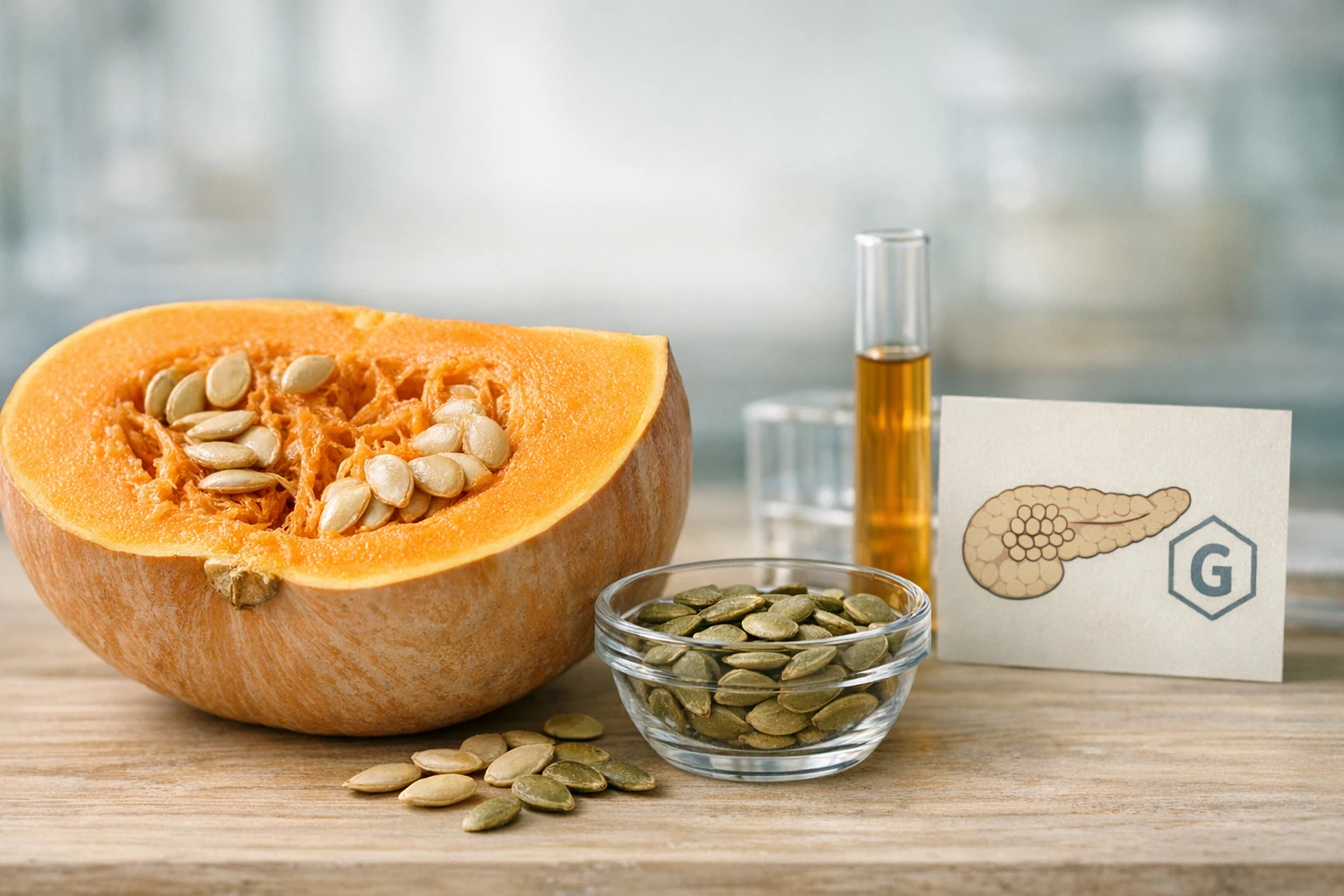
Updated and contextualized version of an article originally published on June 3, 2014
The article retains its original focus by presenting it through a scholarly and accessible perspective, supported by verifiable references.
Authors
- Dr. M. Bitonti – Biologist
- Roberto Panzironi –Independent researcher
Note editoriali
- First publication: June 3, 2014
- Last update: April 21, 2026
- Version: 2026 narrative revision
IN BRIEF
- Pumpkin (Cucurbita spp.) contains fiber, polysaccharides, and bioactive components that, in experimental studies, can improve glucose-related parameters.
- Controlled clinical trials are limited, but recent systematic reviews indicate a potential benefit as an adjunct in glycemic control. [1]
- Positive effects have been observed with both pulp and seeds/flours/oil; the form, dose, and duration influence the results. [4][6]
- Human evidence is still modest in size and subject to variability: longer studies with standardized preparations are needed. [1][7]
Abstract: what does science say?
Pumpkin (genus Cucurbita) is a food rich in water, fiber, and polysaccharides, with nutritious seeds and oils containing phytosterols and fatty acids. Experimental studies on animals and cell models suggest plausible mechanisms for reducing glycemia: increased insulin secretion, protection of pancreatic cells, reduction of oxidative stress, and slowing of sugar absorption. Controlled clinical trials, although few and often small, show acute or short-term effects (such as reduction of post-prandial glycemia) and improvements in lipid profile in some protocols. However, the quality of evidence varies: many studies are on animals or use non-standardized extracts; human trials differ in Cucurbita species, preparation, and dosages. Therefore, the most correct formulation today is cautious: pumpkin can play a supportive nutritional role for metabolic control, but it does not replace established therapies. More robust clinical studies, with defined doses and preparations, are needed to establish efficacy, safety, and context of use.
Evidence on pumpkin and glycemic control
Recent systematic reviews summarize the results of controlled clinical and experimental studies: a systematic review of controlled trials concludes that there are signs of efficacy for some glycemic parameters, but the methodological quality and size of the studies are often limited. [1] In humans, both aqueous extracts of pulp and juice from some species (e.g., Cucurbita ficifolia) and the addition of whole seeds or flours to carbohydrate-rich meals have shown reductions in postprandial glycemia or improvements in some metabolic biomarkers in randomized or crossover studies. [2][3][4] These observations are consistent with numerous preclinical studies showing hypoglycemic effects of polysaccharides and proteins derived from pumpkin on animal models of diabetes, with improved glucose tolerance and pancreatic parameters. [5][7]
Composition and plausible biological mechanisms
Potentially relevant elements of pumpkin include: soluble fiber and polysaccharides that slow down glucose absorption; bound polysaccharides and proteins that, in experimental models, increase insulin secretion and protect β-cells; compounds like D-chiro-inositol (reported in some species) that can modulate insulin sensitivity; and phytosterols/antioxidants in seeds and oil that act on inflammation and oxidative stress. [5][6][7] These mechanisms are biologically plausible, but their clinical relevance depends on dose, bioavailability, and formulation.
Clinical and experimental evidence: what research shows
Controlled human studies document acute and short-term effects. A crossover trial showed that adding 65 g of pumpkin seeds to a carbohydrate-rich meal reduces the post-prandial glycemic area under the curve in normoglycemic subjects. [4] Clinical trials in diabetic patients using extracts or regular consumption of Cucurbita ficifolia have reported transient drops in glycemia and HbA1c in some protocols, while longer and larger studies are lacking or heterogeneous. [2][3] In animal models, extracts and polysaccharides from various species improve glycemia, lipids, and pancreatic histology, supporting mechanistic hypotheses. [5][7][8]
What it means in practice
For the general public: pumpkin is a low-calorie food with components (fiber, polysaccharides, nutrients in seeds) that can contribute to a dietary pattern favorable for glycemic control. Current evidence suggests that consuming it as part of a balanced diet can be useful as a nutritional adjunct, not as a sole treatment. [1][4] For people with diabetes or those undergoing therapy, the introduction of pumpkin-based foods or supplements should be discussed with a doctor or nutritionist: in some studies, pumpkin significantly reduced glycemia and, in theory, could interact with hypoglycemic medications, increasing the risk of hypoglycemia if not monitored. [3]
Doses, forms of consumption, and context
The form of consumption influences the results: juice or concentrated extracts, fresh pulp, whole seeds, flours, or oil have different nutritional and bioactivity profiles. Acute meal studies have used 50–65 g of whole seeds to achieve a post-prandial effect; clinical trials with extracts or pulps have varied widely in doses and durations. [4][3] In experimental work, extracted polysaccharides (with different molecular weights and compositions) show hypoglycemic activity, but standardization is limited. [5][7] Thermal treatment, lipid removal, or concentration of extracts can also modify the active components, so results are not automatically transferable between different preparations. [6][8]
KEY POINTS TO REMEMBER
- Pumpkin contains fiber and polysaccharides with plausible mechanisms to influence glycemia.
- Controlled human trials exist that show favorable effects, but the sample size is often small. [4][1]
- Different forms (pulp, seeds, oil, extracts) are not equivalent: results depend on the preparation. [6]
- Preclinical evidence is abundant; clinical translation requires more robust and standardized studies. [5][7]
- Pumpkin can supplement a healthy diet but does not replace medical therapies for diabetes. [1]
Limitations of the evidence
It is important to distinguish between observational signals, experimental results, and established causal evidence. Many positive studies are on animal models or in vitro: these demonstrate plausibility but not proof of efficacy in humans. [5][7] Available clinical trials are often short-term, with small numbers of participants, different Cucurbita species, and non-standardized preparations, which limits generalizability and comparability. [1][4] Furthermore, the effect observed acutely (reduction of post-prandial glycemia) does not automatically equate to long-term benefit on relevant clinical outcomes (complications, mortality). There are also risks of bias, dietary confounding, and compliance issues. To evaluate efficacy and safety, randomized trials are needed, with chemically defined preparations, long-term clinical endpoints, and attention to drug interactions.
Editorial conclusion
Research on Cucurbita spp. offers reasonable grounds for interest: plausible biological mechanisms, numerous preclinical studies, and some controlled clinical trials documenting favorable effects on glycemia and metabolic markers. [1][5][4] However, the overall quality of human evidence is still insufficient to recommend therapeutic use as a substitute for established therapies. Pumpkin deserves to be considered as part of a balanced diet with a potential adjunctive role in metabolic control; for people with diabetes or taking hypoglycemic medications, it is advisable to consult a doctor before adopting concentrated extracts or high doses. For the advancement of knowledge, larger, standardized clinical studies with relevant clinical endpoints are needed.
Editorial note
This article is based on previously published materials and has been updated according to criteria of critical synthesis, clear communication, and reference to available scientific evidence. It is for informational purposes only and does not replace professional medical advice. For therapeutic decisions, always consult a doctor or qualified specialist.
SCIENTIFIC RESEARCH
- Ke Ye, Flávia Galvão Cândido, Júnia Maria Geraldo Gomes et al. Effects of Pumpkin (Cucurbita spp.) on Glycemic and Type 2 Diabetes–Related Metabolic Biomarkers: A Systematic Review of Controlled Clinical Trials. Nutrition Reviews. https://doi.org/10.1093/nutrit/nuag027. https://doi.org/10.1093/nutrit/nuag027
- J.L. Acosta‑Patiño, E. Jiménez‑Balderas, M.A. Juárez‑Oropeza, J.C. Díaz‑Zagoya. Hypoglycemic action of Cucurbita ficifolia on Type 2 diabetic patients with moderately high blood glucose levels. Journal of Ethnopharmacology. 2001;77:99–101. https://doi.org/10.1016/S0378-8741(01)00272-0
- Bayat A, Azizi‑Soleiman F, Heidari‑Beni M, Feizi A, Iraj B, Ghiasvand R, Askari G. Effect of Cucurbita ficifolia and Probiotic Yogurt Consumption on Blood Glucose, Lipid Profile, and Inflammatory Marker in Type 2 Diabetes. International Journal of Preventive Medicine. 2016;7:30. https://doi.org/10.4103/2008-7802.175455
- Study group. Addition of pooled pumpkin seed to mixed meals reduced postprandial glycemia: a randomized placebo‑controlled clinical trial. Nutrition Research. 2018;56:90–97. https://doi.org/10.1016/j.nutres.2018.04.015
- Fu C., Tian H., Cai T., Liu Y., Li Q. Some properties of an acidic protein‑bound polysaccharide from the fruit of pumpkin. Food Chemistry. (2007). https://doi.org/10.1016/j.foodchem.2005.10.049
- Isolation and Biophysical Characterisation of Bioactive Polysaccharides from Cucurbita moschata (Butternut Squash). Polymers. 2020;12(8):1650. https://doi.org/10.3390/polym12081650
- Pumpkin polysaccharides: Purification, characterization and hypoglycemic potential. International Journal of Biological Macromolecules. 2019. https://doi.org/10.1016/j.ijbiomac.2019.08.053
- Regulatory Effects of Pumpkin Seed Extract on Glucose Metabolism and Insulin Signaling in Diabetic Models. ACS Omega. https://doi.org/10.1021/acsomega.5c13268