Updated and contextualized version of an article originally published on June 12, 2014
The article retains its original focus by presenting it through a scholarly and accessible perspective, supported by verifiable references.
Authors
- Dr. M. Bitonti – Biologist
- Roberto Panzironi –Independent researcher
Note editoriali
- First publication: June 12, 2014
- Last update: April 18, 2026
- Version: 2026 narrative revision
Editorial Note
This article was previously published and updated according to scientific and divulgative criteria. It is for informational purposes only and does not replace the advice of a doctor or other healthcare professionals. For clinical choices or therapies, always consult a qualified healthcare professional.
IN BRIEF
- Mulberry (Morus alba) contains compounds — particularly the iminosugar 1-deoxynojirimycin (DNJ) — that can reduce post-prandial glycemia by inhibiting alpha-glucosidases.
- Controlled clinical trials show acute reductions in post-prandial glycemia with leaf or fruit extracts; the effect depends on the dose and form (leaves vs. fruit) and the amount of DNJ present.
- In addition to its effect on glycemia, mulberry provides polyphenols/anthocyanins with antioxidant activity and possible effects on lipids and inflammation, but clinical evidence is still limited.
- Studies support potential benefits as a dietary complement; however, they do not replace pharmacological therapies for diabetes. Pay attention to doses, interactions, and possible gastrointestinal effects.
MAIN SECTION — Abstract: What does science say?
Mulberry (Morus alba) is studied for its ability to reduce glycemic spikes after meals, mainly due to the iminosugar 1-deoxynojirimycin (DNJ), which inhibits intestinal enzymes involved in carbohydrate breakdown. Randomized controlled trials, dose-response trials, and meta-analyses document a measurable reduction in post-prandial glycemia and, in some studies, a favorable effect on HbA1c with prolonged exposure. The effect depends on: the part of the plant used (leaves vs. fruit), the extraction method, the DNJ content, and the administered dose. Experimental studies also demonstrate plausible cellular mechanisms (alpha-glucosidase inhibition, modulation of GLUT4/AMPK-related pathways). The main limitations are the variability of the tested products, the often small size of the studies, and the scarcity of long-term data and major clinical outcomes. In epidemiological terms, the literature suggests consistent and plausible associations, but translation into clinical recommendations requires caution.
Relevant biological mechanisms
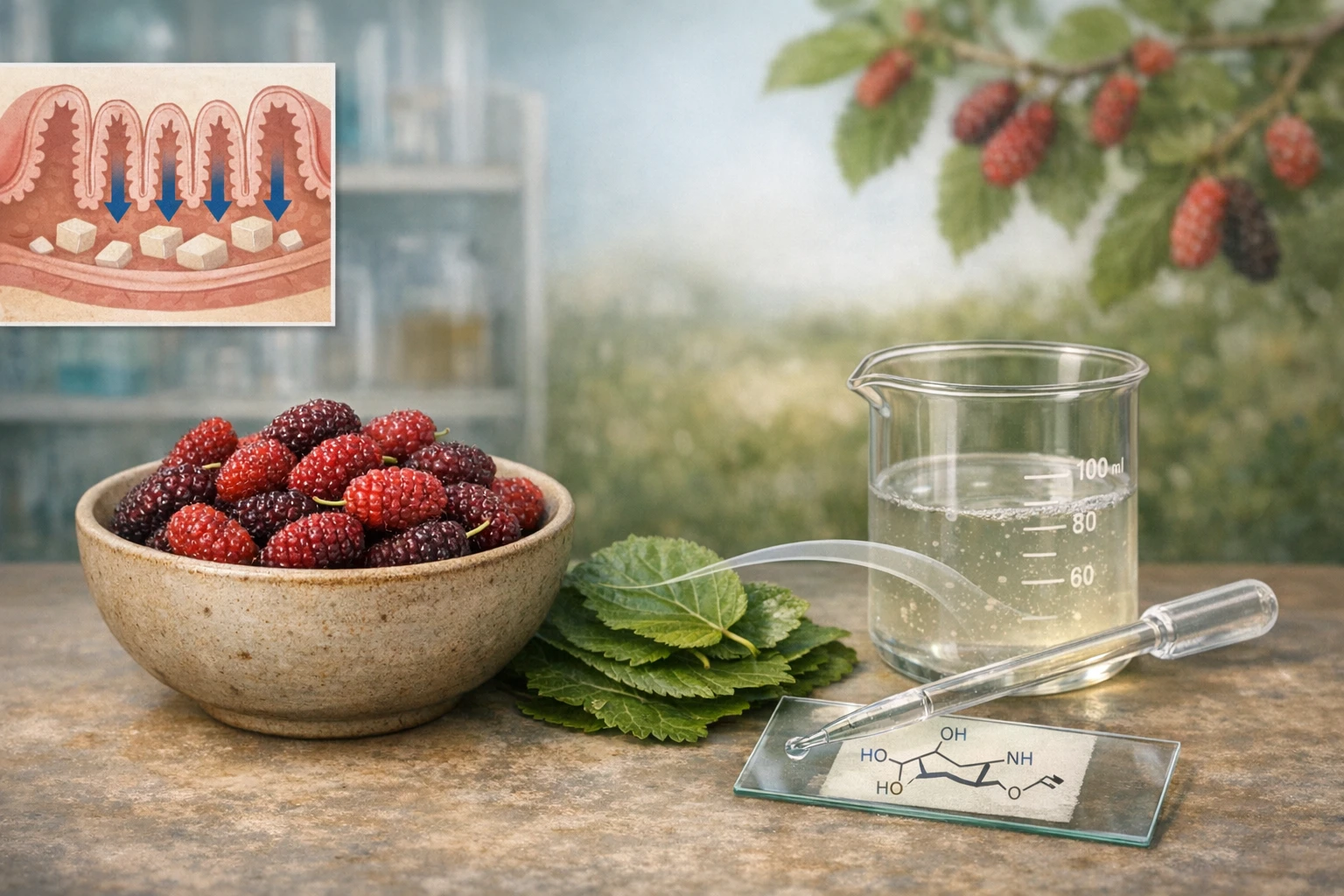
The most studied active principle in mulberry is 1-deoxynojirimycin (DNJ), an iminosugar that inhibits intestinal alpha-glucosidases: enzymes that break down disaccharides and oligosaccharides into absorbable monosaccharides. The inhibition of these enzymes slows down sugar digestion and attenuates the glycemic peak after meals [1]. Molecular physiology studies have also identified metabolic pathways in plants that determine DNJ biosynthesis, supporting the natural variability of its content depending on tissues and growth conditions [2].
The effect on post-prandial glucose is accompanied in some experimental models by modulation of AMPK activity and alterations in glucose transporters (e.g., effects observed on parameters associated with GLUT4), suggesting a possible action at the tissue level in addition to the intestinal level [10]. These mechanisms offer biological plausibility to the clinical observation of a reduction in acute glycemic responses and, in some prolonged studies, an improvement in metabolic parameters.
Clinical and experimental evidence
The clinical literature includes acute studies (single administration co-ingested with a carbohydrate load test) and short-to-medium-term studies. A systematic meta-analysis of randomized trials concludes that supplements based on mulberry leaves or extracts can reduce fasting glycemia, HbA1c, and fasting insulin compared to placebo, with clearer effects for therapies ≥8 weeks [1].
Controlled trials in normoglycemic subjects and those with dysglycemia have shown reductions in post-prandial glycemic peak and the area under the curve for glucose and insulin when the extract was administered with the meal [2][3]. Dose-response studies indicate that the effect is correlated with DNJ content: doses around a few milligrams of DNJ have been effective in several experiments with high-carbohydrate foods [3][6]. More recent data, including trials in people with type 2 diabetes, report acute reductions in post-prandial response even at low doses of standardized fruit extract [4].
Which parts of the plant and which compound are important? (H3)
Studies show that mulberry leaves and fruits contain potentially active compounds, but the concentration of DNJ is generally higher in leaves than in fruit. For this reason, many clinical trials use standardized leaf extracts or products concentrated in DNJ [1][6]. Other compounds present — anthocyanins and flavonoids — contribute with antioxidant and metabolic action, but their specific role in reducing glycemia is less defined and often co-variable with DNJ content [7].
Forms of administration, doses, and tolerability
The most studied forms are dry or fluid leaf extracts, standardized fruit extracts, and food preparations containing the extract. Dosages vary greatly among studies: some acute studies have used 0.125–1.5 g of standardized extract (with varying DNJ percentages), while prolonged studies have used higher or repeated daily doses [3][5].
The most frequent adverse effects reported are transient gastrointestinal issues (gas, flatulence, sometimes diarrhea), related to the mechanism of inactivation of digestive enzymes that increases colonic fermentation [5][6]. Controlled studies generally report good short-term tolerability, but long-term safety and in people with comorbidities require further data [1][3].
Other potential properties: antioxidants, lipid, and cardiovascular (H3)
Mulberry contains anthocyanins and flavonoids with antioxidant activity in cellular and animal models; experiments suggest reductions in oxidative stress, modulation of hepatic metabolic pathways, and possible hypolipidemic effects in preclinical models [7]. However, human evidence on improving lipid profile or reducing blood pressure is limited and not yet consolidated: some experimental studies indicate plausible mechanisms, but the translation into clinical outcomes remains to be established with well-designed trials [8].
PRACTICAL SECTION — What it means in practice
For the reader: the use of mulberry extracts can reduce glycemic spikes after carbohydrate-rich meals; this is consistent with DNJ's activity as an alpha-glucosidase inhibitor. The best results are observed when the product is standardized and the dose contains a recognized amount of DNJ. However, this is not a "cure" for diabetes: extracts can be part of dietary strategies aimed at reducing glycemic load, but they do not replace medications, therapies, or changes prescribed by a doctor.
Prudent practice: discuss with your doctor before starting regular use, especially if you are taking hypoglycemic therapy (risk of hypoglycemia), have gastrointestinal conditions, or are pregnant or breastfeeding. In case of intestinal side effects, reduce or stop intake. Prefer products with clearly indicated composition and DNJ content on the label and from transparent suppliers.
KEY POINTS TO REMEMBER
- DNJ is the main component implicated in the acute antidiabetic effect of mulberry; its presence and concentration largely determine the efficacy observed in clinical studies [2][6].
- Randomized trials and systematic analyses document reductions in post-prandial glycemia and small improvements in HbA1c in selected conditions, but the quality of studies varies [1][2].
- The form, botanical source (leaves vs. fruit), extraction method, and DNJ content influence the effects; not all products are equivalent [3][6].
- Possible gastrointestinal side effects are linked to the mechanism of action and the amount ingested; caution in people with intestinal disorders or who are taking blood sugar medications [5][7].
Limitations of the evidence
It is important to distinguish between types of studies: observational studies can show associations between the consumption of polyphenol-rich foods and lower metabolic risks, but they do not prove causality. Randomized clinical trials provide stronger evidence for acute effects on post-prandial glycemia, but many are short-term or have small samples. Recurring limitations include: heterogeneity of tested products, variability in DNJ content not always reported, modest sample size, and scarcity of long-term clinical outcomes (e.g., reduction of cardiovascular events). Prudent interpretation requires more long-term trials, with standardized products and diverse clinical populations.
Editorial conclusion
Mulberry and its extracts represent an interesting example of how a plant food can provide active compounds with measurable effects on glucose metabolism. Biological plausibility is solid and supported by experimental and acute clinical studies; some evidence also suggests benefits on longer-term parameters. However, the variability of products and the limited amount of long-term data necessitate caution. For now, its use can be considered as a possible dietary support for managing glycemic spikes, but not as a substitute for established medical therapies. Larger, longer-term studies with well-characterized products are needed to draw definitive conclusions.
Closing editorial note
This update was carried out with criteria of transparency, citing peer-reviewed studies with verified DOIs. The information reported here is intended for the general public and does not constitute therapeutic indications. For clinical decisions, consult your treating physician.
SCIENTIFIC RESEARCH
The following peer-reviewed research, available via DOI, was used as a reference for this article. Each entry has been verified for consistency with the cited content.
- Cui W, Luo K, Xiao Q, et al. Effect of mulberry leaf or mulberry leaf extract on glycemic traits: a systematic review and meta-analysis. Food Funct. 2023;14:1277-1289. https://doi.org/10.1039/D2FO02645G
- Thondre PS, Lightowler H, Ahlström L, et al. Mulberry leaf extract improves glycaemic response and insulinaemic response to sucrose in healthy subjects: results of a randomized, double blind, placebo-controlled study. Nutr Metab (Lond). 2021;18:41. https://doi.org/10.1186/s12986-021-00571-2
- Mela DJ, Cao X-Z, Govindaiah S, et al. Dose–response efficacy of mulberry fruit extract for reducing post-prandial blood glucose and insulin responses: randomised trial evidence in healthy adults. Br J Nutr. 2023;129:771-778. https://doi.org/10.1017/S0007114522000824
- Effect of Low-Dose Mulberry Fruit Extract on Postprandial Glucose and Insulin Responses: A Randomized Pilot Trial in Individuals with Type 2 Diabetes. Nutrients. 2024;16:2177. https://doi.org/10.3390/nu16142177
- Nakamura M, Nakamura S, Oku T. Suppressive response of confections containing the extractive from leaves of Morus alba on postprandial blood glucose and insulin in healthy human subjects. Nutr Metab (Lond). 2009;6:29. https://doi.org/10.1186/1743-7075-6-29
- Kimura T, Nakagawa K, Kubota H, et al. Food-grade mulberry powder enriched with 1-deoxynojirimycin suppresses the elevation of postprandial blood glucose in humans. J Agric Food Chem. 2007;55:5869-5874. https://doi.org/10.1021/jf062680g
- Mudra M, Ercan-Fang N, Zhong L, Furne J, Levitt M. Influence of mulberry leaf extract on the blood glucose and breath hydrogen response to ingestion of 75 g sucrose by type 2 diabetic and control subjects. Diabetes Care. 2007;30:1272-1274. https://doi.org/10.2337/dc06-2120
- He N, et al. Dehydrogenase MnGutB1 catalyzes 1-deoxynojirimycin biosynthesis in mulberry. Plant Physiology. 2023;192:1307-1320. https://doi.org/10.1093/plphys/kiad065
- Chung HI, Kim J, Kim JY, Kwon O. Acute intake of mulberry leaf aqueous extract affects postprandial glucose response after maltose loading: randomized double-blind placebo-controlled pilot study. J Funct Foods. 2013;5:1502-1506. https://doi.org/10.1016/j.jff.2013.04.015
- Le Thi NH, Park JH, Han MJ, et al. Promotion of glucose uptake by mulberry leaf extract and its active component 1-deoxynojirimycin in C2C12 cells. Appl Biol Chem. 2026;69:6. ORCID (author Ki Sung Kang): https://orcid.org/0000-0003-2050-5244. https://doi.org/10.1186/s13765-025-01078-7