Updated and contextualized version of an article originally published on June 17, 2014
The article retains its original focus by presenting it through a scholarly and accessible perspective, supported by verifiable references.
Authors
- Dr. A. Conte – Biologist
- Roberto Panzironi –Independent researcher
Note editoriali
- First publication: June 17, 2014
- Last update: April 18, 2026
- Version: 2026 narrative revision
In brief
- Industrial margarine may contain trans fats produced during the partial hydrogenation of oils; these isomers negatively affect cholesterol and inflammatory markers.
- Experimental and observational evidence links trans fats to a higher cardiovascular risk; associations with certain cancers have been found in more recent studies but cannot yet be interpreted as definitive cause-and-effect relationships.
- Polyunsaturated oils (PUFA) have beneficial effects on cholesterol, but in experimental models, some forms and doses can promote tumor growth; human data are heterogeneous.
- Public recommendations have focused on reducing industrial trans fats in the food supply chain; individual interpretation requires attention to dose, source, and overall dietary context.
Abstract: what does science say?
The key issue is to distinguish between two elements: (1) industrially produced trans fats (mainly from partial hydrogenation of vegetable oils) and (2) polyunsaturated fats (PUFAs) naturally present in vegetable oils. Controlled and observational evidence shows that industrial trans fats worsen the lipid profile (increase LDL and reduce HDL) and promote inflammatory responses; these effects largely explain their established role in cardiovascular risk. Several population studies have also found associations between circulating levels of specific trans fats and certain cancers, but the data are not uniform and do not establish a direct causal relationship. For PUFAs (particularly linoleic acid, omega-6), experimental literature on animal models has highlighted potential tumor-promoting mechanisms in contexts of high exposure or in the presence of initiating agents, while human evidence is variable. In summary: industrial trans fats are recognized as harmful to cardiovascular health; the relationship between PUFAs and cancer is complex and depends on dose, type of PUFA, and dietary context; public recommendations prioritize reducing industrial trans fats and a balanced consumption of healthy fats. Limitations include the observational nature of many analyses, the variability of exposure measures, and the dependence on food processing times and formats.
History and Transformation of Margarine and Industrial Fats
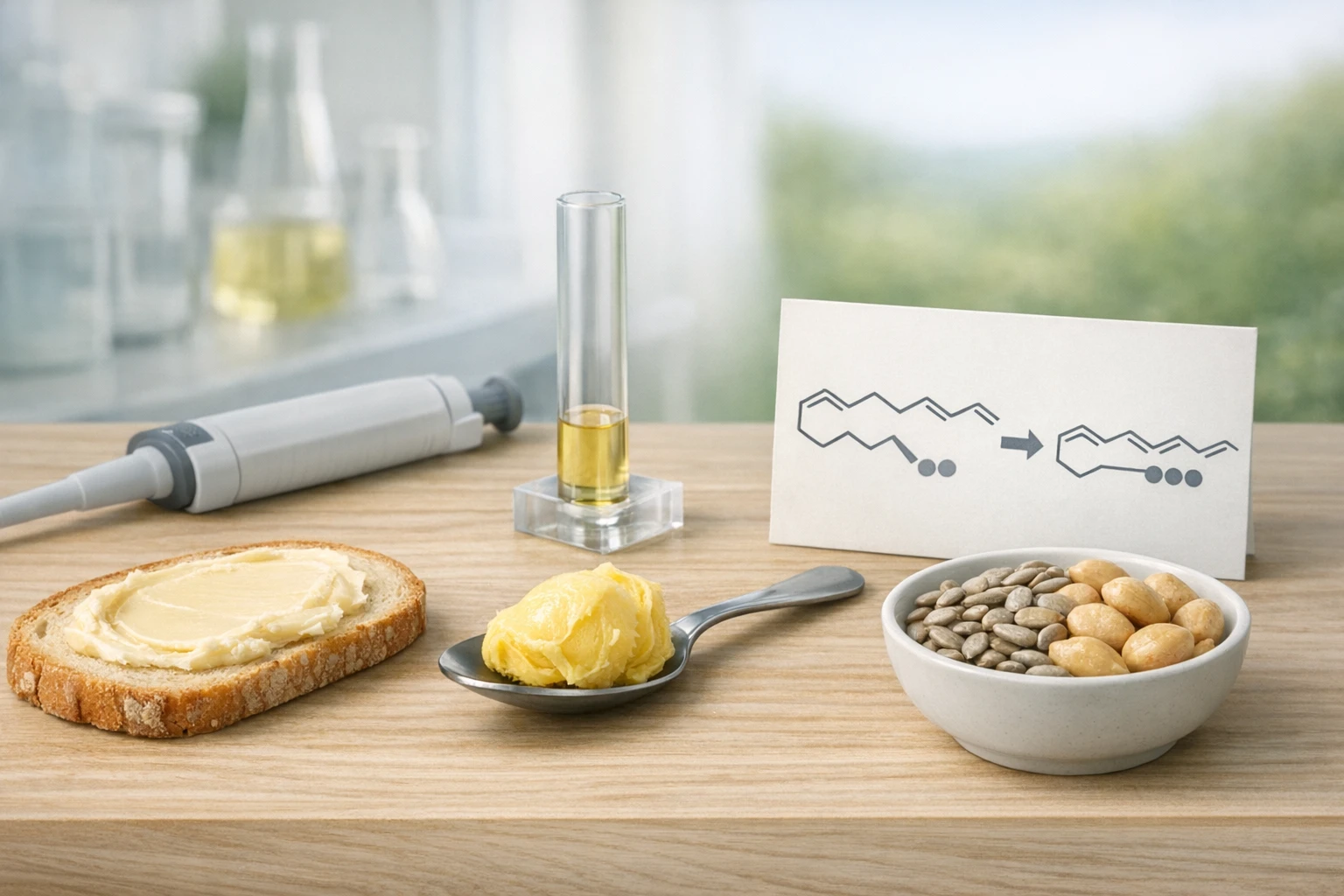
Margarine originated historically as an economical butter substitute; over time, its composition has profoundly changed. Industrial processes such as solvent extraction and partial hydrogenation have allowed liquid oils to be transformed into more stable and spreadable products. Partial hydrogenation, in particular, converts some cis double bonds into trans isomers, generating the most common trans fatty acids in processed products. The presence of catalyst residues and secondary reactions depends on technology and process control: in recent decades, the industry has modified formulations and processes to reduce contaminants and trans fats, but historical production has left a significant imprint on modern nutrition. The health implications therefore derive not only from the lipid source (animal vs. vegetable) but from the technological treatment that alters the chemical structure of fats [3].
Biological Mechanisms: How Trans Fats and PUFAs Affect the Body
Trans fats influence key metabolic mechanisms linked to cardiovascular risk: they increase LDL-cholesterol concentrations and reduce HDL, altering the total/HDL ratio; they also promote pro-inflammatory processes measurable with systemic biomarkers. These alterations have been observed in both controlled experimental studies and population studies and form the biological basis of the adverse effect of trans fats on cardiovascular disease risk [1] [2].
PUFAs, particularly linoleic acid (omega-6), play essential roles in physiology (membranes, lipid signals, metabolism). However, under experimental conditions, an excess of certain PUFAs can favor metabolic pathways that support cell growth and the production of pro-inflammatory or oxidative mediators; this does not equate to proof of carcinogenicity for humans, but describes plausible promotional mechanisms in the presence of initial damage or at very high doses [3] [5].
Polyunsaturated Fats and Cancer: What Experimental Studies Show
In animal and cell models, consistent increases in dietary linoleic acid can accelerate the growth of experimentally induced tumors. These results indicate that PUFAs can act as promoters in the presence of initiating agents: the relevance for normal human exposures remains uncertain, because animals often receive doses and combinations not comparable to those of the usual human diet [5].
Recent human studies: observational associations and biomarkers
Large-scale cohort analyses, which measure circulating fatty acids as exposure biomarkers, have reported associations between certain industrial trans isomers and cancer risk (for example, some results from EPIC indicate an increased risk of ovarian cancer associated with higher levels of elaidate, a trans fat typical of partially hydrogenated fats). Such evidence is important because it uses objective biological measures, but it remains observational: it can suggest useful relationships to explore, not proof of universal causality [6] [8].
What it means in practice
For the general public, the practical implications can be summarized into three operational, non-prescriptive points: (1) reduce exposure to industrially produced trans fats — typically found in products with "partially hydrogenated oils" or in highly processed foods — because the balance of evidence associated with cardiovascular risk is robust [1] [8]; (2) prefer unprocessed or minimally processed fat sources (olive oil, nuts, fish) and consume vegetable oils rich in PUFAs or MUFAs within a balanced diet, avoiding excessive doses from fried and repeatedly reheated products; (3) consider that the associations between PUFAs and cancer risk are complex: it is not useful to generically demonize PUFAs, but it makes sense to maintain variety, moderation, and choose products with processes that limit chemical transformations (for example, by avoiding products notoriously rich in industrial trans fats). Public policies now aim to eliminate industrial trans fats from the food chain; at an individual level, reading labels and preferring fresh foods remains a reasonable strategy.
Key points to remember
- Industrial trans fats worsen lipid profile and increase inflammation; they are associated with a higher cardiovascular risk. [1]
- Some population analyses find associations between trans fats and tumors; causality is not proven and requires additional studies. [6]
- PUFAs play essential functions, but in experimental models at high doses they can lead to promotional effects on tumor growth; human studies are heterogeneous. [5]
- The source and industrial treatment of fats (e.g., hydrogenation) are key determinants of their quality and potential risk. [3]
- Dietary choices based on variety, limiting ultra-processed foods, and paying attention to labels remain prudent practices.
Limitations of the Evidence
It is important to highlight the main limitations in interpreting the data: many studies linking fats and cancer are observational and thus susceptible to confounding factors (dietary patterns, lifestyle, environmental exposures). Animal models often use doses and experimental conditions that are not comparable to the daily human diet; therefore, the results do not automatically translate into clinical recommendations. Furthermore, exposure measurement varies: some analyses are based on food questionnaires, while others use plasma biomarkers that reflect recent or cumulative exposure differently. The industrial processing and treatment of oils (temperature, catalysts, repeated heating) affect the final products; this makes it difficult to attribute effects to a single chemical category without considering the technological context. For these reasons, any interpretation requires caution and consideration of the overall individual health and diet picture [3] [9].
Editorial Conclusion
In light of established literature, industrially produced trans fats pose a risk to cardiovascular health and are the subject of policies aimed at their elimination from the food chain. Associations between specific fatty acids (such as some trans fats) and cancer risk emerge in modern observational studies and warrant scientific attention, but do not reach definitive proof of causality. For PUFAs, experimental data indicate possible biological mechanisms of tumor promotion in particular contexts, while human evidence is heterogeneous. For the general public, the informed strategy is to reduce ultra-processed foods, prefer unprocessed fat sources, and discuss with a doctor or dietitian in case of specific health conditions.
Scientific research
- Mozaffarian D, Katan MB, Ascherio A, Stampfer MJ, Willett WC. Trans Fatty Acids and Cardiovascular Disease. N Engl J Med. 2006;354(15):1601–1613. https://doi.org/10.1056/NEJMra054035
- de Souza RJ, Mente A, Maroleanu A, et al. Intake of saturated and trans unsaturated fatty acids and risk of all cause mortality, cardiovascular disease, and type 2 diabetes: systematic review and meta-analysis of observational studies. BMJ. 2015;351:h3978. https://doi.org/10.1136/bmj.h3978
- Mozaffarian D, Aro A, Willett WC. Health effects of trans-fatty acids: experimental and observational evidence. Eur J Clin Nutr. 2009;63(S2):S5–S21. https://doi.org/10.1038/sj.ejcn.1602973
- New research development on trans fatty acids in food: biological effects, analytical methods, formation mechanism, and mitigating measures. Prog Lipid Res. 2022;101199. https://doi.org/10.1016/j.plipres.2022.101199
- Gebauer SK, Destaillats F, Dionisi F, Krauss RM, Baer DJ. Vaccenic acid and trans fatty acid isomers from partially hydrogenated oil both adversely affect LDL cholesterol: a double-blind, randomized controlled trial. Am J Clin Nutr. 2015;102(6):1339–1346. https://doi.org/10.3945/ajcn.115.116129
- Yammine S, Huybrechts I, Biessy C, et al. Dietary and circulating fatty acids and ovarian cancer risk in the European Prospective Investigation into Cancer and Nutrition (EPIC). Cancer Epidemiol Biomarkers Prev. (EPIC analysis). https://doi.org/10.1158/1055-9965.EPI-20-1426
- Hirayama T, Wakai K, et al. Linoleic acid intake and cancer risk: review and meta-analysis. Am J Clin Nutr. 1998;68(1):142–153. https://doi.org/10.1093/ajcn/68.1.142
- Chajès V, Assi N, Biessy C, et al. A prospective evaluation of plasma phospholipid fatty acids and breast cancer risk in the EPIC study. Ann Oncol. 2019;30:2836–2842. https://doi.org/10.1093/annonc/mdx482
- Mozaffarian D, Pischon T, Hankinson SE, et al. Dietary intake of trans fatty acids and systemic inflammation in women. Am J Clin Nutr. 2004;79(4):606–612. https://doi.org/10.1093/ajcn/79.4.606