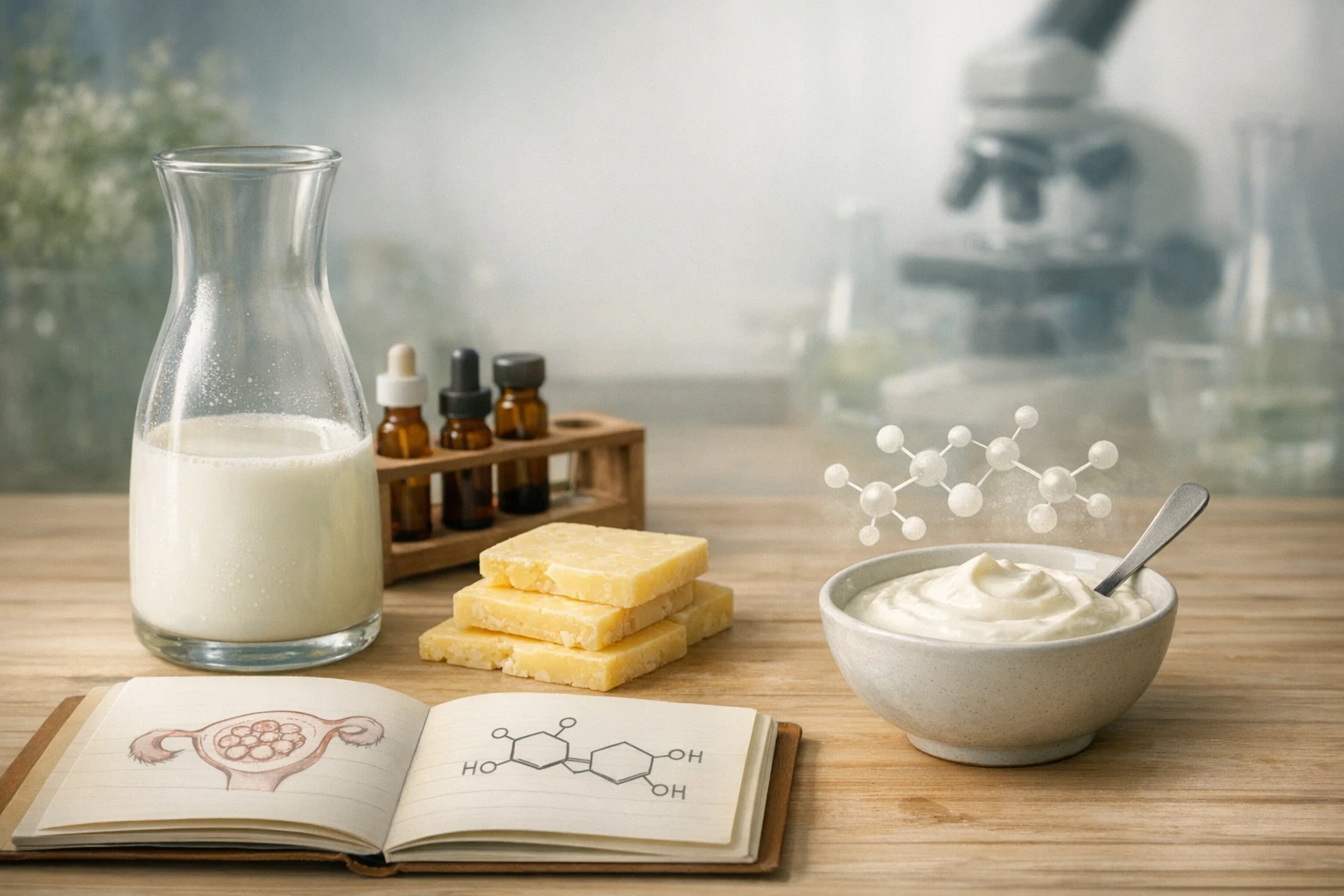
Updated and contextualized version of an article originally published on June 25, 2014
The article retains its original focus by presenting it through a scholarly and accessible perspective, supported by verifiable references.
Authors
- Dr. D. Iodice – Biologist
- Roberto Panzironi –Independent researcher
Note editoriali
- First publication: June 25, 2014
- Last update: April 20, 2026
- Version: 2026 narrative revision
Editorial note: This article was previously published and has been updated according to scientific and divulgative criteria. It is for informational purposes only and does not replace personalized medical advice.
In brief
- Some cohort studies have reported an association between high consumption of dairy products or lactose and a modest increase in the risk of ovarian cancer, particularly the serous subtype.
- Overall results are heterogeneous: meta-analyses and aggregated analyses show weak or no associations for most dairy products.
- Biological hypotheses include effects of galactose (a product of lactose digestion) or hormonal differences, but mechanistic evidence remains uncertain.
- Current evidence is predominantly observational: it does not allow for definitive causal claims. Caution in interpretation is needed.
Abstract: what does science say?
The question is whether and to what extent the consumption of milk and other dairy products alters the risk of developing ovarian cancer. Epidemiological research includes prospective cohort studies, case-control studies, and several meta-analyses. Some large cohorts have observed an increased risk for women with very high consumption of dairy products or lactose, with stronger signals for the serous subtype of the neoplasm. Other aggregated analyses and systematic reviews indicate inconsistent results: sometimes a modest effect for very high lactose intake or for whole milk, but in many cases, the association is not confirmed. The proposed mechanisms (e.g., galactose toxicity on ovarian tissues or hormonal alterations) are biologically plausible but not proven to explain a causal link. Overall, the evidence suggests that, if an increased risk exists, it is likely modest and dependent on the dose, type of product, and histological subtype; however, methodological limitations and variability among populations remain, requiring cautious interpretation.
Context and problem definition
Dairy consumption refers to foods such as milk (whole, semi-skimmed, skimmed), yogurt, cheese, and derivatives. Lactose is the main sugar in milk; during digestion, it breaks down into glucose and galactose. The epidemiological hypothesis that has guided much research is that high intakes of lactose — and thus galactose — may have harmful effects on ovarian cells or influence reproductive hormones, contributing to an increased risk of ovarian cancer. This question is relevant for public health because dairy products are widespread in the diets of many countries and because nutritional guidelines recommend daily portions for bone and metabolic health. It is therefore important to distinguish between observed associations and proof of causality, methodically evaluating study designs, effect sizes, and consistency of evidence.
What the main studies show
Prospective cohort studies have provided some of the most cited results. A Swedish cohort found that women with high consumption of dairy products and lactose had an increased risk for the serous subtype of ovarian cancer: in that analysis, consumption of ≥4 servings/day was associated with a higher risk compared to <2 servings/day [1]. Similarly, a large analysis derived from the Nurses' Health Study reported an increased risk for the serous subtype in relation to high lactose intake and low-fat milk in some consumption categories [2].
Conversely, a pooled analysis combining individual data from 12 large cohorts found no statistically significant associations for most dairy products, although it did observe a modest increase in risk for high levels of lactose (equivalent to ≥3 servings of milk per day) [3]. Subsequent meta-analyses and systematic reviews have yielded mixed results: some highlight weak associations or no overall association, while others indicate possible links with whole milk consumption or very high amounts of lactose [4][5][6].
Variations by product type and histological subtype
Some studies suggest that any increased risk is more evident for liquid milk compared to cheese or yogurt, and more pronounced for serous carcinoma compared to other histological subtypes. However, not all analyses replicate these patterns, and differences may arise from dietary measurements, subgroup sizes, or incompletely controlled confounding factors [1][7].
Mechanistic evidence: biological plausibility
Biological plausibility is mainly based on two lines: the potential toxicity of galactose (a product of lactose digestion) on ovarian tissues, and the possibility that some milk components modify hormone levels or growth factors. These hypotheses are supported by experimental studies and biochemical observations, but have not been definitively established as a causal explanation for the effects observed in epidemiological studies [4][3].
What it means in practice
For a person seeking information on the topic, a cautious reading of the evidence leads to some operational, non-prescriptive conclusions. First, the associations indicated by valid studies are generally weak or inconsistent: there is currently no definitive proof that typical dairy consumption in Western diets is a direct and strong cause of ovarian cancer. Second, when an increased risk is observed, it tends to appear for high consumption of lactose or milk and in relation to specific tumor subtypes; this suggests that the risk, if present, may depend on dose, frequency, and type of product.
From a practical standpoint, anyone concerned about their personal risk should discuss the overall profile of factors with their doctor or a nutrition professional: family history, reproductive factors, contraceptive use, menopause, and other elements influence ovarian risk much more directly than a single food category. For most of the population, current nutritional guidelines (which also include recommendations on dairy for bone health) remain the reference basis until more solid and consistent evidence emerges.
Key takeaways
- Some quality studies have found associations between high milk/lactose consumption and the risk of serous ovarian cancer, but the results are not consistent across all research [1][2][3].
- Aggregated analyses and larger meta-analyses show heterogeneous outcomes: some indicate modest effects at very high doses, others find no significant associations [3][5][6].
- The evidence is mostly observational: it can indicate associations but does not prove cause-and-effect.
- Possible biological mechanisms (e.g., the role of galactose) are plausible but not proven as an explanation for the observed risk [4].
- Individual dietary decisions should consider the overall risk profile and the nutritional benefits of dairy products.
Limitations of the evidence
It is important to distinguish between various types of evidence: case-control studies, prospective cohorts, and meta-analyses have different strengths and weaknesses. Observational studies can be subject to imprecise dietary measurement, selection bias, residual confounding (e.g., other lifestyle or dietary aspects), and problems related to tumor subtype classification. Meta-analyses aggregate results but do not necessarily resolve methodological variability among studies. Many analyses report heterogeneity among populations (geographical, genetic, and dietary habit differences) and do not always have sufficient power to analyze rare histological subtypes.
Finally, mechanistic plausibility is not equivalent to causal proof: in vitro or animal model experiments provide clues but do not establish that the same effect occurs in the same way in humans at ordinary consumption levels.
Editorial conclusion
Research conducted over the past two decades has sparked a legitimate scientific debate about the potential role of milk and lactose in ovarian cancer risk. The largest studies and aggregated analyses suggest that, if an increased risk exists, it is modest and concentrated in specific exposure conditions (very high consumption) and in some tumor subtypes. The cautious recommendation for the public is not to draw radical conclusions based on single studies: anyone with significant doubts should speak with their doctor. The scientific priority is to have further well-designed studies (including approaches that reduce the problem of confounding and deepen biological mechanisms) to clarify the dose-response relationship and any specificity for histological subtypes.
Editorial note
This piece has been updated to integrate evidence subsequent to the original studies. The content is informative: it does not replace individual clinical evaluation or personalized medical recommendations.
Scientific research
- Larsson SC, Wolk A. Milk and lactose intakes and ovarian cancer risk in the Swedish Mammography Cohort. Am J Clin Nutr. 2004;80(5):1353-1357. https://doi.org/10.1093/ajcn/80.5.1353
- Fairfield KM, Hunter DJ, Colditz GA, et al. A prospective study of dietary lactose and ovarian cancer. Int J Cancer. 2004;110(2):271-277. https://doi.org/10.1002/ijc.20086
- Genkinger JM, Hunter D, Spiegelman D, et al. Dairy products and ovarian cancer: a pooled analysis of 12 cohort studies. Cancer Epidemiol Biomarkers Prev. 2006;15(2):364-372. https://doi.org/10.1158/1055-9965.EPI-05-0484
- Larsson SC, Orsini N, Wolk A. Milk, milk products, and lactose intake and ovarian cancer risk: a meta-analysis of epidemiological studies. Int J Cancer. 2005;116(3):431-436. https://doi.org/10.1002/ijc.21305
- Liu J, Tang W, Sang L, et al. Milk, yogurt, and lactose intake and ovarian cancer risk: a meta-analysis. Nutr Cancer. 2014;66(1):68-72. https://doi.org/10.1080/01635581.2014.956247
- Effects of dairy products, calcium and vitamin D on ovarian cancer risk: a meta-analysis of twenty-nine epidemiological studies. Br J Nutr. 2020;124(9):1001-1012. https://doi.org/10.1017/S0007114520001075
- Use of dairy products, lactose, and calcium and risk of ovarian cancer – results from a Danish case-control study. Scand J Gastroenterol. 2012;47(4):??-??. https://doi.org/10.3109/0284186X.2011.636754
- Dairy food and nutrient intake in different life periods in relation to risk of ovarian cancer. Cancer Causes Control. 2014;25(12):??-??. https://doi.org/10.1007/s10552-014-0381-7
Note on bibliography: references include verified DOIs. Some minor bibliographic details (e.g., precise page numbers for certain editions) are indicated as [??] where they were not clearly available in the sources; these placeholders have been inserted for transparency and should be completed during final layout if required.