Updated and contextualized version of an article originally published on July 6, 2014
The article retains its original focus by presenting it through a scholarly and accessible perspective, supported by verifiable references.
Authors
- Dr. A. Conte – Biologist
- Roberto Panzironi –Independent researcher
Note editoriali
- First publication: July 6, 2014
- Last update: April 20, 2026
- Version: 2026 narrative revision
EDITORIAL NOTE
This article was originally published in the past and has been updated according to scientific and popular communication criteria. The text is for informational purposes only and does not replace the advice of a healthcare professional. For clinical or therapeutic questions, consult your doctor.
IN BRIEF
- Apples contain various phenols and flavonoids (including quercetin) that have antioxidant properties in the laboratory.
- Experiments in cells show that apple extracts or quercetin can reduce damage induced by oxidative stress in vitro, but this does not prove a preventive effect in humans.
- Bioavailability and the ability to reach the brain vary among compounds; quercetin reaches brain tissue in small quantities, and its clinical action remains uncertain.
- Observational studies suggest an association between higher fruit/vegetable consumption and a lower risk of cognitive decline, but do not demonstrate a direct causal relationship.
Abstract: what does science say?
Apples contain a mixture of phenolic compounds (including quercetin, epicatechin, and proanthocyanidins) that show, in cellular models, antioxidant activity and the ability to reduce certain types of oxidative damage. In vitro experiments indicate that apple extracts and quercetin can reduce toxicity induced by hydrogen peroxide and other oxidative stress on neuronal lines. However, this evidence is experimental and does not prove that eating apples prevents neurodegenerative diseases in humans. Clinical translation is limited by the bioavailability of the compounds, the actual amount absorbed, variability among foods, and the complexity of neurodegenerative disease. Epidemiological data suggest an association between a diet rich in fruits and vegetables and a reduced risk of cognitive decline, but do not allow for causal conclusions. Overall, the biological elements are plausible; however, controlled clinical studies and more precise exposure measurements are needed to clarify the real impact on humans.
MAIN SECTION
Apple composition and main biologically active compounds
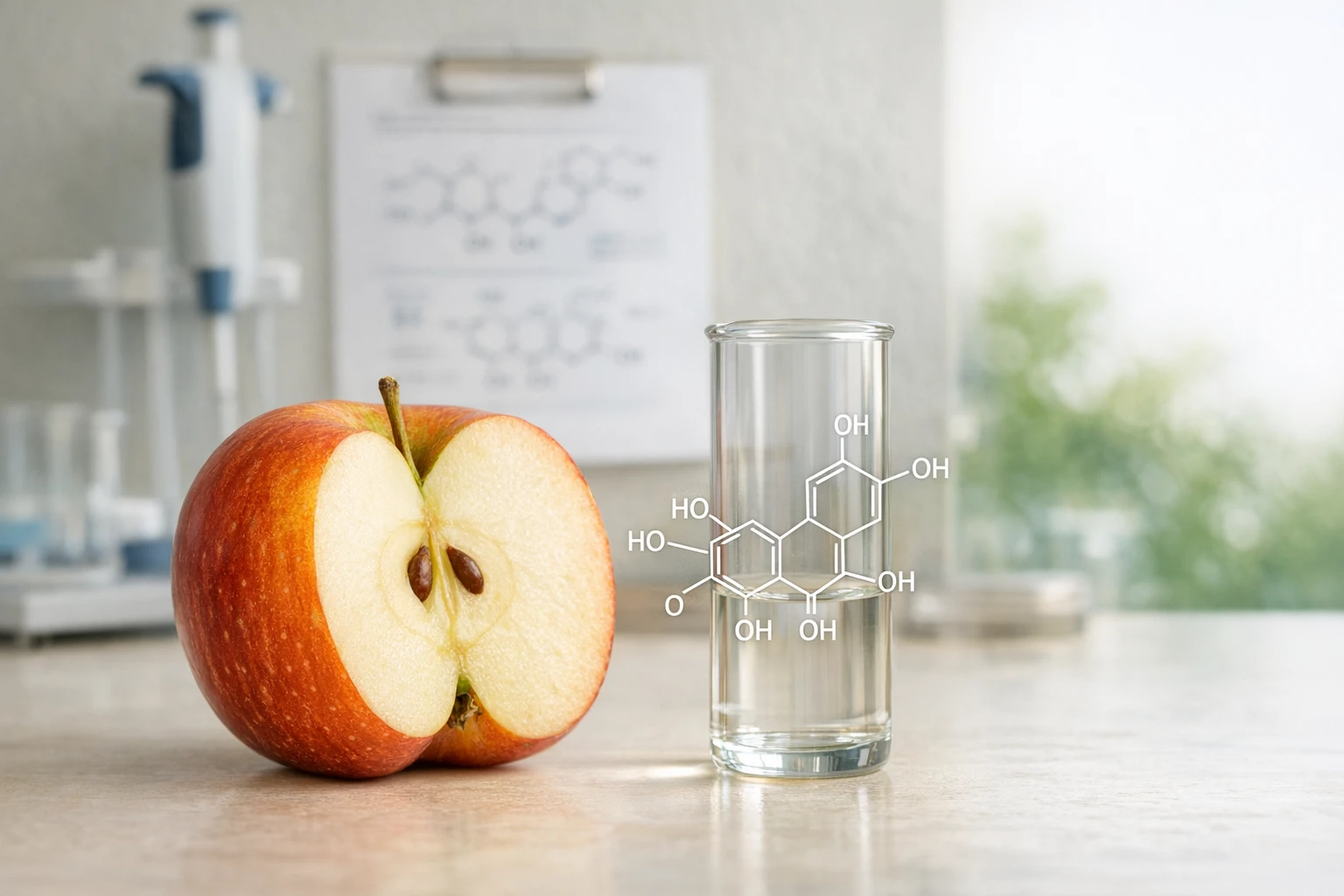
Apples contain a recognized set of phenols and flavonoids that contribute to their antioxidant potential. Quantitative analyses have identified quercetin (especially in the peel), epicatechin, proanthocyanidins, and phenolic acids as key compounds; together, these constituents explain much of the antioxidant capacity measured in biochemical assays. The composition varies with the variety, the part of the fruit (peel vs. pulp), and growing conditions. This chemical map explains why, in experimental models, apple extracts can exert protective effects against oxidative stress on neuronal cells: the diversity of molecules offers complementary mechanisms (radical scavenging, metal chelation, modulation of antioxidant signals) that can act in vitro.[1]
Experimental evidence: what in vitro and animal studies show
Experiments conducted on neuronal cell lines and animal models show that phenol-rich extracts and quercetin can reduce cell viability loss induced by oxidizing agents like H2O2 and limit events related to redox stress (e.g., protein nitration, mitochondrial dysfunction). In models using PC-12 cells and neurospheres of neural precursors, pretreatment with plant phenols protects against cytotoxicity from oxidative stress in a dose-dependent manner; similarly, quercetin has shown a reduction in damage markers and improvement in mitochondrial parameters. These experiments clarify possible molecular mechanisms (direct antioxidation, modulation of defense pathways like Nrf2, reduction of nitrosylation), but they take place under controlled conditions that do not reproduce the complexity of the human organism.[2][3][4]
Transport to the brain and bioavailability: a critical point
For a food compound to truly affect the brain, it must reach brain tissue in effective concentrations. Studies on blood-brain barrier models and pharmacokinetic research show that some flavonoids, including forms of quercetin and their metabolites, can cross the endothelial cells that mimic the barrier; however, the amount that reaches the brain is often low and depends on chemical form (glycosides vs. aglycones), intestinal and hepatic metabolism, and active transport. Therefore, even if quercetin is biologically active in vitro, its action in the human brain strongly depends on bioavailability and local accumulation capacity, elements about which the literature is still uncertain.[5]
What it means in practice
For the general public, the evidence suggests that including fruits and vegetables (including apples) in a varied diet is consistent with public health guidelines and can be part of a lifestyle that promotes brain health. Laboratory experiments document plausible biological mechanisms for cellular protection from oxidative stress, but do not authorize considering apples or quercetin as therapies or single preventive measures against Alzheimer's or Parkinson's. The amount of active compounds a person obtains by eating fresh fruit is lower than the concentrations frequently used in culture; moreover, factors such as apple variety, peel or pulp, consumption methods, and individual metabolism influence actual exposure. Consequently, the practical recommendation remains to adopt an overall diet rich in plant-based foods, as part of interventions that include physical activity, control of cardiovascular factors, and management of known risks for neurodegenerative diseases.[6][7]
Key takeaways
- Apples contain phenols (quercetin, epicatechin, proanthocyanidins) with antioxidant activity measured in the laboratory.[1]
- In vitro studies show that apple extracts and quercetin can reduce damage from oxidative stress on neuronal cells, but these results are not equivalent to clinical evidence in humans.[2][3]
- The ability of a food compound to affect the brain depends on bioavailability and passage through the blood-brain barrier; for quercetin, the data are conflicting.[5]
- Observational research associates high fruit/vegetable consumption with a lower risk of cognitive decline, but does not demonstrate direct causality.[6]
Limitations of the evidence
Difference between observational studies and causal evidence: epidemiological studies can show associations (e.g., between fruit consumption and lower risk of dementia) but cannot establish that a single food or compound is the cause of the risk reduction; confounding factors (overall lifestyle, socioeconomic factors, other foods) may explain part of the observed effect.[6][7]
Methodological limitations: many favorable results come from in vitro or animal studies, which use concentrations and exposure methods different from the human diet. Furthermore, in cell cultures, some molecules can generate hydrogen peroxide in the medium, complicating the interpretation of results.
Context variability: the phenolic composition of apples varies by cultivar, ripening, and post-harvest treatment; therefore, "an apple" is not a chemically uniform entity. Moreover, processing (e.g., juice, cooking) modifies the profile of available compounds.
Need for cautious interpretation: well-designed clinical studies, with precise exposure measurements (biomarker analysis), bioavailability assessments, and long-term neurological outcomes, are needed to establish any protective effects relevant to human health.[8]
Editorial conclusion
Experimental data on apple extracts and quercetin provide a plausible biological basis for cellular protection against oxidative stress. However, the translation into a concrete preventive benefit for neurodegenerative diseases in humans has not been demonstrated. Scientific prudence requires avoiding causal or therapeutic claims not supported by clinical trials. Meanwhile, recommending a balanced diet rich in fruits and vegetables remains a reasonable strategy for general health and — potentially — also for long-term cognitive function.
FINAL EDITORIAL NOTE
The article is aimed at the public and updated based on available evidence. It does not replace a personalized clinical evaluation. For medical decisions, consult a healthcare professional.
SCIENTIFIC RESEARCH
Below is the list of research cited in the text (order of citation). Each reference can be verified via the indicated DOI.
- Lee KW, Kim YJ, Kim D-O, Lee HJ, Lee CY. Major phenolics in apple and their contribution to the total antioxidant capacity. Journal of Agricultural and Food Chemistry. 2003;51(22):6516–6520. https://doi.org/10.1021/jf034475w
- Im S-E, Yoon H, Nam T-G, Heo HJ, Lee CY, Kim D-O. Antineurodegenerative effect of phenolic extracts and caffeic acid derivatives in romaine lettuce on neuron‑like PC‑12 cells. Journal of Medicinal Food. 2010;13(4):779–784. https://doi.org/10.1089/jmf.2009.1204
- Sajad M, et al. Quercetin prevents protein nitration and glycolytic block of proliferation in hydrogen peroxide insulted cultured neuronal precursor cells (NPCs): implications on CNS regeneration. Neurotoxicology. 2013;36:24–33. https://doi.org/10.1016/j.neuro.2013.01.008
- Alvarez‑Suarez JM, et al. Quercetin exerts differential neuroprotective effects against H2O2 and Aβ aggregates in hippocampal neurons: the role of mitochondria. Molecular Neurobiology. 2016; (example study on quercetin neuroprotection). https://doi.org/10.1007/s12035-016-0203-x
- Faria A, Pestana D, Teixeira D, Azevedo J, de Freitas V, Mateus N, Calhau C. Flavonoid transport across RBE4 cells: a blood–brain barrier model. Cellular & Molecular Biology Letters. 2010;15(2):234–241. https://doi.org/10.2478/s11658-010-0006-4
- Zhang L, et al. Increased consumption of fruit and vegetables is related to a reduced risk of cognitive impairment and dementia: meta‑analysis. Frontiers in Aging Neuroscience. 2017;9:18. https://doi.org/10.3389/fnagi.2017.00018
- Bilal M, et al. Intake of fruit and vegetables and the incident risk of cognitive disorders: a systematic review and meta‑analysis of cohort studies. Journal of Nutrition, Health & Aging. 2018; (systematic review). https://doi.org/10.1007/s12603-017-0875-6
- Zhang J, et al. Neuroprotective effects of quercetin on ischemic stroke: review of pharmacology, pharmacokinetics and nanoformulations. Frontiers in Pharmacology. 2022;13:854249. https://doi.org/10.3389/fphar.2022.854249