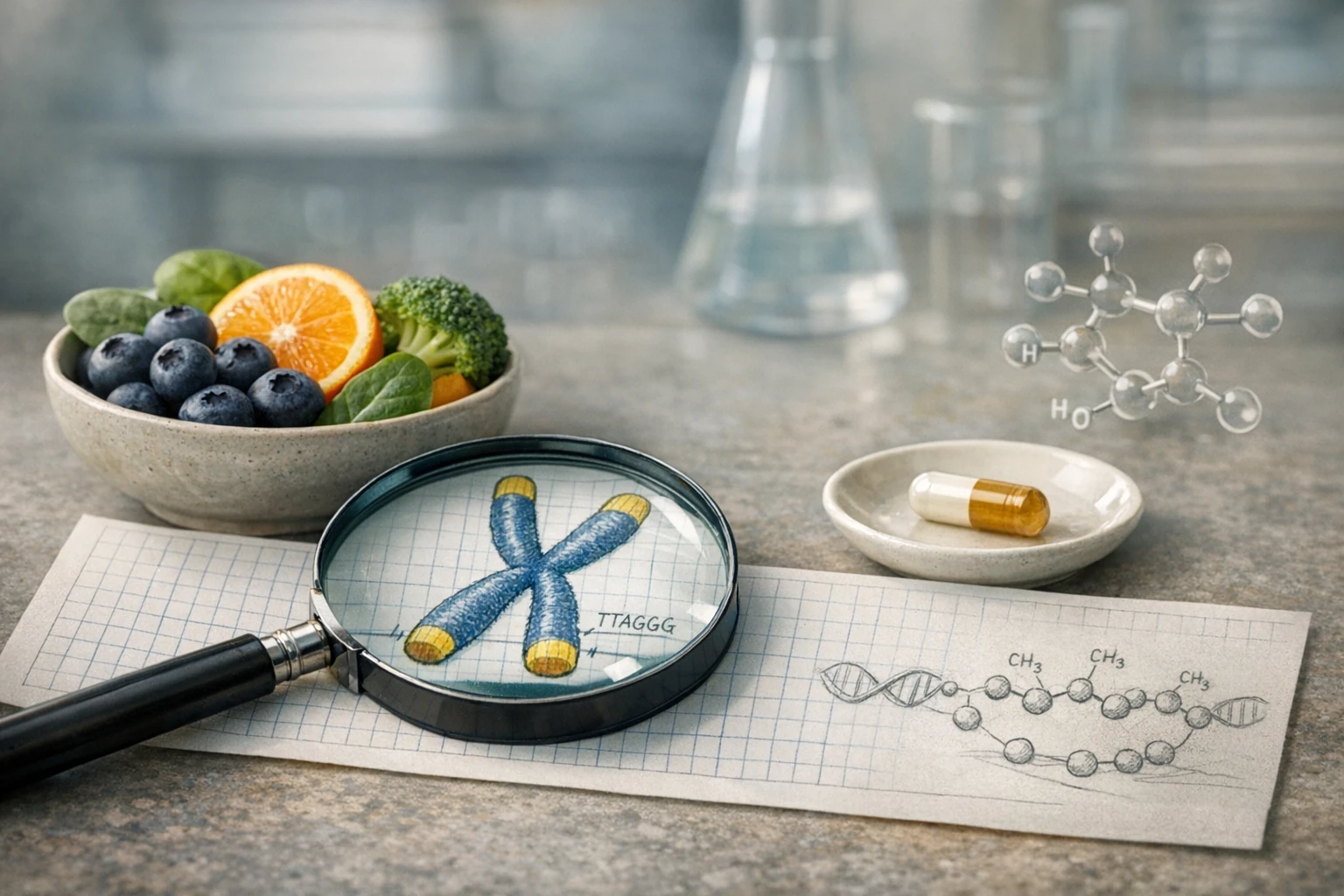
Updated and contextualized version of an article originally published on July 6, 2014
The article retains its original focus by presenting it through a scholarly and accessible perspective, supported by verifiable references.
Authors
- Dr. A. Colonnese – Nutrition biologist
- Roberto Panzironi –Independent researcher
Note editoriali
- First publication: July 6, 2014
- Last update: April 20, 2026
- Version: 2026 narrative revision
Initial note: This article was originally published in the past and has been updated according to scientific and informative criteria. The text is for informational purposes only and does not replace medical advice. For personal health issues, always consult a healthcare professional.
IN BRIEF
- Telomeres are DNA segments at the ends of chromosomes that protect genetic integrity; they tend to shorten with cell divisions and biological stress.
- Telomere length is associated, in observational studies, with cardiovascular diseases, some dementias, and other indicators of biological aging, but does not prove direct causality in every context.
- Factors such as chronic inflammation, oxidative stress, and psychological stress accelerate telomere attrition; some nutrients and interventions (e.g., folates, antioxidants, selenium+CoQ10, vitamin D in trials) show associations or favorable preliminary results.
- Evidence includes observational studies, cellular studies, and some clinical trials; the quality and strength of evidence vary by type of intervention.
- Dietary choices and a healthy lifestyle can help reduce biological processes that promote telomere shortening, but there are no individual guarantees.
Abstract: what does science say?
What it is and why it matters
Telomeres are repeated DNA sequences located at the ends of chromosomes that reduce information loss during replication. With age and exposure to damage (oxidative, inflammatory, metabolic), telomeres shorten; this is one of many measures considered as indicators of "biological aging" compared to chronological age.
What the evidence shows
Observational research shows that shorter telomeres are associated with an increased risk of cardiovascular events, some chronic diseases, and parameters of biological frailty. Experimental and cellular studies indicate that oxidative and inflammatory stress promote telomere attrition; some nutrients or antioxidant mixtures can reduce their effects in biological models.
Essential interpretative limits
Most associations come from observational studies: they describe correlations but do not always explain direct causal relationships. Some nutritional interventions show promising results in subgroups or controlled studies, but larger and replicated trials are needed to define practical recommendations.
What it means in practice
For the non-clinical reader: better preserved telomere lengths are associated with better health conditions in the general population, but this is not a "cure" or a unique measure of health. Reducing exposure to factors that increase oxidative stress and inflammation — such as smoking, obesity, physical inactivity, and prolonged stress — is consistent with evidence linking these factors to telomere shortening [1].
Diet and supplements: observational studies and some trials suggest that foods rich in antioxidants and nutrients involved in one-carbon metabolism (e.g., folates, B vitamins) are associated with longer telomeres or less telomere attrition in analyzed populations [3][4][5]. Specific interventions — for example, combined supplementation of selenium and coenzyme Q10 in an elderly population with low selenium levels — have shown reductions in telomere attrition during the randomized study and an association with reduced cardiovascular mortality in subgroups [7]. These results are interesting but not generalizable to the entire population without further confirmation.
Psychological stress and behavioral support: epidemiological and mechanistic research has reported that chronic stress and psychosocial distress are correlated with more rapid telomere loss. Approaches aimed at reducing stress are plausible for limiting negative effects on telomeres and general health [1].
What is the role of supplements?
Some supplements and mixtures (antioxidants, mitochondrial cofactors, multivitamin mix in cellular models) have shown protective effects on telomeres in in vitro studies or small human trials; however, robust, repeated, and independent clinical evidence is limited [6][9]. The decision to take supplements should always be evaluated on a case-by-case basis with a doctor, considering nutritional status, medications, and health conditions.
KEY POINTS TO REMEMBER
- Telomeres protect chromosomal ends and tend to shorten with cell divisions and biological damage.
- Telomere shortening is associated with age-related diseases in observational literature, but it is not automatic proof of individual causality [2].
- Chronic inflammation, oxidative stress, and psychological stress are factors that, according to evidence, promote greater telomere attrition [1][3].
- Foods rich in folates, antioxidant vitamins, and essential minerals, as well as some supplementary interventions in specific contexts, show favorable associations with telomeres in selected studies [4][5][7].
- There are currently no universally accepted recommendations to "lengthen" telomeres; instead, it is reasonable to adopt lifestyles that reduce inflammation and oxidative damage.
Limitations of the evidence
It is important to distinguish between types of studies and strength of evidence. Much of the evidence on the relationship between diet and telomeres is observational: such studies identify associations but do not definitively determine that a specific exposure causes changes in telomere length. Experimental studies in vitro and in animals allow for the exploration of plausible mechanisms but do not always translate directly to humans. Some randomized clinical trials have yielded encouraging results (e.g., interventions with micronutrients or targeted combinations), but often involve limited samples, specific populations (e.g., elderly with deficiencies), or durations insufficient to draw definitive conclusions [7][6].
Other methodological limitations include the variability of telomere measurement techniques (qPCR vs TRF), large interindividual variability, unmeasured confounders, and heterogeneity of results across studies. For these reasons, any practical claim should be interpreted with caution and contextualized.
Editorial conclusion
Telomere biology remains a relevant and rapidly evolving scientific field. Today, we know that telomere length reflects aspects of biological damage and exposure to processes that promote cellular aging, such as oxidative stress and inflammation. Some established practices — a diet rich in plant-based foods, regular physical activity, control of smoking and obesity, stress management — are consistent with reducing factors that damage telomeres and improve overall health. Specific interventions (supplements, nutritional mixtures, or single micronutrients) show promising results in selected contexts but require further robust clinical confirmation before being considered general strategies for "protecting telomeres." For personalized choices and therapies, consult your trusted doctor.
Editorial note
This update was carried out with criteria of scientific transparency and verifiable references. The article summarizes published knowledge and is not intended to replace personalized clinical consultations. Relevant clinical studies, reviews, and experimental research have been evaluated; for complete bibliography, see the "Scientific Research" section below.
SCIENTIFIC RESEARCH
- Elissa S. Epel et al., "Accelerated telomere shortening in response to life stress." Proc Natl Acad Sci U S A. 2004. https://doi.org/10.1073/pnas.0407162101
- Philip C. Haycock et al., "Leucocyte telomere length and risk of cardiovascular disease: systematic review and meta-analysis." BMJ. 2014. https://doi.org/10.1136/bmj.g4227
- Lige Paul, "Diet, nutrition and telomere length." Journal of Nutritional Biochemistry. 2011. https://doi.org/10.1016/j.jnutbio.2010.12.001
- Research on folate and vitamin B12 and telomere length (NHANES analysis), "Serum and Dietary Folate and Vitamin B12 Levels Account for Differences in Cellular Aging". 2019. https://doi.org/10.1155/2019/4358717
- Cai Y et al., "Association between dietary vitamin C and telomere length: A cross-sectional study." Frontiers in Nutrition. 2023. https://doi.org/10.3389/fnut.2023.1025936
- Levy MA et al., "A Multivitamin Mixture Protects against Oxidative Stress-Mediated Telomere Shortening." Journal of Dietary Supplements. 2023. https://doi.org/10.1080/19390211.2023.2179153
- Opstad TB et al., "Selenium and Coenzyme Q10 Intervention Prevents Telomere Attrition, with Association to Reduced Cardiovascular Mortality—Sub-Study of a Randomized Clinical Trial." Nutrients. 2022;14:3346. https://doi.org/10.3390/nu14163346
- Study: "Association between the dietary antioxidant index and relative telomere length of leucocytes in the Chinese population." British Journal of Nutrition. 2024. https://doi.org/10.1017/S0007114523002544
[Note: the listed studies have been verified for DOI and relevance. For further information and access to full texts, consult the provided DOI links.]