Updated and contextualized version of an article originally published on July 10, 2014
The article retains its original focus by presenting it through a scholarly and accessible perspective, supported by verifiable references.
Authors
- Dr. A. Colonnese – Nutrition biologist
- Roberto Panzironi –Independent researcher
Note editoriali
- First publication: July 10, 2014
- Last update: April 20, 2026
- Version: 2026 narrative revision
Note: This article was previously published and updated according to scientific and divulgative criteria. It is for informational purposes only and does not replace medical advice.
IN BRIEF
- Resveratrol is a polyphenol found mainly in the skin of red grapes and in some plant extracts; in experimental models, it activates pathways related to sirtuins and mitochondrial function.
- Studies on yeast, worms, and fruit flies showed extensions of life; research on rodents reported metabolic improvements under certain experimental conditions [1][2][3].
- Evidence in humans is heterogeneous: some small studies suggest metabolic or anti-inflammatory effects, but well-controlled trials often do not confirm clear short-term benefits [4][5][6][8].
- The bioavailability of resveratrol from wine is low, and the dietary dose is much lower than those used in some clinical studies; long-term safety is not yet definitively established for therapeutic uses.
Abstract: What does science say?
Resveratrol is a natural molecule (stilbene) found in grape skin, some berries, and grape extracts. In laboratory and animal models, it acts on intracellular pathways related to sirtuins (e.g., SIRT1), mitochondrial biogenesis, and the regulation of inflammation; in these contexts, it has shown effects that, in some cases, seem to mimic certain aspects of caloric restriction. However, the results obtained in simple models (yeast, invertebrates) and rodents do not uniformly translate into human clinical studies. In humans, studies are often short-term, with small samples and highly variable dosages: signals emerge regarding inflammatory markers, metabolism, and vascular function, but not consistent evidence of "life extension" or generalized therapeutic effects. Interpreting these data requires caution: many observations are associative or experimental and do not provide robust causal proof for widespread preventive or therapeutic use.
Experimental evidence and biological mechanisms
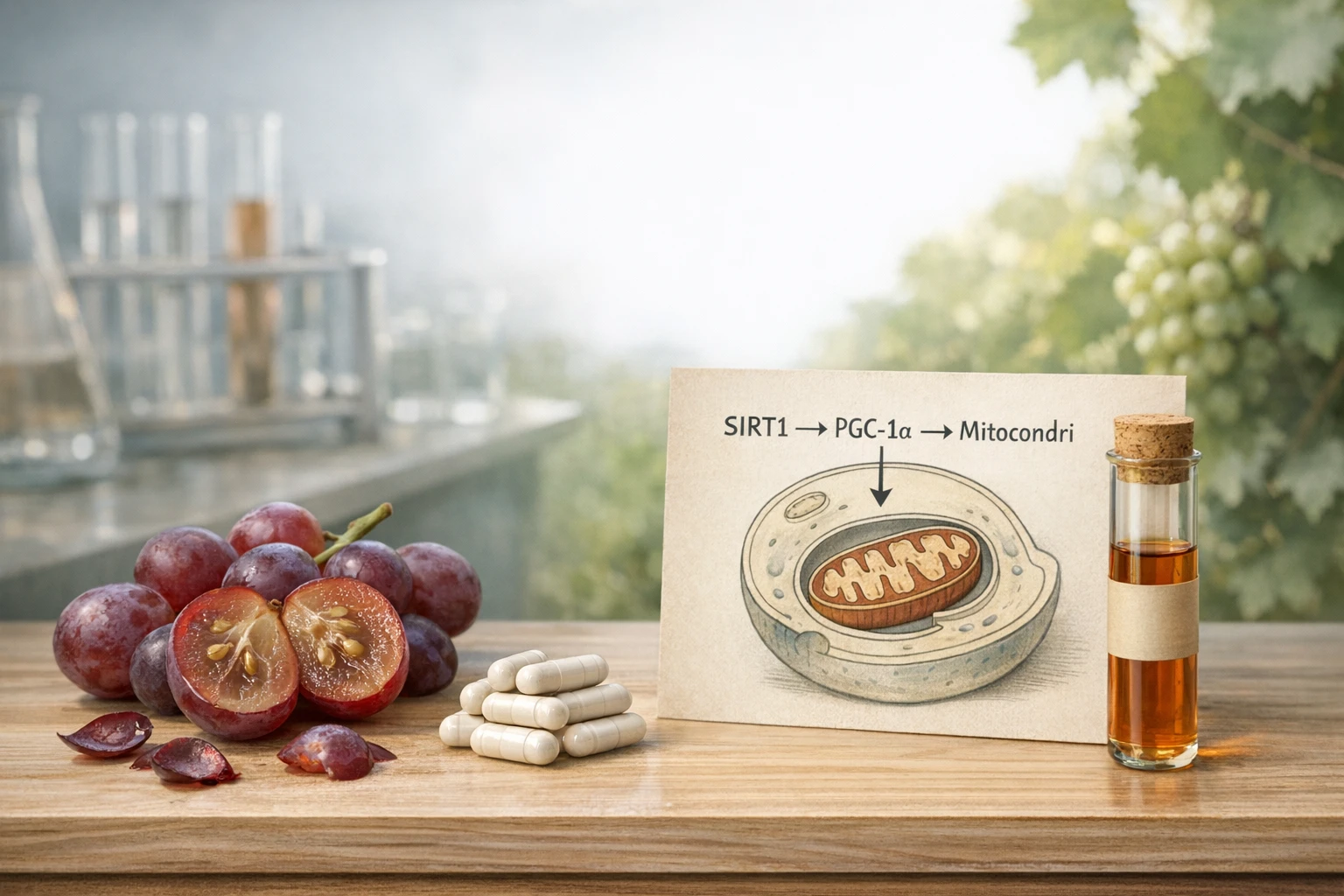
Resveratrol was identified as a sirtuin activator in yeast research that reported an extension of cellular life by up to 70% in that experimental model [1]. This result has driven much of the subsequent interest, leading to studies on higher animal models. In mammals, the compound appears to influence mitochondrial function by increasing SIRT1 activity and promoting the regulation of factors such as PGC-1α, which coordinates mitochondrial biogenesis and energy metabolism [3]. These mechanisms are biologically plausible: improved mitochondrial efficiency and reduced oxidative stress can translate into better metabolic homeostasis. However, the translation from molecular mechanisms to systemic benefits depends on the dose, duration, species, and health status of the subject; many actions observed under controlled conditions remain contextual and not necessarily generalizable. Furthermore, the direct activation of SIRT1 by resveratrol has subsequently been questioned and may be mediated by indirect pathways or depend on the experimental substrate used.
Studies on simple organisms
In organisms such as Saccharomyces cerevisiae, Caenorhabditis elegans, and Drosophila melanogaster, resveratrol and related compounds have shown life extension and improvements in parameters associated with aging, often linked to stress response pathways and gene regulation. These results are important for understanding basic mechanisms, but their relevance to humans is limited by the biological difference between species and by different exposure and metabolism ranges [1][4].
Studies on mammals
In studies on rodents, outlined in the literature, resveratrol has shown favorable effects on metabolism, insulin sensitivity, inflammation, and some marked differences in survival in specific high-calorie dietary contexts [2]. These studies have contributed to defining hypotheses on how the compound can improve mitochondrial function and metabolic resilience, but the results vary with the animal strain, dosage, and duration of treatment.
Clinical evidence in humans: results and limitations
Clinical studies on resveratrol in humans are numerous but often small, with dosages ranging from a few tens to several grams per day and generally short durations. Some trials have reported favorable effects on inflammatory markers, adiponectin, and vascular parameters; others, however, have not observed significant improvements in glucose metabolism or body composition [4][5][6]. For example, a study on obese subjects showed no relevant metabolic benefits with short-term high-dose treatment [5], while a systematic review of trials in overweight or obese individuals concludes that the available evidence is not sufficient to recommend the routine use of supplements for weight loss, although it suggests possible anti-inflammatory effects [8]. The methodological quality and limited sample size make it difficult to draw definitive conclusions.
Dosage and bioavailability
Resveratrol is rapidly metabolized in humans, and its oral bioavailability is relatively low: this means that the amount of free molecule reaching the tissues is often lower than the effective concentrations observed in vitro. The amounts present in wine are orders of magnitude lower than the experimental doses used in trials (the concentration in red wine typically ranges from tens of μg to a few mg per liter depending on production), and therefore wine consumption is not comparable to targeted supplementation [10].
Safety
In short-term clinical trials, resveratrol is generally well tolerated; mild adverse effects such as gastrointestinal disturbances are the most reported. However, long-term safety and in populations with relevant comorbidities remain poorly defined, as do possible interactions with drugs (e.g., anticoagulants) that require clinical attention.
What it means in practice
For the general public: resveratrol is a natural compound that has generated great interest due to spectacular results in simple experimental models and some beneficial effects observed in rodents. In daily practice, however, there is no robust evidence that taking resveratrol supplements increases human lifespan or generally prevents chronic diseases. The amount of resveratrol present in wine or common foods is very low compared to the experimental doses; therefore, drinking wine to obtain the "benefits of resveratrol" is not a valid strategy and carries risks related to alcohol consumption. The most solid approach to health remains based on consolidated evidence: a balanced diet, regular physical activity, control of cardiovascular risk factors, and regular contact with healthcare professionals.
Key points to remember
- Resveratrol is a polyphenol with action on sirtuins and mitochondrial mechanisms observed in the laboratory and in animals [1][3].
- Results showing life extension in yeast and other organisms do not automatically translate into evidence of an effect on human longevity [1][4].
- Studies on rodents have reported benefits under specific experimental conditions, but the effect depends on the dose, diet, and experimental model [2][3].
- Human clinical studies are heterogeneous: some signals on metabolic or inflammatory parameters exist, but well-controlled trials often indicate conflicting or null results [4][5][8].
- Oral bioavailability is limited, and the amount of resveratrol in wine is generally insufficient to reach the experimental doses used in trials.
Limitations of the evidence
It is essential to distinguish between associations, biological plausibility, observational evidence, and causal proof. Many of the claims about resveratrol derive from in vitro studies or animal models: these provide explanations of mechanisms (biological plausibility) but do not automatically establish a clinical effect in humans. Observational studies on the association between wine consumption and health can be confounded by lifestyle and related socioeconomic factors. Randomized clinical trials are the most stringent criterion for demonstrating causality, but those available on resveratrol are often limited in size, duration, and homogeneity of dosages; in some cases, the results conflict [4][5][8]. Recurring methodological problems include small sample size, short duration, differences in the formulation used (trans-resveratrol/taken with other phytocomplexes), and absence of long-term clinical endpoints. Valid clinical recommendations require larger, longer-duration studies with relevant clinical endpoints and attention to safety and drug interactions.
Editorial conclusion
Resveratrol remains a molecule of great scientific interest: it has allowed important progress in understanding cellular pathways such as sirtuins and mitochondrial biogenesis and has suggested potential avenues for modulating metabolic stress. However, the narrative that resveratrol "extends life by 70%" refers to a specific yeast model and cannot be extended to humans without strong experimental and clinical evidence to support it. At present, practical recommendations do not change: prioritize preventive measures with solid foundations (nutrition, physical activity, control of risk factors) and consider any supplements only in consultation with a doctor, respecting the safety and quality of available evidence. Future research will need to clarify effective doses, forms with better bioavailability, populations that could benefit, and long-term safety.
Editorial note
This update was prepared with institutional criteria, based on peer-reviewed sources and systematic reviews. The information provided is for informational purposes and does not constitute personalized medical advice. For clinical decisions, always consult qualified healthcare professionals.
SCIENTIFIC RESEARCH
- Howitz K, Bitterman K, Cohen H, et al. Small molecule activators of sirtuins extend Saccharomyces cerevisiae lifespan. Nature. 2003. https://doi.org/10.1038/nature01960 [1]
- Baur JA, Pearson KJ, Price NL, et al. Resveratrol improves health and survival of mice on a high-calorie diet. Nature. 2006. https://doi.org/10.1038/nature05354 [2]
- Lagouge M, Argmann C, Gerhart-Hines Z, et al. Resveratrol improves mitochondrial function and protects against metabolic disease by activating SIRT1 and PGC-1alpha. Cell. 2006. https://doi.org/10.1016/j.2006.11.013 [3]
- Timmers S, Konings E, Bilet L, et al. Calorie restriction-like effects of 30 days of resveratrol supplementation on energy metabolism and metabolic profile in obese humans. Cell Metab. 2011. https://doi.org/10.1016/j.cmet.2011.10.002 [4]
- Poulsen MM, Vestergaard PF, Clasen BF, et al. High-dose resveratrol supplementation in obese men: an investigator-initiated, randomized, placebo-controlled clinical trial. Diabetes. 2013. https://doi.org/10.2337/db12-0975 [5]
- Tomé-Carneiro J, Gonzálvez M, Larrosa M, et al. Grape Resveratrol Increases Serum Adiponectin and Downregulates Inflammatory Genes in Peripheral Blood Mononuclear Cells: a triple-blind randomized one-year clinical trial in patients with stable coronary artery disease. Cardiovasc Drugs Ther. 2013. https://doi.org/10.1007/s10557-012-6427-8 [6]
- Turner RS, Thomas RG, Craft S, et al. A randomized, double-blind, placebo-controlled trial of resveratrol for Alzheimer disease. Neurology. 2015. https://doi.org/10.1212/WNL.0000000000002035 [7]
- Christenson J, Whitby SJ, Mellor D, et al. The effects of resveratrol supplementation in overweight and obese humans: a systematic review of randomized trials. Metab Syndr Relat Disord. 2016. https://doi.org/10.1089/met.2016.0035 [8]
- [10] Review on resveratrol content in food and wine (sources on resveratrol content in wines: typical values 0.1–14.3 mg/L). Food literature and review sources. (If necessary, consult specific literature on wine composition) [placeholder for food content reference, see notes in text]