Updated and contextualized version of an article originally published on July 11, 2014
The article retains its original focus by presenting it through a scholarly and accessible perspective, supported by verifiable references.
Authors
- Dr. A. Conte – Biologist
- Roberto Panzironi –Independent researcher
Note editoriali
- First publication: July 11, 2014
- Last update: April 20, 2026
- Version: 2026 narrative revision
Initial note
This article was previously published and has been updated according to scientific and divulgative criteria to offer a current, balanced, and verifiable overview of tea tree oil (Melaleuca alternifolia). The content is for informational purposes only and does not replace medical advice: for personal clinical decisions, it is always necessary to consult a healthcare professional.
In brief
- Tea tree oil contains compounds (primarily terpinen-4-ol) with antimicrobial and anti-inflammatory activity in in vitro studies and some clinical studies.
- For some topical applications — e.g., mild-to-moderate acne and dandruff reduction — trials with favorable results exist, but methodological quality is variable.
- For fungal foot infections and MRSA decolonization, clinical results are heterogeneous; in some cases, effects are only symptomatic or inferior to conventional drugs.
- Interesting preclinical data are available on terpinen-4-ol and tumor models, but these do not justify antineoplastic use in humans outside of research.
- Topical use can cause irritation or allergy; ingestion is potentially toxic. Dilute and patch test if necessary.
Abstract: what does science say?
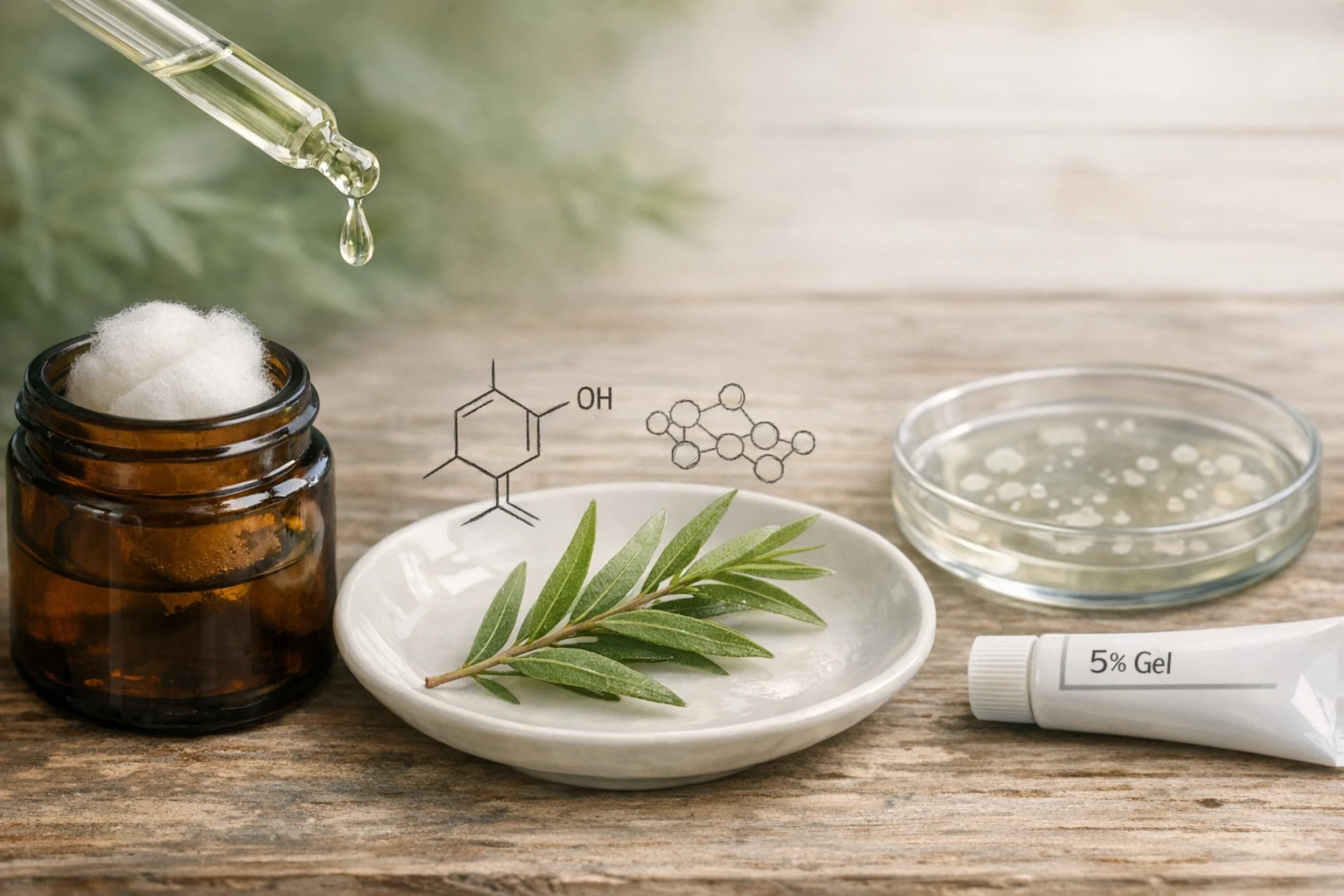
The essential oil of Melaleuca alternifolia (tea tree oil) is mainly characterized by monoterpenes and terpenic alcohols, with terpinen-4-ol as the biologically relevant component. Scientific literature shows antimicrobial activity in the laboratory and positive clinical results, especially for topical applications at moderate concentrations (e.g., 5% gel for acne, 5% shampoo for dandruff). Studies also exist on MRSA decolonization, oral hygiene, and wound healing models, with variable results. Preclinical studies indicate possible cytotoxic effects of terpinen-4-ol on tumor cell lines in vitro and animal models, but clinical evidence for cancer treatment is absent. Safety: diluted topical use is generally well-tolerated, but cases of contact dermatitis and reactions related to product oxidation have been documented; ingestion is not recommended. In summary, some topical uses are supported by moderate evidence; for other uses, higher quality clinical trials are needed.
What it means in practice
The application of tea tree oil in topical products can offer benefits for some common skin conditions due to a combination of antimicrobial activity and moderate anti-inflammatory action. However, efficacy depends on practical factors: the formulation (gel, shampoo, cream, gargle solution), the oil concentration, product quality, method of use, and duration of treatment. For example, 5% gels are the most studied for acne; 5% shampoos have been evaluated for dandruff; diluted solutions are used in oral hygiene studies. Variability among studies (small samples, different designs, short duration) limits the generalization of results. In addition, skin tolerability may worsen if the oil is applied undiluted or in unstable formulas that oxidize. Therefore, when considering a tea tree-based product: prefer tested formulas, adhere to studied concentrations, avoid pure use on the skin, and consult a professional in case of sensitive skin, children, or concomitant medical conditions. Finally, preclinical research on components like terpinen-4-ol should not be confused with clinical evidence supporting systemic or oncological treatments.
Reported benefits (and what the evidence supports)
Acne: evidence and limitations
For mild-to-moderate acne, several clinical studies and reviews conclude that gels containing approximately 5% tea tree oil can reduce the number of inflammatory lesions and severity compared to placebo or show results comparable to standard topical treatments, but with less dryness and irritation in some trials. A recent review synthesizes available trials and notes moderate evidence of efficacy, with differences in speed of action compared to benzoyl peroxide. However, some studies are small or not perfectly controlled, so the observed effect should be interpreted with caution [2].
Athlete's foot and fungal infections
Clinical literature shows heterogeneous results for fungal foot infections: in some trials, tea tree oil reduces symptoms (itching, burning) and at certain concentrations can promote mycological negativization, while in other studies, the effect is comparable to placebo or inferior to conventional antifungal drugs. A recent systematic synthesis highlights that, despite positive data in some contexts, the evidence is not uniform and varies greatly by concentration, duration, and formulation [1].
Dandruff and scalp health
A controlled study evaluated a shampoo containing 5% tea tree oil and reported a reduction in flaking, itching, and oiliness after four weeks compared to placebo; a reduction in Malassezia (Pityrosporum) growth was reported in the short term. These results suggest a potential role as an antifungal/anti-dandruff ingredient in specific cosmetic formulations, but longer-term studies with quality control of products are needed [3].
Oral hygiene and periodontal disease
Highly diluted tea tree oil formulations used as mouthwash or in dental products have been studied for plaque reduction and gingival inflammation. Recent clinical studies on low-concentration mouthwashes show reductions in plaque and bleeding in the short term and partial comparability with chlorhexidine, with fewer side effects such as tooth staining in some cases; however, confirmation on larger samples and longer follow-ups is needed [10].
Wound healing and local antimicrobial activity
Preclinical research and some small clinical studies suggest that tea tree oil-based preparations can help reduce the microbial load of colonized wounds and modulate elements of tissue repair (fibroblasts, angiogenesis) in animal models and experimental formulations. Delivery technologies (e.g., microemulsions) have been tested to improve stability and topical efficacy, with promising results in preclinical models but still limited in large-scale clinical trials [7][8].
Anticancer: laboratory vs. clinical
Terpinen-4-ol, the main component of the oil, has shown in vitro ability to induce apoptosis and slow proliferation in various tumor cell lines; studies in animal models also report a reduction in tumor growth. However, these are preclinical findings: there is no solid clinical evidence to justify the systemic or local use of tea tree oil as an anticancer therapy in humans. Any therapeutic development requires controlled clinical trials and evaluations of pharmacokinetics, dosage, and safety [5][6].
Key points to remember
- Tea tree oil has documented antimicrobial activity in the laboratory and some clinical effects in topical applications; the quality of evidence varies greatly.
- For acne and dandruff, there are clinical studies supporting the use of specific formulations (e.g., 5% gel or shampoo).
- For athlete's foot and MRSA decolonization, results are heterogeneous: in some studies, symptoms improve, but antifungal drugs or standard protocols generally remain more effective for complete cure.
- Terpinen-4-ol shows anticancer activity in vitro and in animal models, but it is not an approved cancer therapy.
- Real risks: irritation, contact dermatitis, and potential toxicity if ingested. Avoid undiluted, oxidized, or sensitive mucous membrane use.
Limitations of evidence
It is important to distinguish between study types: many positive results for tea tree oil come from in vitro studies or small clinical trials with different methodologies. Observational studies can show associations or effect signals but do not prove causality. Common limitations include: small samples, absence of prior registration or independent replication, short durations, variability in tested concentrations and formulations, and poor standardization of oil quality (oxidation, adulteration). These factors make it difficult to generalize results and determine optimal dosages/forms. For some claims (e.g., anticancer activity), the evidence is exclusively preclinical and cannot be translated into therapeutic recommendations. Caution is needed in interpretation, and further randomized, multicenter, preregistered clinical trials are required to clarify efficacy and safety in specific clinical contexts.
Editorial conclusion
Tea tree oil is a natural substance with biologically active components and a long tradition of use. Modern research confirms some useful properties, especially topically and in controlled formulations. However, the variability of studies and methodological limitations require a cautious approach: for some applications (e.g., mild acne), there is moderate evidence that can inform consumer choices; for others (systemic treatment, oncology), there is insufficient clinical evidence. Safety depends on concentration, purity, and method of use: avoid undiluted applications, check the expiration date, and prefer products subject to quality control. Finally, those with sensitive skin, known allergies, or particular medical conditions should consult their doctor or a dermatologist before use.
Editorial note
Updated version: this text integrates recent research and systematic reviews to offer reliable and transparent synthesis. The article is informative: it does not propose diagnoses or personalized therapies. For therapeutic choices or for the management of infectious, dermatological, or oncological diseases, always consult qualified healthcare professionals.
SCIENTIFIC RESEARCH
- Front. Pharmacol. 2023. Efficacy and safety of Melaleuca alternifolia (tea tree) oil for human health—A systematic review of randomized controlled trials. https://doi.org/10.3389/fphar.2023.1116077
- Antioxidants (MDPI) 2023. Tea Tree Oil: Properties and the Therapeutic Approach to Acne—A Review. https://doi.org/10.3390/antiox12061264
- Med. J. Dermatol. 2002. Treatment of dandruff with 5% tea tree oil shampoo. https://doi.org/10.1067/mjd.2002.122734
- J. Hosp. Infect. 2004. A randomized, controlled trial of tea tree topical preparations versus a standard topical regimen for the clearance of MRSA colonization. https://doi.org/10.1016/j.jhin.2004.01.008
- Oncol. Lett. 2017. Terpinen-4-ol inhibits colorectal cancer growth via reactive oxygen species. https://doi.org/10.3892/ol.2017.6370
- J. Dermatol. Treat. / J. Invest. 2004. Terpinen-4-ol, the main component of Melaleuca alternifolia, inhibits the in vitro growth of human melanoma cells. https://doi.org/10.1046/j.0022-202X.2004.22236.x
- Drug Deliv. Transl. Res. / AAPS/Publ. 2020. Bicontinuous microemulsions containing Melaleuca alternifolia essential oil as a therapeutic agent for cutaneous wound healing. https://doi.org/10.1007/s13346-020-00850-0
- J. Integr. Complement. Med. 2013. The Effect of Tea Tree Oil (Melaleuca alternifolia) on Wound Healing Using a Dressing Model. https://doi.org/10.1089/acm.2012.0787
- Contact Dermatitis 2016. Tea tree oil: contact allergy and chemical composition. https://doi.org/10.1111/cod.12591
- Dental J. / Dent. J. 2025. Clinical and Microbiological Evaluation of 0.2% Tea Tree Oil Mouthwash in Prevention of Dental Biofilm-Induced Gingivitis. https://doi.org/10.3390/dj13040149