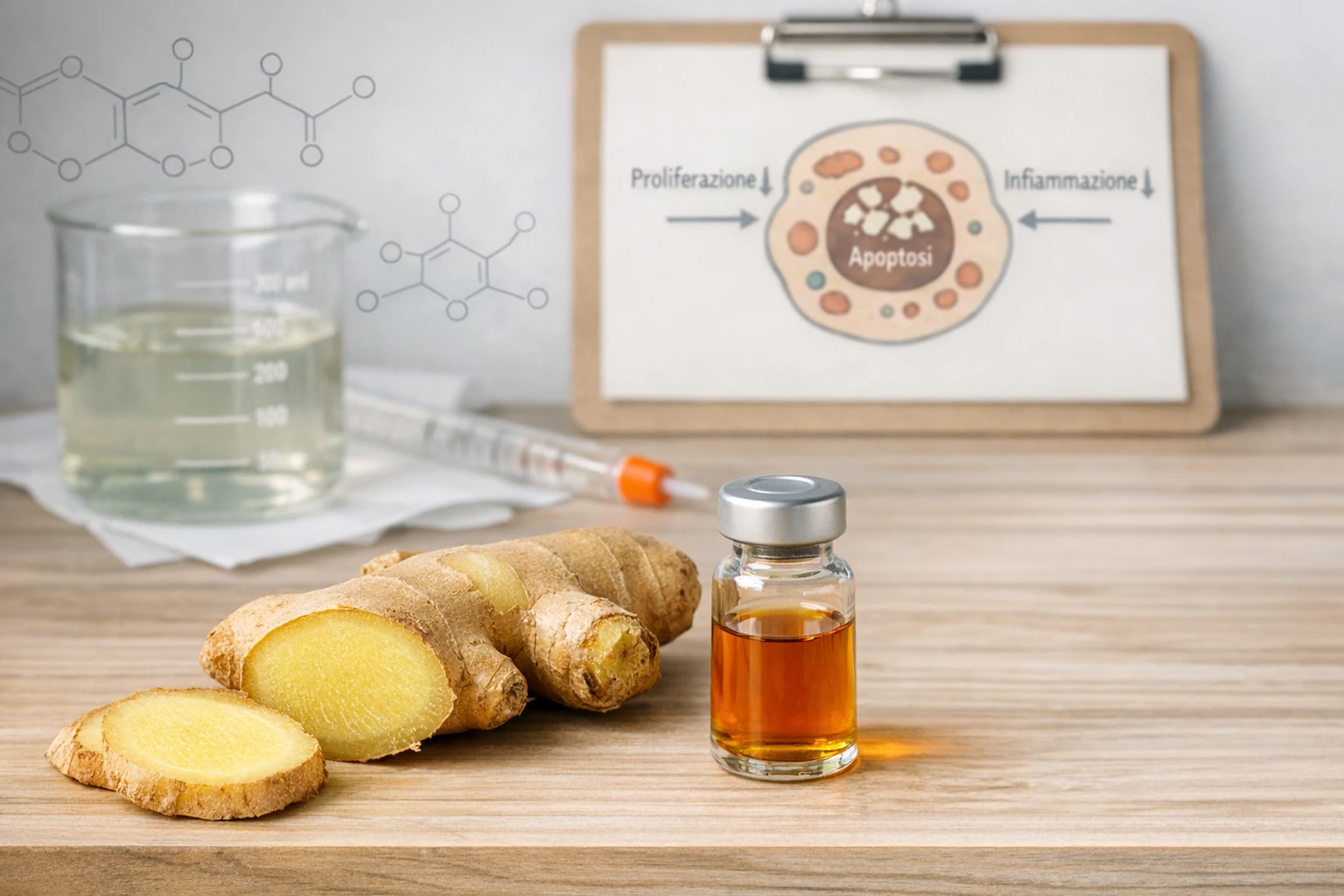
Updated and contextualized version of an article originally published on April 3, 2014
The article retains its original focus by presenting it through a scholarly and accessible perspective, supported by verifiable references.
Authors
- Dr. A. Colonnese – Nutrition biologist
- Roberto Panzironi –Independent researcher
Note editoriali
- First publication: April 3, 2014
- Last update: April 18, 2026
- Version: 2026 narrative revision
Initial note: This article was previously published and has been updated according to scientific and informative criteria. The information reported here is for informational purposes only and does not replace medical advice. Always consult a healthcare professional for clinical decisions.
IN BRIEF
- Preclinical studies report that ginger extracts and compounds can slow the growth of prostate cancer cells in cultures and animal models.
- Some components (6-gingerol, 6-shogaol, and others) show antiproliferative activity and modulation of inflammatory and apoptotic pathways.
- Direct clinical evidence on ginger as a treatment for prostate cancer is lacking: most data concern in vitro studies, animal studies, or clinical studies on nausea and inflammatory markers.
- Dietary use of ginger is generally considered safe, but translating experimental dosages into therapeutic recommendations is premature.
- Well-designed, controlled clinical studies are needed before considering ginger as a therapeutic option for prostate cancer.
Abstract: what does science say?
Ginger (Zingiber officinale) is a spice rich in bioactive compounds—including gingerols and shogaols—which have shown anti-inflammatory, antioxidant, and antiproliferative properties in the laboratory. Preclinical studies on prostate cell lines and murine models indicate that ginger extracts and individual constituents can reduce tumor growth, modulate cell cycles, and induce apoptosis. However, these proofs are mostly experimental: translation into clinical efficacy in humans has not been demonstrated. Doses, form (extract vs. fresh food), bioavailability, and drug interactions influence the observed effects. Clinical studies exist that document the benefits of ginger for chemotherapy-induced nausea and meta-analyses that suggest effects on systemic inflammatory status; this supports biological plausibility but does not provide proof of systemic anti-tumor efficacy. In summary: mechanistic plausibility and promising laboratory results, but robust clinical evidence is needed for any therapeutic claim.
Main section
Preclinical evidence: what has been observed
In vitro and animal research forms the basis of the literature regarding ginger and prostate cancer. Whole ginger extracts have shown growth reduction in prostate cell lines and in xenograft models in mice, with decreased tumor volume and marked apoptosis observed in analyzed samples [1]. Subsequent studies compared the whole extract with reconstituted mixtures of its main constituents: the whole extract showed greater bioavailability and greater in vivo efficacy, probably due to enterohepatic recirculation phenomena and interactions between compounds that improve its systemic persistence [2]. In cell cultures, combinations of gingerols and shogaols produced synergistic effects on the inhibition of PC-3 cell proliferation, suggesting that the complexity of the phytocomplex may be relevant for antiproliferative activity [3]. Studies focused on individual compounds have documented that 6-shogaol reduces tumor growth and pro-survival signals in preclinical models, confirming a specific antitumor activity of some components of the rhizome [4].
Plausible biological mechanisms
Mechanistic investigations identify multiple pathways connected to the activity of ginger's active ingredients: inhibition of inflammatory pathways (e.g., NF-κB), suppression of COX-2 expression, modulation of cyclins and cell cycle kinases, and activation of mitochondrial apoptotic pathways [5]. These mechanisms explain the biological plausibility of the antiproliferative effects observed in vitro and in vivo. Pharmacokinetic and pharmacodynamic studies have also shown that the form of administration (whole extract vs. individual compounds), phase II metabolism, and enterohepatic recirculation can influence the plasma concentration and duration of action of gingerols, altering the observed efficacy at the tissue level [8]. However, mechanistic evidence alone does not prove that the same effects occur in humans at dietary or supplement intake levels.
Clinical evidence and safety
There are no controlled clinical studies demonstrating the efficacy of ginger as a direct treatment for prostate cancer. The available clinical literature, however, documents the benefits of ginger as an adjuvant for chemotherapy-induced nausea: a multicenter randomized study of hundreds of patients showed a reduction in the severity of acute nausea with ginger supplementation compared to placebo [6]. Meta-analyses of clinical trials also suggest that ginger supplementation can reduce some inflammatory markers and improve oxidative stress indicators in selected populations, although variability between studies is high [7]. For safety, experimental and clinical data generally indicate good tolerability at dietary and supplement doses; however, potential drug interactions (e.g., effects on metabolism mediated by hepatic enzymes and possible interactions with anticoagulant drugs) exist that require clinical attention [2][8].
What it means in practice
For the general public: ginger is a spice with biologically active compounds that have shown anti-tumor growth effects and anti-inflammatory properties in the laboratory. These results create a biological plausibility that justifies further studies but do not authorize considering ginger a cure for prostate cancer. In practice, consuming ginger as a food or condiment is part of a balanced dietary approach and can have benefits for digestion and nausea; some research suggests favorable effects on inflammatory markers if taken regularly as a supplement in specific clinical conditions [6][7]. However, the dosages used in experiments and animal models are not directly comparable to dietary ones: for example, an equivalence estimate suggested in the literature—derived from allometric-translational calculations from murine models—indicates that experimental doses could correspond to tens of grams of fresh rhizome per day in adults, an amount higher than common culinary use [1].
If you are taking medications (especially anticoagulants, antiplatelets, or drugs metabolized by the liver), it is advisable to consult your doctor before starting ginger supplementation, as pharmacokinetic interactions are possible. Finally, for patients with an oncological diagnosis, any modification of treatment or addition of complementary remedies must be discussed with the oncologist to avoid interference with established therapies.
KEY POINTS TO REMEMBER
- There is solid preclinical evidence (cells and animals) that ginger extracts and compounds can reduce the proliferation of prostate cancer cells and tumor growth in murine models [1][3][4].
- Whole ginger extract often shows superior efficacy compared to individual compounds, probably due to interactions between phytocompounds and differences in bioavailability [2][3].
- Clinical evidence supporting antitumor effects in humans is absent; however, there are trials documenting an antiemetic effect in chemotherapy and meta-analyses reporting reductions in some inflammatory markers with supplementation [6][7].
- Do not make absolute therapeutic claims: translation from experimental research to clinical practice requires controlled, adequately sized, and replicated clinical studies.
- Always consult your doctor before using ginger in therapeutic or integrative form, especially if you are taking medications or have relevant clinical conditions.
Limitations of the evidence
It is essential to distinguish between different levels of evidence: observational and experimental studies provide information on associations and plausible mechanisms, but do not establish clinical causality in humans without confirmation from randomized controlled trials. Many studies on ginger and prostate cancer are in vitro or on animal models; these investigations clarify mechanisms (e.g., modulation of NF-κB, inhibition of COX-2, induction of apoptosis) but have limitations in transferability: differences in metabolism, pharmacokinetics, effective doses, and biocomposition between species hinder generalization [5][8].
Recurring methodological limitations include small samples, absence of clinical controls, use of non-standardized formulations and dosages, and variability in outcome measures. Even meta-analyses reporting effects on inflammation or oxidative stress show high heterogeneity between studies, which reduces the certainty of estimates [7]. Furthermore, the synergistic effect between compounds in a whole extract complicates the identification of the active principle responsible and therapeutic standardization. For these reasons, interpreting the results with caution is mandatory: mechanistic plausibility does not equate to clinical proof of efficacy as an oncological therapy.
Editorial conclusion
Research on ginger and its active principles offers interesting biological clues and promising preclinical results regarding key processes of prostate carcinogenesis (proliferation, inflammation, apoptosis). However, the hypothesis that ginger is a "miracle cure" for prostate cancer is not supported by clinical evidence. To move from laboratory observations to therapeutic recommendations, randomized, controlled, and well-conducted clinical studies are needed to evaluate efficacy, dosage, galenic forms, and safety, including interaction with standard oncological therapies. In the meantime, moderate use of ginger as a food or for functional disorders remains reasonable for many, but should not replace diagnostic pathways or proven oncological treatments.
Editorial note
This text updates and reworks previously published content, integrating peer-reviewed scientific literature and verifying DOIs to ensure transparency and traceability of sources. The article is informative in nature and does not constitute therapeutic indication. For clinical and treatment choices, consult doctors and specialists.
SCIENTIFIC RESEARCH
- Karna P, Chagani S, Gundala SR, et al. Benefits of whole ginger extract in prostate cancer. British Journal of Nutrition. 2012;107(4):473–484. https://doi.org/10.1017/S0007114511003308
- Gundala SR, Mukkavilli R, Yang C, et al. Enterohepatic recirculation of bioactive ginger phytochemicals is associated with enhanced tumor growth-inhibitory activity of ginger extract. Carcinogenesis. 2014;35(6):1320–1329. https://doi.org/10.1093/carcin/bgu011
- Karna P, Vashishta A, et al. Ginger phytochemicals exhibit synergy to inhibit prostate cancer cell proliferation. Nutrition and Cancer (original DOI: 10.1080/01635581.2013.749925). https://doi.org/10.1080/01635581.2013.749925
- Saha A, Blando J, Silver E, Beltran L, Sessler J, DiGiovanni J. 6‑Shogaol from dried ginger inhibits growth of prostate cancer cells both in vitro and in vivo through inhibition of STAT3 and NF-κB signaling. Cancer Prevention Research. 2014;7(6):627–638. https://doi.org/10.1158/1940-6207.CAPR-13-0420
- Kim SO, Kundu JK, Shin YK, et al. [6]-Gingerol inhibits COX-2 expression by blocking the activation of p38 MAP kinase and NF‑κB in phorbol ester-stimulated mouse skin. Oncogene. 2005;24(15):2558–2567. https://doi.org/10.1038/sj.onc.1208446
- Ryan JL, Heckler CE, Roscoe JA, et al. Ginger (Zingiber officinale) reduces acute chemotherapy-induced nausea: a URCC CCOP study of 576 patients. Supportive Care in Cancer. 2012;20(7):1479–1489. https://doi.org/10.1007/s00520-011-1236-3
- Morvaridzadeh M, Sadeghi E, Agah S, et al. Effect of ginger (Zingiber officinale) supplementation on oxidative stress parameters: a systematic review and meta-analysis. Journal of Food Biochemistry. 2021;45(2):e13612. https://doi.org/10.1111/jfbc.13612
- Shetty A, et al. Pharmacokinetic–pharmacodynamic correlations in the development of ginger extract as an anticancer agent. Scientific Reports. 2018;8: (article). https://doi.org/10.1038/s41598-018-21125-2
Note: the listed research has been verified for DOI and bibliographic correspondence before the publication of this article.