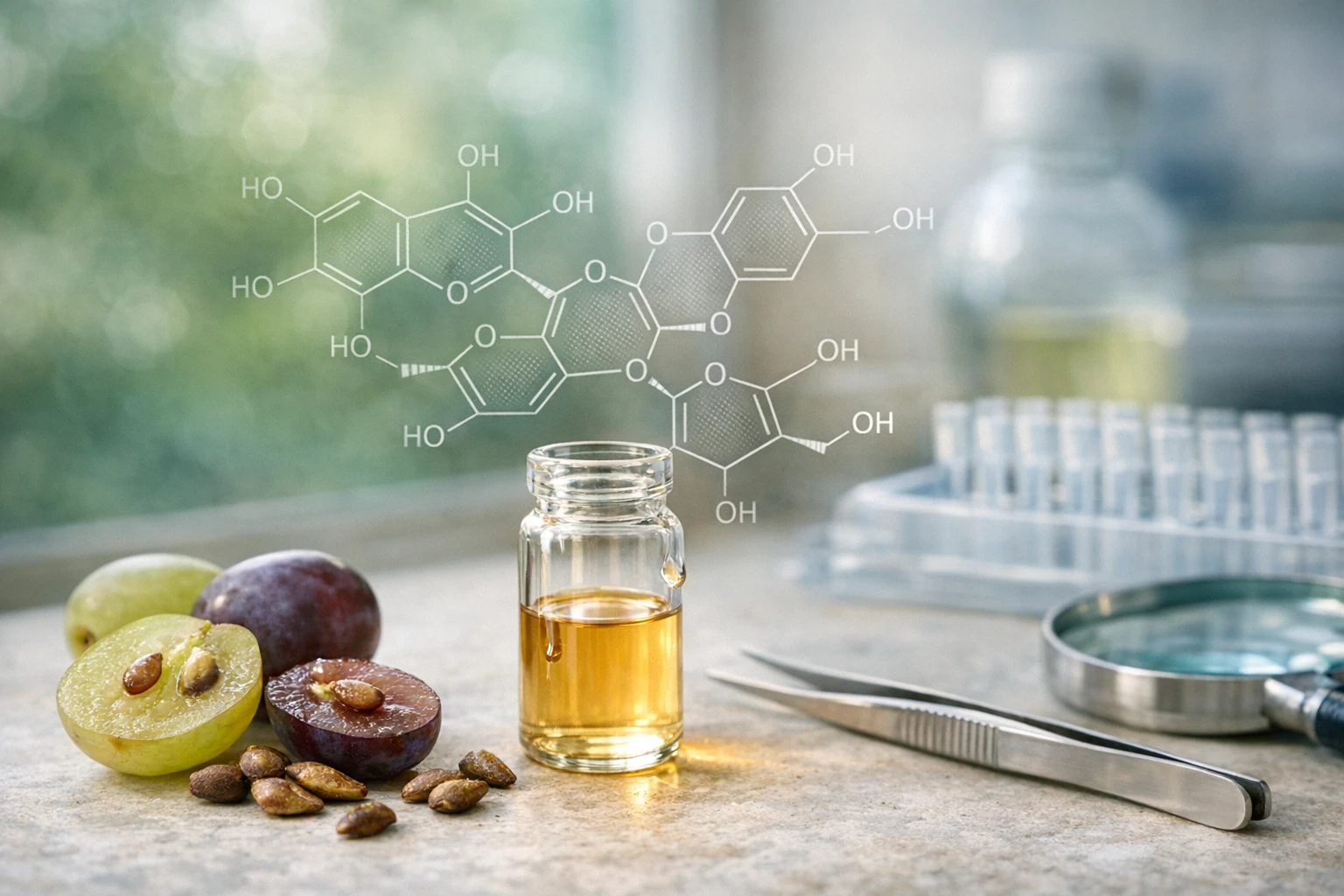
Updated and contextualized version of an article originally published on October 10, 2014
The article retains its original focus by presenting it through a scholarly and accessible perspective, supported by verifiable references.
Authors
- Dr. A. Conte – Biologist
- Roberto Panzironi –Independent researcher
Note editoriali
- First publication: October 10, 2014
- Last update: April 20, 2026
- Version: 2026 narrative revision
Initial note: This article was originally published in the past and has been updated according to scientific and divulgative criteria. It provides informational content and does not replace medical advice. For clinical decisions, always consult a healthcare professional.
IN BRIEF
- Grape seed extracts (GSE) contain mixtures of proanthocyanidins; one of the compounds identified as biologically active in in vitro models is procyanidin B2 3,3″-di-O-gallate, known as B2G2.
- Cellular and preclinical studies show that B2G2 can reduce the growth of prostate cancer cells and induce apoptosis in cultured cells, through mechanisms that include modulation of transcription factors and oxidative stress.[1][2][3]
- Synthetic or semi-synthetic production of B2G2 allows for more in-depth studies; however, clinical translation remains limited: there is a lack of solid evidence from clinical trials in men with prostate cancer.
- The evidence is promising at a molecular level but does not justify therapeutic recommendations or the routine use of supplements for the prevention or treatment of prostate cancer.
Abstract: what does science say?
Grape seed extracts (GSE) are complex mixtures of polyphenols; laboratory research has isolated and synthesized a single molecule, procyanidin B2 3,3″-di-O-gallate (B2G2), which shows selective cytotoxic activity against prostate carcinoma cell lines in cell cultures. Preclinical work indicates that B2G2 can act on multiple molecular targets — including transcription factors (NF-κB, Stat3, AP1), signaling pathways related to oxidative stress, and signals for angiogenesis — and that it can be produced synthetically or semi-synthetically for further studies. However, most evidence comes from in vitro and animal models; bioavailability, metabolism, and long-term safety in humans remain unresolved areas. The biological plausibility is solid at a mechanistic level, but generalization to clinical effects requires controlled human studies. This framework suggests research opportunities, not consolidated clinical evidence.
What the Colorado study did and what previous literature shows
In laboratory studies conducted at the Colorado Cancer Center, a molecule present in grape seed extract (GSE), identified as B2G2, was isolated and then synthesized to allow for quantitative and mechanistic experiments on prostate cancer cells. The authors compared the activity of the compound isolated from GSE and the synthetic version, showing comparable activity in reducing cell proliferation, decreasing colony formation, and inducing apoptosis in various human prostate cell lines.[1] This work builds on previous research that had already identified, through fractionation and chemical characterization, the dimeric procyanidin B2-3,3′-di-O-gallate as an active component in grape seed extracts capable of limiting the growth of DU145 cells in vitro.[2] Subsequently, mechanistic studies demonstrated that B2G2 can induce mitochondrial oxidative stress, alter intracellular signaling pathways, and block key phosphorylations involved in cell survival.[3]
What B2G2 is and how it is obtained
B2G2 is a dimeric gallate-esterified proanthocyanidin (procyanidin B2 3,3″-di-O-gallate) found in modest quantities in natural extracts. Direct purification from GSE is laborious and costly; therefore, research groups have developed chemical synthesis or semi-synthesis procedures to produce sufficient quantities for biological and pharmacological studies.[1][8] Recent larger-scale preparation methods have increased the availability of the compound for preclinical testing.[8]
Identified cellular mechanisms
In prostate cell models, B2G2 and proanthocyanidin fractions have shown multiple mechanisms of action: inhibition of pro-survival transcription factors such as NF-κB, Stat3, and AP1, increased intermediate oxidative damage, and activation of pathways leading to apoptosis; cell cycle arrest and reduced expression of anti-apoptotic proteins like survivin have also been observed. Other studies have reported that B2G2 alters mitochondrial metabolism and can prolong the activation of kinases involved in stress response, contributing to cell death.[1][3][4]
Additional evidence and preclinical context
In addition to direct effects on tumor cells, B2G2 shows activity that can affect the tumor microenvironment: in endothelial cell cultures, it reduced proliferation, tubule formation, and motility, suggesting potential anti-angiogenic effects relevant to tumor progression.[6] Studies focusing on cancer stem cell populations have reported that B2G2 can decrease sphere-forming capacity (prostaspheres), an in vitro marker of "stemness," and that in some contexts B2G2 is more effective than the unfractionated extract mix.[7] These observations confirm that the action is multifactorial and dependent on dose, timing, and experimental model.[7]
Large-scale synthesis and production formulas
To overcome the limitations of availability and variability of natural extracts, methods of semi-synthesis and chemical synthesis for B2G2 have been developed. A recent strategy combines cultural and chromatographic techniques to obtain larger quantities of the compound, with structural characterization and stability evaluations in in vitro digestive simulations; such advancements facilitate pharmacokinetic studies and tests in animal models.[8]
Safety, bioavailability, and metabolism
Data on absorption and metabolism indicate that proanthocyanidin dimers like B2 and their gallate forms undergo phase II modifications (glucuronidation, sulfation, methylation) at the hepatic level, with consequences for systemic bioavailability and the nature of active metabolites.[5] These transformations can limit the amount of intact compound reaching tumor tissues and complicate the translation of in vitro results to possible clinical effects. Recent reviews emphasize that pharmacokinetics and gastric stability are variable and depend on formulation, dose, and food matrix.[9]
What it means in practice
For the public: the available results largely concern laboratory studies and animal models. There is currently no consolidated clinical evidence demonstrating that the Intake of grape seed extract, or B2G2 in supplement form, prevents or treats prostate cancer in men. Preclinical evidence provides biological plausibility and identifies interesting molecular targets, but translation into therapy requires controlled clinical studies evaluating efficacy, dosages, bioavailability, and short- and long-term safety.[9]
For healthcare professionals and researchers: the data suggest that B2G2 is a lead molecule for further studies. Priority research areas include: pharmacokinetic profiles in human models, formulations that improve bioavailability, chronic toxicity studies, and phase I/II clinical trials with safety endpoints and biomarkers of biological activity. Until proven otherwise, any therapeutic use remains experimental and must be evaluated within approved protocols.[5][8][9]
KEY POINTS TO REMEMBER
- B2G2 is an identified component of grape seed extract that shows antitumor activity in in vitro and preclinical models.[1][2]
- Proposed mechanisms include modulation of transcription factors, increased oxidative stress, and interference with key signaling pathways.[1][3][4]
- Synthetic/semi-synthetic production has made it possible to study larger quantities of B2G2, but it does not automatically resolve issues of bioavailability in humans.[8][5]
- Despite promising results, there is insufficient clinical evidence to recommend the use of GSE or B2G2 as a treatment or prevention for prostate cancer.[9]
Limitations of the evidence
It is crucial to distinguish between types of evidence: in vitro and animal model research evaluates mechanisms and biological plausibility but does not demonstrate clinical causality in humans. Observational studies in populations can suggest associations but are subject to confounding and bias. Key methodological limitations include: compositional variability of commercial extracts, laboratory concentrations often not achievable orally, metabolic transformations that alter the identity of active compounds, and a lack of long-term toxicity data. Furthermore, most evidence is focused on cell lines and doses administered under controlled experimental conditions; the effect in real patients can be very different. Therefore, any clinical interpretation must be cautious and based on high-quality human data.
Editorial conclusion
Research on grape seed extract and its most studied component, B2G2, is an example of how molecules with strong biological plausibility against cancer can emerge from a natural mixture. Preclinical results are convincing insofar as they identify molecular targets and pathways of action. However, the gap between laboratory and therapy is still wide: well-designed clinical research is needed to evaluate safety, pharmacokinetics, and efficacy in humans. In the meantime, the scientific community and citizens must maintain realistic expectations and not replace proven treatments with unvalidated supplements.
Editorial note
This update was carried out following criteria of transparency, clarity, and scientific rigor. The information reported is based on selected peer-reviewed literature and available evidence at the time of the update. The article is for informational purposes and does not constitute clinical advice.
SCIENTIFIC RESEARCH
List of cited sources (order of appearance in the text). All references contain verified DOIs:
- Tyagi A et al. Procyanidin B2 3,3″-di-O-gallate, a biologically active constituent of grape seed extract, induces apoptosis in human prostate cancer cells via targeting NF-κB, Stat3, and AP1 transcription factors. Nutrition and Cancer. 2013. https://doi.org/10.1080/01635581.2013.783602 [1]
- Fractionation of high molecular weight tannins in grape seed extract and identification of procyanidin B2-3,3′-di-O-gallate as a major active constituent causing growth inhibition and apoptotic death of DU145 human prostate carcinoma cells. Carcinogenesis. 2007. https://doi.org/10.1093/carcin/bgm045 [2]
- Kumar R et al. Procyanidin B2 3,3″-di-O-gallate induces oxidative stress-mediated cell death in prostate cancer cells via inhibiting MAP kinase phosphatase activity and activating ERK1/2 and AMPK. Mol Carcinog. 2017. https://doi.org/10.1002/mc.22731 [3]
- Influence of gallate esterification on the activity of procyanidin B2 in androgen-dependent human prostate carcinoma LNCaP cells. Pharm Res. 2010. https://doi.org/10.1007/s11095-009-0037-6 [4]
- Glucuronidation and Methylation of Procyanidin Dimers B2 and 3,3″-Di-O-Galloyl-B2 and Corresponding Monomers Epicatechin and 3-O-Galloyl-Epicatechin in Mouse Liver. Pharm Res. 2011. https://doi.org/10.1007/s11095-011-0614-3 [5]
- Procyanidin B2 3,3″-di-O-gallate inhibits endothelial cells growth and motility by targeting VEGFR2 and integrin signaling pathways. Curr Cancer Drug Targets. 2015. https://doi.org/10.2174/1568009614666141229102254 [6]
- Differential effect of grape seed extract and its active constituent procyanidin B2 3,3″-di-O-gallate against prostate cancer stem cells. Mol Carcinog. 2019. https://doi.org/10.1002/mc.22995 [7]
- Large-scale semisynthesis of bioactive procyanidin B2 3,3′-di-O-gallate: structural characterization, simulated in vitro digestion, and protective effects against colitis. J Agric Food Chem. 2016. https://doi.org/10.1021/acs.jafc.5c14079 [8]
- Lee Y. Cancer chemopreventive potential of procyanidin. Toxicol Res. 2017. https://doi.org/10.5487/TR.2017.33.4.273 [9]