Updated and contextualized version of an article originally published on April 28, 2014
The article retains its original focus by presenting it through a scholarly and accessible perspective, supported by verifiable references.
Authors
- Dr. D. Iodice – Biologist
- Roberto Panzironi –Independent researcher
Note editoriali
- First publication: April 28, 2014
- Last update: April 18, 2026
- Version: 2026 narrative revision
Editorial Note
Article previously published and updated according to scientific and divulgative criteria. The content is for informational purposes only and does not replace personalized medical advice. For clinical decisions, consult a healthcare professional.
IN BRIEF
- Lycopene is a carotenoid found mainly in tomatoes; many observational studies and some clinical interventions associate it with favorable effects on LDL and systolic blood pressure.
- Meta-analyses and trials indicate that measurable effects are observed primarily with standardized doses (typically ≥12–25 mg/day) or with processed products that increase bioavailability.
- Comparison with statins is inappropriate: some analyses have estimated moderate reductions in LDL with very high doses of lycopene, but the evidence does not reach the level of pharmacological therapies for reducing cardiovascular events.
- The form of consumption (cooked tomato, concentrate, juices, supplements) and the presence of dietary fats influence absorption.
Abstract: what does science say?
Lycopene, the carotenoid pigment abundant in tomatoes, has been studied for its potential cardiovascular benefits, particularly for reducing LDL cholesterol and blood pressure. Epidemiological evidence suggests inverse associations between serum lycopene levels and the risk of cerebrovascular and cardiovascular events; meta-analyses of interventions report modest reductions in LDL and systolic blood pressure when doses and duration are adequate. The effects appear to depend on the dose, duration, and food form (processing and presence of lipids) which influences its bioavailability. However, the data come from heterogeneous studies: small trials, different formulations, and variability of results require cautious interpretation. Current evidence supports biological plausibility and a potential favorable effect, but does not replace pharmacological treatment in high-risk patients; larger and longer-term studies are needed to clarify the impact on clinical events.
Main Section
Biological mechanisms (brief)
Lycopene is a lipophilic carotenoid with a high capacity for quenching reactive oxygen species. In cellular and animal model studies, it shows antioxidant effects and modulation of inflammatory and lipid pathways that can theoretically reduce lipoprotein oxidation and improve endothelial function. Other proposed mechanisms include modulation of the expression of hepatic LDL receptors and enzymes involved in cholesterol synthesis, as well as antithrombotic and anti-inflammatory effects that may contribute to reducing vascular risk. These actions constitute the biological plausibility that justifies clinical and observational studies on the topic.
Dose, form, and cooking: what changes
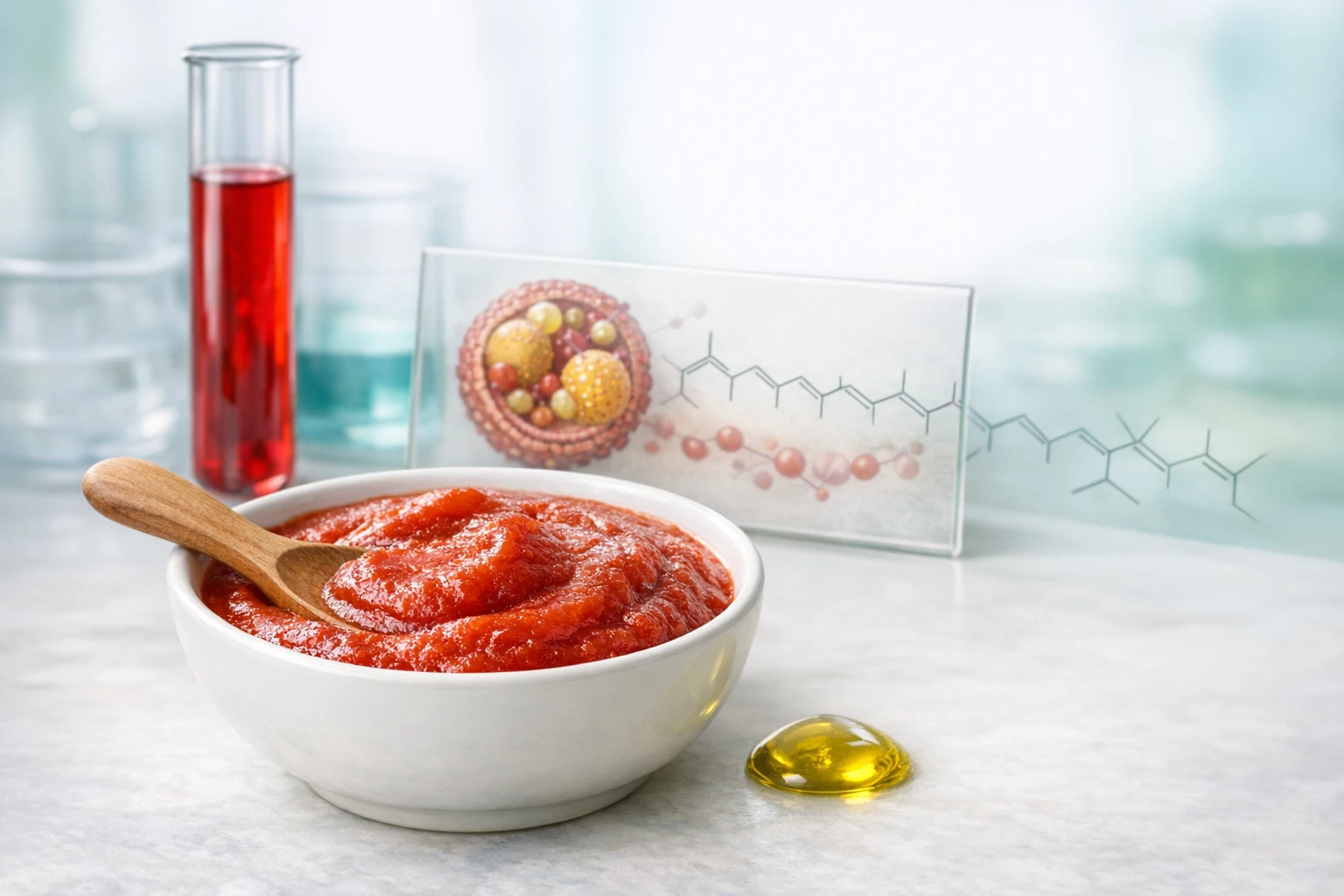
Lycopene is more bioavailable after heat treatments and in the presence of fats: cooking tomatoes (sauce, concentrate) and consumption with oil favor the release and absorption of the compound compared to raw fruit. Supplementary formulations or standardized extracts allow reaching doses examined in trials (e.g., 15–30 mg/day). Intervention evidence indicates that effects on LDL and blood pressure are more likely with high doses and/or standardized products; contained doses present in normal diet can increase serum levels, but the clinical effect also depends on the duration and overall dietary context.
What evidence: epidemiology vs clinical trials
Observational studies (cohort and case-control) repeatedly show inverse associations between serum lycopene levels or consumption of tomato-based products and certain cardiovascular outcomes, such as stroke and cardiovascular mortality. However, associations do not prove causality and are subject to confounding by dietary patterns and lifestyle. Randomized clinical interventions and meta-analyses on supplementation or tomato-based products have shown heterogeneous results: some reports indicate moderate reductions in LDL and systolic blood pressure with significant doses, while others do not confirm uniform effects. In summary, observations and trials provide consistent signals of biological benefit but not yet robust proof of long-term event reduction.
PRACTICAL SECTION
What it means in practice
For the public: regular consumption of tomatoes and derived products (sauce, passata, concentrate, juices) is consistent with dietary guidelines aimed at cardiovascular prevention and can increase lycopene intake in a bioavailable form. Clinical interventions indicate that standardized products containing significant amounts of lycopene can modestly reduce systolic blood pressure and, in some cases, LDL cholesterol if taken for weeks or months [1][2][3]. It is important to distinguish the potential nutritional effect from drugs: statins remain the therapy with consolidated evidence for reducing cardiovascular events in people at risk; lycopene does not replace recommended pharmacological therapies. For those who want to increase intake, the cooked form (sauce, concentrate) consumed with a fat source (olive oil) increases absorption compared to raw tomato [4][6]. Clinical studies useful for evaluating a direct therapeutic effect on major events are still lacking sufficiently; dietary choices should be evaluated within an overall prevention plan shared with the doctor.
KEY POINTS TO REMEMBER
- Lycopene is associated with possible benefits on LDL and blood pressure, especially if taken in concentrated form or as a supplement at the studied doses.
- Bioavailability increases with cooking and the presence of dietary fats.
- The evidence is promising but heterogeneous: there is currently insufficient evidence to replace effective pharmacological therapies in people at high cardiovascular risk.
- For prevention, integrating tomatoes and derivatives into a balanced diet is reasonable; for therapeutic choices, consult a doctor.
Limitations of the evidence
It is crucial to distinguish between observational association and causal proof: cohort studies show correlations between lycopene levels and lower cardiovascular risk, but they may reflect dietary habits or unmeasured confounding factors [7]. Clinical trials are often small, with short durations, and use different formulations (juices, extracts, concentrates, supplements), making it difficult to compare results and estimate a clear dose-effect [2][5]. Many meta-analyses show heterogeneity among studies and an important role of the dose and the baseline population (e.g., hypertensive subjects or those with borderline LDL are more responsive) [1][2]. Finally, most research evaluates surrogates (LDL, blood pressure, oxidation markers) and not the impact on major clinical events (heart attack, stroke, cardiovascular death) on a large scale; larger and longer-duration RCTs are needed to definitively answer this question [9][6].
Editorial conclusion
Scientific literature suggests that lycopene from tomatoes, especially in cooked or concentrated forms, can help improve some cardiovascular risk factors such as LDL and systolic blood pressure. These results are consistent with plausible biological mechanisms and observational data associating higher serum levels with lower event risk. However, the evidence is not yet sufficient to consider lycopene a substitute for approved pharmacological therapies for reducing cardiovascular risk in high-risk individuals. For the public, the recommendation of a varied diet rich in fruits and vegetables, including tomato-based products cooked with a fat source, remains valid as part of an overall prevention strategy. Future research will need to clarify the dose, duration, formulation, and impact on major clinical events.
Editorial Note
This article is an update of previously published content. The update was made based on systematic reviews and clinical trials available in peer-reviewed literature. The information provided is for informational purposes and does not replace medical advice.
SCIENTIFIC RESEARCH
- Ried K, Fakler P. Protective effect of lycopene on serum cholesterol and blood pressure: Meta-analyses of intervention trials. Maturitas. 2011;68(4):299–310. https://doi.org/10.1016/j.maturitas.2010.11.018
- Xu J, Li X. Lycopene supplement and blood pressure: an updated meta-analysis of intervention trials. Nutrients. 2013;5(9):3696–3712. https://doi.org/10.3390/nu5093696
- Wolak T, Sharoni Y, Levy J, et al. Effect of Tomato Nutrient Complex on Blood Pressure: A Double Blind, Randomized Dose–Response Study. Nutrients. 2019;11(5):950. https://doi.org/10.3390/nu11050950
- Nishimura M, Tominaga N, Ishikawa-Takano Y, Maeda-Yamamoto M, Nishihira J. Effect of 12-week daily intake of the high-lycopene tomato (PR-7) on lipid metabolism: a randomized, double-blind, placebo-controlled study. Nutrients. 2019;11(5):1177. https://doi.org/10.3390/nu11051177
- Rao AV, Agarwal S. Tomato lycopene and its role in human health and chronic diseases. Atherosclerosis. 2017;257:100–108. https://doi.org/10.1016/j.atherosclerosis.2017.01.009
- Mozos I, Stoian D, Caraba A, et al. Lycopene and Vascular Health. Front Pharmacol. 2018;9:521. https://doi.org/10.3389/fphar.2018.00521
- Li D, Zhang Y, Li H, et al. Dietary and circulating lycopene and stroke risk: a meta-analysis of prospective studies. Sci Rep. 2014;4:5031. https://doi.org/10.1038/srep05031
- Rismanchi M, Butler T, et al. Tomato juice decreases LDL cholesterol levels and increases LDL resistance to oxidation. Br J Nutr. 2007;98(6):1251–1258. https://doi.org/10.1017/S0007114507787445
- Goulis DG, Poulimeneas D, et al. Effect of dietary and supplemental lycopene on cardiovascular risk factors: a systematic review and meta-analysis. Adv Nutr. 2020;11(6):1453–1488. https://doi.org/10.1093/advances/nmaa069
Note: if some complete bibliographic data are missing or specific in-depth information is needed, they are indicated with clear placeholders in square brackets [ ].