Updated and contextualized version of an article originally published on May 12, 2014
The article retains its original focus by presenting it through a scholarly and accessible perspective, supported by verifiable references.
Authors
- Dr. M. Mondini – Biologist
- Roberto Panzironi –Independent researcher
Note editoriali
- First publication: May 12, 2014
- Last update: April 18, 2026
- Version: 2026 narrative revision
Editorial Note (initial)
This article is based on previously published material and has been updated according to scientific and informative criteria. It is for informational purposes only and does not replace medical advice. For personal health conditions, consult a qualified healthcare professional.
IN BRIEF
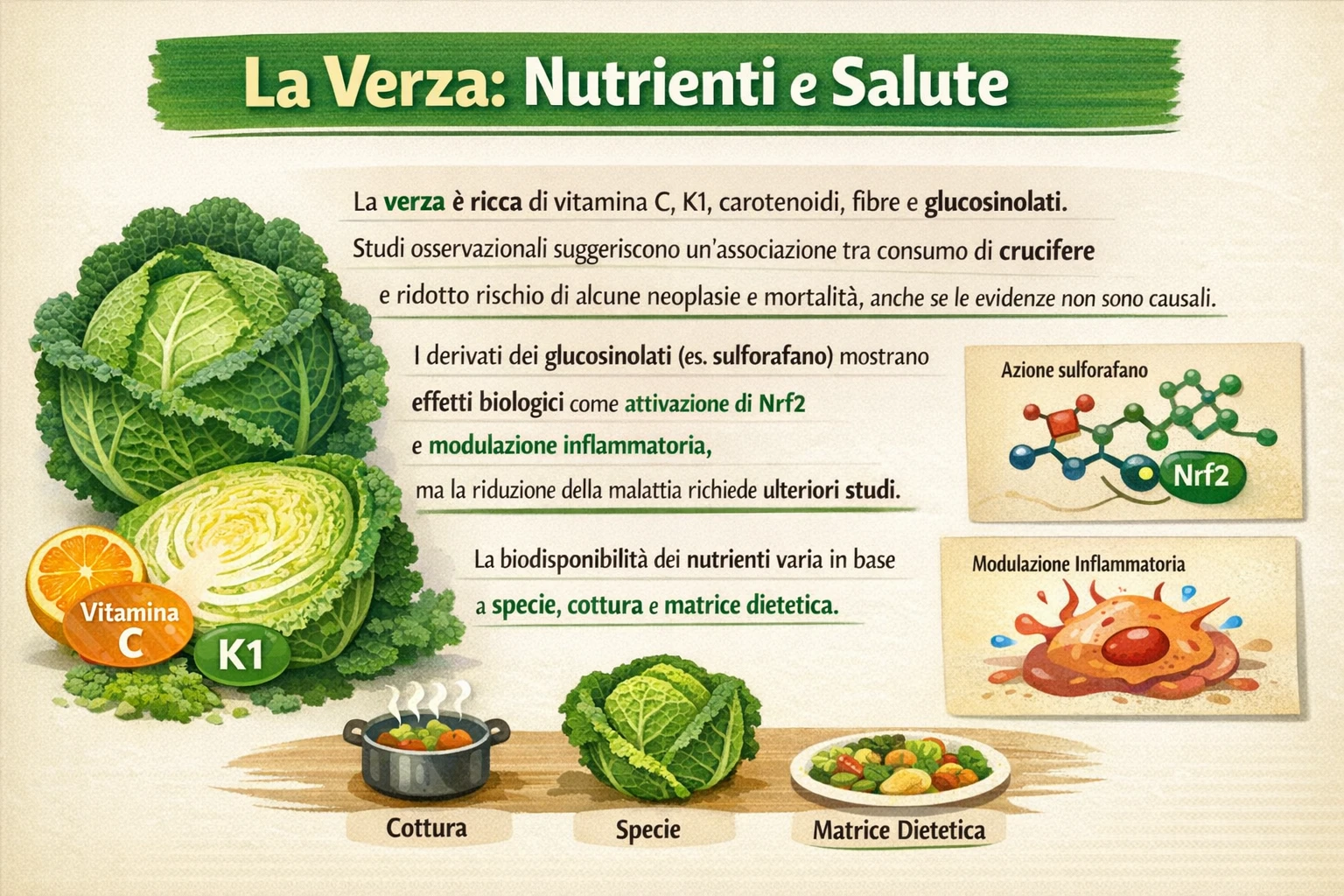
- Savoy cabbage is a cruciferous vegetable with a rich nutritional profile including vitamin K, vitamin C, fiber, carotenoids, and sulfur compounds (glucosinolates).
- Observational epidemiology associates cruciferous vegetable consumption with reduced risk for certain cancers and possible metabolic benefits, but causality remains uncertain. [1]
- Compounds like sulforaphane show plausible biological mechanisms (Nrf2, inflammatory modulation) and are the subject of clinical studies on biomarkers. [6][8]
- The bioavailability of vitamins and minerals depends on the species, maturation, cooking, and dietary context. [2][5]
Abstract: what does science say?
Savoy cabbage (a form of Brassica oleracea) contains essential nutrients (vitamins K and C, carotenoids), fiber, and phytochemicals typical of the cruciferous family (glucosinolates and their derivatives). Observational epidemiological evidence suggests favorable associations between cruciferous consumption and a lower risk of certain cancers and mortality outcomes, but the evidence is largely observational and subject to confounding. Clinical studies on sulforaphane-rich extracts or preparations show effects on biomarkers of detoxification, inflammation, and metabolism; however, these vary depending on the dose, form (whole vegetable vs. extract), and individual characteristics. The bioavailability of vegetable calcium and iron is conditioned by the content of oxalates and phytates and by dietary interactions; some cruciferous vegetables have relatively assimilable calcium. In summary, savoy cabbage is a nutritious food with plausible health benefits when included in a varied diet, but it is not a cure or an exclusive source for all nutrients.
Savoy Cabbage: Nutritional Composition and Bioactive Compounds
Savoy cabbage belongs to the Brassicaceae family; like other cruciferous vegetables, it is a good dietary source of micronutrients and bioactive compounds. Recent reviews on the family indicate that, for the same serving size, many Brassica varieties contain significant amounts of vitamin C, provitamin A (carotenoids), vitamin K (phylloquinone or K1), fiber, and minerals such as calcium and potassium. [2] The composition varies between cultivars (green vs. red savoy cabbage), growing conditions, and degree of ripeness. [2] Glucosinolates, typical of the group, are precursors of isothiocyanates such as sulforaphane; these form when plant tissue is damaged (chewing, cutting) and the enzyme myrosinase comes into contact with the substrates. [6] The presence of fiber and water makes savoy cabbage low in calories by volume, contributing to satiety. [5]
Vitamins and minerals
Cruciferous vegetables provide water-soluble and fat-soluble vitamins: vitamin C is present in amounts useful for contributing to the recommended daily intake and has documented roles in immune and antioxidant functions. [3] Vitamin K1 (phylloquinone) is typical of green leaves and contributes to coagulation and bone remodeling processes; dietary content depends on the species, maturation, and preparation. [2][5] For calcium and iron, savoy cabbage offers modest amounts but with bioavailability that can be higher than other high-oxalate plant sources; however, the actual intake depends on the rest of the diet. [4][5]
Phytochemicals: glucosinolates and sulforaphane
Glucosinolates are metabolized into isothiocyanates (e.g., sulforaphane) which modulate cellular pathways involved in detoxification (phase II enzymes), antioxidation, and inflammation regulation (Nrf2 pathway and other pathways). [6] These mechanisms are plausible to explain associations observed in epidemiology between cruciferous vegetable consumption and reduced risk of certain cancers; however, clinical effects in humans vary based on dose, form (whole vegetable vs. extract), and individual microbiome. [6][8]
Epidemiological and Clinical Evidence
Available epidemiological data are primarily based on observational studies (cohort and case-control). A comprehensive summary of meta-analyses highlights inverse associations between cruciferous vegetable consumption and certain cancers and mortality, but the strength of evidence is often classified as "weak" or "suggestive" for many tumor sites. [1] Recent reviews emphasize geographical variability, the role of quantity and consumption methods, as well as possible genetic interactions that modify the effects. [1]
From a clinical perspective, controlled trials using preparations rich in glucoraphanin/sulforaphane have demonstrated effects on biomarkers of environmental detoxification and on some inflammatory or metabolic markers; a significant example is the randomized study conducted in China (Qidong) which showed an increase in urinary excretion of benzene and acrolein metabolites after daily administration of a broccoli sprout-based beverage, suggesting an enhancement of detoxification pathways. [8] Such results indicate measurable biological effects, but cannot be automatically interpreted as proof of clinical disease reduction without long-term studies with primary clinical outcomes.
Plausible biological mechanisms
The most studied mechanisms include the activation of the Nrf2 pathway, which induces the expression of phase II enzymes (glutathione S-transferase, NAD(P)H:quinone oxidoreductase), contributing to xenobiotic detoxification and antioxidant defense. [6] Other mechanisms include the inhibition of pro-inflammatory pathways (e.g., NF-κB), epigenetic modifications, effects on cancer stem cells observed in preclinical models, and actions on the gut microbiota that can modulate metabolism and systemic inflammation. [6][7] Polyunsaturated fatty acids of plant origin (such as ALA) present in trace amounts in the leaves contribute to a lipid profile that, although limited, is plausibly anti-inflammatory in the context of a varied diet. [7]
Uses, preparation, and impact on nutritional quality
The method of preparing savoy cabbage influences the availability of nutrients and bioactive compounds. Vitamin C and some phenols are sensitive to heat and cooking water; methods that reduce contact with water (steaming, quick stir-frying) better preserve these compounds compared to prolonged boiling. [5] For sulforaphane formation, myrosinase activation is important: consuming the raw vegetable or combining it with external sources of myrosinase (e.g., a small amount of mustard seeds) can increase the conversion of glucosinolate into active isothiocyanates. [6]
Fermentation (e.g., sauerkraut) modifies the glucosinolate profile and can generate stable products with distinct effects; some analytical studies show significant variations in composition during fermentation and storage. [2] In general, incorporating savoy cabbage into various recipes (salads, soups, light cooking) helps to obtain nutritional benefits with a low caloric intake.
What it means in practice
For the general public: savoy cabbage is a nutritious food that can contribute to dietary variety and quality. Regularly incorporating various cruciferous vegetables (cabbage, broccoli, cauliflower, savoy cabbage) provides vitamins (C, K1), fiber, and bioactive compounds associated with possible long-term benefits when consumed as part of an overall balanced diet. [2][3]
There is no evidence that savoy cabbage alone "prevents" diseases in a guaranteed way: the observed benefits derive from complex dietary patterns. Some groups (people on anticoagulant therapy based on vitamin K antagonists) should discuss the consumption of foods high in vitamin K with their doctor, because vitamin K can interfere with therapy; any therapeutic adjustment requires clinical supervision. [5]
Key points to remember
- Savoy cabbage is a cruciferous vegetable rich in vitamin C, vitamin K1, fiber, carotenoids, and glucosinolates; the composition varies by variety and preparation. [2][5]
- Observational evidence links cruciferous vegetable consumption to reduced risks for some diseases, but causality is not established. [1]
- Glucosinolate derivatives (e.g., sulforaphane) have plausible biological mechanisms and demonstrated effects on biomarkers in clinical studies, but the translation to disease outcomes remains to be clarified. [6][8]
- Cooking and fermentation modify the availability of nutrients and bioactive compounds; the choice of method affects the benefits obtained. [5][6]
Limitations of Evidence
Available research is mostly observational or based on biomarkers: population studies involve risks of confounding (lifestyles, overall vegetable consumption) and dietary measurement subject to error. [1] Clinical studies on cruciferous extracts or preparations often use different doses, forms, and durations, with heterogeneous results, making generalization difficult. [6][8] Differences in bioavailability (e.g., for calcium and iron) depend on the food matrix, inhibitors like oxalates and phytates, and overall dietary habits; therefore, composition data must be interpreted in the context of the total diet. [4][5]
Editorial Conclusion
Savoy cabbage is a food with a solid nutritional profile and bioactive compounds that support plausible physiological benefits. Evidence supports the inclusion of cruciferous vegetables in a varied and balanced diet, without specific therapeutic promises. The literature suggests measurable effects on biomarkers and favorable observational associations, but long-term clinical studies with clinical outcomes are needed to confirm direct impacts on disease. In the absence of individual contraindications, savoy cabbage can be considered a reasonable food choice within a healthy dietary pattern.
Editorial Note (final)
This update was created with an institutional scientific-editorial approach, with attention to transparency and verifiability. The cited research was selected from peer-reviewed sources with verifiable DOIs. The content is for informational purposes only and does not replace personalized medical advice.
SCIENTIFIC RESEARCH
- [1] Yi‑Zi Li et al., "Cruciferous vegetable consumption and multiple health outcomes: an umbrella review of 41 systematic reviews and meta‑analyses of 303 observational studies", Food & Function, 2022. https://doi.org/10.1039/D1FO03094A
- [2] Zhang et al., "Brassica vegetables—an undervalued nutritional goldmine", Horticulture Research, 2024/2025. https://doi.org/10.1093/hr/uhae302
- [3] Anitra C. Carr & Silvia Maggini, "Vitamin C and Immune Function", Nutrients, 2017. https://doi.org/10.3390/nu9111211
- [4] Lucarini et al., "In vitro calcium availability from brassica vegetables (Brassica oleracea L.) and as consumed in composite dishes", Food Chemistry, 1999. https://doi.org/10.1016/S0308-8146(98)00159-9
- [5] Frontiers in Nutrition, "Bioavailability of Micronutrients From Nutrient‑Dense Whole Foods: Zooming in on Dairy, Vegetables, and Fruits", 2020. https://doi.org/10.3389/fnut.2020.00101
- [6] (review) "Effects of sulforaphane and related isothiocyanates: clinical evidence and mechanisms", Frontiers (review), 2021. https://doi.org/10.3389/fnut.2021.648788
- [7] "The review of alpha‑linolenic acid: Sources, metabolism, and pharmacology", Journal of Oleo Science, 2021. https://doi.org/10.5650/jos.ess16064
- [8] Egner et al., "Rapid and Sustainable Detoxication of Airborne Pollutants by Broccoli Sprout Beverage: Results of a Randomized Clinical Trial in China", Cancer Prevention Research, 2014. https://doi.org/10.1158/1940-6207.CAPR-14-0103
- [9] Joanne L. Slavin, "Dietary fiber and body weight", Nutrition, 2005. https://doi.org/10.1016/j.nut.2004.08.018