Updated and contextualized version of an article originally published on May 13, 2014
The article retains its original focus by presenting it through a scholarly and accessible perspective, supported by verifiable references.
Authors
- Dr. D. Iodice – Biologist
- Roberto Panzironi –Independent researcher
Note editoriali
- First publication: May 13, 2014
- Last update: April 20, 2026
- Version: 2026 narrative revision
Editorial Note (Update)
This article was previously published and has been updated for clarity, rigor, and bibliographic references according to scientific and popular science criteria. The content is for informational purposes only and does not replace medical advice. [Additional information or missing data indicated in square brackets].
IN BRIEF
- Oleocanthal is a phenol found in extra virgin olive oil (EVOO) that, in cellular and animal models, shows activity potentially relevant to processes related to Alzheimer's.
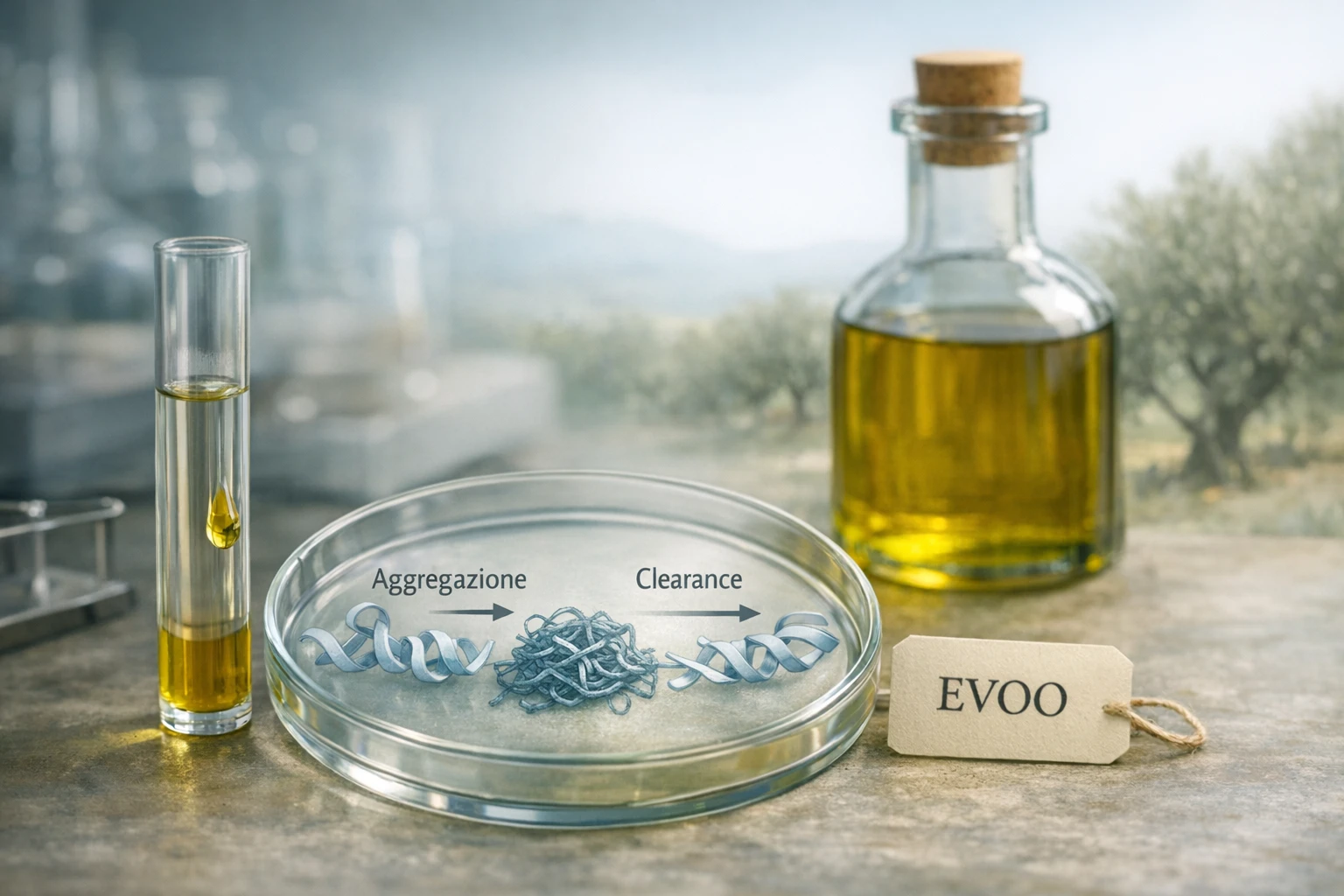
- Proposed mechanisms include inhibition of tau aggregation, increased beta-amyloid clearance, and modulation of inflammation and blood-brain barrier function.
- Clinical and observational evidence links the Mediterranean diet (with EVOO consumption) to a lower risk of cognitive decline, but does not prove a direct cause-and-effect relationship.
- Translating preclinical results to humans is limited by doses, bioavailability, and differences between purified extracts and dietary consumption.
Abstract: what does science say?
Over the last decade, research has investigated how bioactive components of extra virgin olive oil (particularly oleocanthal) can influence biological processes linked to Alzheimer's disease. Laboratory studies and animal models show that oleocanthal can interfere with the formation of protein aggregates (tau, beta-amyloid), increase mechanisms for removing beta-amyloid peptide, and modulate inflammatory responses and blood-brain barrier function. Epidemiological evidence indicates associations between adherence to a Mediterranean diet rich in EVOO and a lower incidence of cognitive decline, but significant uncertainties remain regarding the effective dose, the bioavailability of the compound when consumed with food, and the generalizability of preclinical results to humans. In summary, there are plausible biological signals and promising results in experimental models; however, proof that the consumption of oleocanthal (or EVOO in general) prevents Alzheimer's in humans requires more targeted clinical studies and accurate exposure data.
Proposed Biological Mechanisms
Experimental literature describes multiple pathways through which oleocanthal and other EVOO phenols could influence processes associated with Alzheimer's. These include direct interaction with proteins that tend to aggregate in the brain, modulation of transporters and receptors that regulate the removal of beta-amyloid peptide across the blood-brain barrier, and action on inflammatory and autophagy pathways that participate in cellular surveillance and cleaning. Multiple experimental studies agree in detecting measurable changes in proteins or enzymes involved in beta-amyloid degradation and cerebral endothelium function, offering biological plausibility consistent with the observed reduction in plaque load in murine models. It is important to note that the observed effects depend on the experimental context (dose, duration, pure form versus mixture present in the oil) and do not automatically imply a preventive effect in humans.
Interaction with tau and protein aggregation
Biochemical experiments indicate that oleocanthal can interfere with the formation of tau protein filaments, hindering the conformational transition that promotes aggregation. Studies on critical tau fragments and protein constructs have suggested the formation of covalent modifications between oleocanthal and amino acid residues that result in a reduced tendency to fibrillization [1]. Subsequent research has confirmed and expanded these observations, showing that the modulation of tau aggregation is a credible and measurable biological mechanism in vitro [2]. These results support the plausibility that phenolic compounds can reduce proteopathy processes but do not demonstrate direct clinical effects on the evolution of the disease in humans.
Beta-amyloid removal and transport across the blood-brain barrier
Cellular and animal models show that oleocanthal can increase the expression or activity of proteins involved in amyloid transport and removal (e.g., P-gp and LRP1) at the blood-brain barrier, thus facilitating the efflux of Aβ peptide from the brain parenchyma [3]. In vivo studies on transgenic Alzheimer's models have shown a decrease in amyloid load after treatment with extracts or forms rich in oleocanthal [4]. This evidence supports the hypothesis that improving Aβ clearance is one of the possible ways through which EVOO components exert neuroprotective effects in experimental models.
Effects on inflammation, autophagy, and the blood-brain barrier
In addition to its effects on amyloid proteins and tau, oleocanthal has been associated with a reduction in central and peripheral inflammatory responses and with the modulation of cellular pathways such as autophagy, which promotes the elimination of damaged cellular material. In murine models, oils rich in oleocanthal have shown improvements in blood-brain barrier function and a reduction in NLRP3 inflammasome activation, with potential consequences on neuroinflammation and neuronal protection [6]. These data contribute to a multifactorial picture in which multiple mechanisms converge towards the reduction of pathogenetic processes related to dementia.
Epidemiological and Clinical Evidence
Observational evidence and some dietary intervention trials suggest an association between adherence to the Mediterranean diet, including regular consumption of extra virgin olive oil, and a lower risk of cognitive decline or dementia. The PREDIMED trial and its secondary analyses documented cognitive improvements in groups assigned to a Mediterranean diet with EVOO supplementation compared to controls, suggesting a favorable effect on cognitive decline in populations at high cardiovascular risk [7]. Numerous meta-analyses and systematic reviews confirm an inverse relationship between Mediterranean diet adherence scores and the risk of dementia, while highlighting heterogeneity among studies and methodological limitations [8]. It is fundamental to interpret these results in the context of nutrition as a complex behavior: the observed effect may derive from a combination of foods, lifestyle, and metabolic factors, rather than from the action of a single isolated compound.
Safety, Bioavailability, and Limitations in Clinical Translation
Most of the data on oleocanthal comes from in vitro studies and animal models where the concentration of the administered compound can be higher than that achievable with normal diet. The bioavailability, metabolism, and ability to cross the blood-brain barrier in humans are still poorly defined aspects. Some studies have used extra virgin oils naturally rich in oleocanthal or concentrated extracts; these experimental scenarios are not directly comparable to daily EVOO consumption in cooking. Furthermore, the variability of oleocanthal content among different oils (related to cultivar, pressing process, freshness) complicates the definition of an effective nutritional "dose." Regarding safety, no relevant risk signals associated with dietary EVOO consumption have emerged in the studied populations; however, the use of purified extracts or supplements would require specific safety and pharmacokinetic evaluations.
What it means in practice
For the general public, current evidence supports that an overall healthy eating pattern—such as the Mediterranean diet—is associated with better cognitive outcomes compared to less balanced diets. This does not mean that a single compound, taken in isolation, is a "cure" or guarantees prevention of Alzheimer's. Experimental results on oleocanthal offer biological reasons why EVOO can contribute to a protective nutritional profile: anti-aggregating effects on proteins involved in AD, improvement of clearance processes, and modulation of inflammation are plausible mechanisms. In practical terms, using extra virgin olive oil as the main fat source in the diet can be considered part of a dietary approach favorable to brain health; however, there is insufficient evidence to recommend pharmacological doses of oleocanthal or specific supplements for the prevention of dementia. Any significant change in diet or the introduction of supplements should be discussed with a healthcare professional, especially in the presence of medical conditions or ongoing therapies.
KEY POINTS TO REMEMBER
- Oleocanthal is one of the phenolic compounds in EVOO with relevant biological activities in experimental models.
- Proposed mechanisms: inhibition of tau aggregation, increased beta-amyloid clearance, reduction of inflammation, and protection of the blood-brain barrier.
- Observational associations between the Mediterranean diet/EVOO and a lower risk of cognitive decline are convincing, but do not demonstrate direct causality of the single compound.
- The translation of laboratory data to humans is limited by uncertainties regarding dose, bioavailability, and oil variability.
Limitations of the Evidence
It is essential to distinguish between observational studies, experimental in vitro/animal studies, and clinical trials in humans. Observational studies can identify associations, but are subject to confounding factors and do not prove causality. Preclinical models are useful for exploring mechanisms and generating hypotheses, but can overestimate the effect of a compound when tested under controlled conditions and with doses unrealistic for human consumption. Common methodological limitations include variability in measuring dietary exposure, heterogeneity of studied populations, and the lack of long, randomized clinical trials with robust clinical endpoints. For a prudent evaluation, well-designed clinical studies are needed that measure real exposure (quantity and quality of EVOO), exposure biomarkers, and medium-to-long-term cognitive outcomes.
Editorial Conclusion
Research on oleocanthal and other polyphenols in extra virgin olive oil has produced interesting biological evidence consistent with a potentially favorable role for brain health. However, current knowledge does not justify absolute claims or specific therapeutic recommendations. The most solid path remains to improve the quality of human studies, integrating precise measurements of dietary exposure, biomarkers, and experimental design that reduces bias. In the meantime, including EVOO as part of a balanced diet and an overall healthy lifestyle remains a choice supported by nutritional literature for cardiovascular health and, probably, also for brain health.
Editorial Note
The article has been updated to reflect the state of knowledge and the main available research. The information is for informational purposes: it does not constitute medical advice. For individual questions, consult your doctor.
SCIENTIFIC RESEARCH
- Li W, Sperry JB, Crowe A, Trojanowski JQ, Smith AB 3rd, Lee VM. Inhibition of tau fibrillization by oleocanthal via reaction with the amino groups of tau. J Neurochem. [PubMed entry]. DOI: https://doi.org/10.1111/j.1471-4159.2009.06224.x. [1]
- Monti MC, Margarucci L, Tosco A, Riccio R, Casapullo A. New insights on the interaction mechanism between tau protein and oleocanthal, an extra‑virgin olive‑oil bioactive component. Food Funct. 2011. DOI: https://doi.org/10.1039/c1fo10064e. [2]
- Abuznait AH, Qosa H, Busnena BA, El Sayed KA, Kaddoumi A. Olive‑Oil‑Derived Oleocanthal Enhances β‑Amyloid Clearance as a Potential Neuroprotective Mechanism against Alzheimer’s Disease: In Vitro and In Vivo Studies. ACS Chem Neurosci. DOI: https://doi.org/10.1021/cn400024q. [3]
- Qosa H, Batarseh YS, Mohyeldin MM, El Sayed KA, Keller JN, Kaddoumi A. Oleocanthal enhances amyloid‑β clearance from the brains of TgSwDI mice and in vitro across a human blood–brain barrier model. ACS Chem Neurosci. DOI: https://doi.org/10.1021/acschemneuro.5b00190. [4]
- Batarseh YS, Mohamed LA, Al Rihani SB, et al. Oleocanthal‑rich extra‑virgin olive oil enhances donepezil effect by reducing amyloid‑β load and related toxicity in a mouse model of Alzheimer’s disease. J Nutr Biochem. 2018. DOI: https://doi.org/10.1016/j.jnutbio.2017.12.006. [5]
- Al Rihani SB, Darakjian LI, Kaddoumi A. Oleocanthal‑Rich Extra‑Virgin Olive Oil Restores the Blood–Brain Barrier Function through NLRP3 Inflammasome Inhibition Simultaneously with Autophagy Induction in TgSwDI Mice. ACS Chem Neurosci. 2019. DOI: https://doi.org/10.1021/acschemneuro.9b00175. [6]
- Martínez‑González MA, et al. Mediterranean Diet and Cognitive Decline: results from the PREDIMED trial and related analyses. JAMA Intern Med. DOI: https://doi.org/10.1001/jamainternmed.2015.1668. [7]
- Scarmeas N, Anastasiou CA, Yannakoulia M. Association of Mediterranean diet with mild cognitive impairment and Alzheimer’s disease: systematic review and meta‑analysis. J Alzheimers Dis. DOI: https://doi.org/10.3233/JAD-130830. [8]
[If some complete bibliographic data were missing or further details were needed, placeholders have been inserted in square brackets for transparency. Any author ORCIDs were not present in the provided text and therefore have not been added.]