Updated and contextualized version of an article originally published on May 15, 2014
The article retains its original focus by presenting it through a scholarly and accessible perspective, supported by verifiable references.
Authors
- Dr. A. Colonnese – Nutrition biologist
- Roberto Panzironi –Independent researcher
Note editoriali
- First publication: May 15, 2014
- Last update: April 18, 2026
- Version: 2026 narrative revision
Editorial note: This article was originally published in the past and has been updated according to scientific and informative criteria. The purpose is informational and does not replace medical judgment: for clinical decisions, consult your trusted professional.
In brief
- Chronic low-grade inflammation is a process associated with many chronic diseases and aging, but the causal link varies depending on the context.
- Mitochondria, nutritional status, adipose tissue, sleep, and lifestyle influence the regulation of inflammation.
- Certain nutrients and supplements (omega-3, magnesium, curcumin, CoQ10, NAC, polyphenols) show modest but repeated reductions in inflammatory markers in specific clinical contexts.
- Non-pharmacological interventions — weight loss, a diet rich in plant-based foods, regular physical activity, adequate sleep, and smoking cessation — remain the most solid foundation for reducing inflammation at a population level.
Abstract: what does science say?
Inflammation is a useful biological response when acute; if it persists at a low level, it can contribute to an increased risk of chronic-degenerative diseases. The conceptual literature describes a process of "inflammaging" linked to age and many metabolic factors. Experimental studies and clinical trials show that some substances (e.g., EPA/DHA, curcumin, CoQ10, NAC, tea polyphenols) can modulate selected markers of inflammation in certain groups. However, the magnitude of the effect depends on dose, duration, population, and the parameter measured; observational evidence is not proof of causality. In practice, combining healthy lifestyles with evidence-based nutritional choices is the most prudent approach to reducing the inflammatory state without medication.
What is chronic inflammation and why it matters
Inflammation is a defense mechanism involving immune cells and chemical mediators. When acute, it facilitates repair; when it persists at low, chronic, and widespread levels, it can contribute to cardiovascular diseases, diabetes, some cancers, and functional decline with age. The concept of "inflammaging" describes the increase in pro-inflammatory signals linked to biological aging, with a significant epidemiological impact on morbidity in the elderly population [1]. It is important to distinguish between association and causality: many population studies show correlations between inflammatory markers (e.g., high-sensitivity CRP, IL-6, TNF-α) and disease risk, but the clinical significance depends on the biological context and confounding factors such as obesity, smoking, and comorbidities [1].
Mitochondria and biological mechanisms
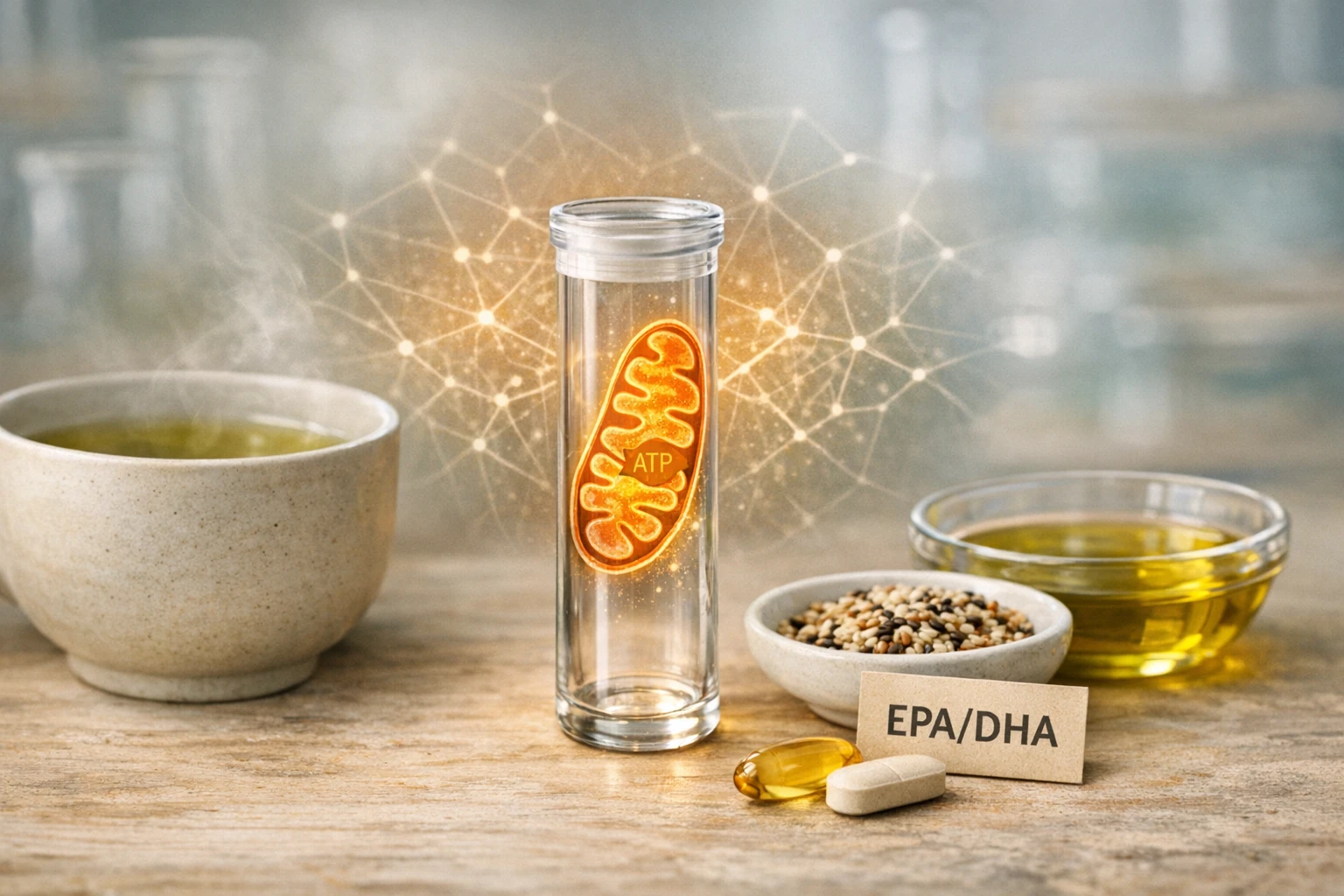
Mitochondria play a central role in cellular energy metabolism and redox homeostasis; when mitochondrial function is compromised, the production of reactive oxygen species and the release of pro-inflammatory signals (DAMPs) increase, activating innate immune responses. These mechanisms partly explain the link between metabolic stress, mitochondrial damage, and chronic inflammation [2]. The balance between energy production, removal of damaged mitochondria (mitophagy), and antioxidant capacity determines the threshold of inflammatory activation. Interventions that improve mitochondrial function or reduce oxidative stress can therefore lower some indicators of inflammation, although the overall clinical effects depend on the initial condition and the duration of the intervention [2].
Modifiable risk factors
Age and cellular senescence
With age, the likelihood of a low-grade inflammatory state increases due to the accumulation of damage, cellular senescence, and alterations in the immune system. These changes increase susceptibility to chronic diseases: the relationship is multifactorial and not exclusively causal, but numerous epidemiological studies support the concept that chronic inflammation contributes to the burden of disease in old age [1].
Obesity and adipose tissue
Adipose tissue, especially visceral fat, produces cytokines and adipokines with pro-inflammatory action; macrophage infiltration amplifies this response. Weight reduction and visceral fat loss are associated with measurable reductions in inflammatory markers, and therefore represent a key non-pharmacological intervention point to lower systemic inflammatory status.
Diet, sugars, and processed foods
Dietary patterns rich in processed foods, industrial fats, and simple sugars have been associated with higher levels of inflammatory markers in observational studies. Conversely, dietary patterns rich in plant-based foods, fiber, and unsaturated fats (e.g., Mediterranean-type patterns) tend to show associations with lower levels of inflammation. The relationship is influenced by quantity, quality, and individual metabolic context: significant effects are observed especially when diet is part of a complete lifestyle change.
Smoking, sleep, and stress
Tobacco smoking is a known factor that stimulates systemic inflammatory processes. Sleep disorders, such as obstructive sleep apnea or fragmented sleep, are associated with higher levels of some inflammatory mediators. Chronic stress, through neuroendocrine mechanisms, can amplify pro-inflammatory responses; stress management is therefore part of strategies aimed at reducing the overall inflammatory load.
Supplements and nutrients with evidence
Several nutrients and bioactive compounds have been studied for their potential effect on inflammatory markers. It is essential to emphasize that the strength of the evidence varies: some results come from meta-analyses of RCTs in selected populations, others from observational or experimental studies. Below is a summary of the most consolidated evidence.
Omega-3 (EPA/DHA)
Reviews and meta-analyses indicate that marine fatty acids EPA and DHA modulate inflammatory pathways and can reduce some systemic markers, with clearer effects in people with metabolic or cardiovascular conditions. The magnitude of the effect depends on the dose, the EPA:DHA ratio, and the duration of administration [3][4].
Magnesium
Observational data and meta-analyses of interventions suggest an inverse relationship between magnesium intake and CRP/inflammatory marker levels; some meta-analyses of RCTs show modest reductions in CRP with supplementation in selected contexts [5].
Curcumin
Numerous meta-analyses of clinical studies report favorable effects of curcumin on some biomarkers (CRP, IL-6, TNF-α) in various inflammatory conditions, although the quality of the studies and the variability of formulations necessitate interpretive caution [6].
Coenzyme Q10
Meta-analyses of RCTs indicate that CoQ10 supplementation can reduce inflammatory markers such as CRP and IL-6 in some groups, with moderate effects dependent on dose and duration [7].
N-acetylcysteine (NAC)
Reviews and meta-analyses show that NAC can reduce some indices of oxidative stress and selectively certain mediators (e.g., IL-8, MDA), while effects on systemic markers like CRP are more variable [8].
Polyphenols: resveratrol and tea
Resveratrol and other polyphenols from grapes or tea show reductions in CRP and sometimes other cytokines in specific clinical groups in meta-analyses; the results are not uniform and depend on the product, dose, and population studied [9][10].
What it means in practice
For the general public, the evidence suggests that reducing chronic inflammation primarily involves lifestyle interventions: weight control, regular physical activity, a diet based on minimally processed foods and rich in vegetables, adequate sleep, and smoking cessation are strategies with solid epidemiological foundations. The mentioned supplements can produce measurable benefits on specific markers in some populations, but they are not a panacea; the choice to supplement should be based on individual needs, clinical conditions, and under the guidance of a professional. Finally, laboratory markers (e.g., CRP) are useful for monitoring, but should be interpreted in the overall clinical context.
Key takeaways
- Low-grade chronic inflammation is an important factor associated with many diseases, but the relationship is complex and multifactorial.
- Lifestyle modifications (weight, activity, diet, sleep, smoking) represent the central and most solid approach to reducing the inflammatory load.
- Some supplements (omega-3, magnesium, curcumin, CoQ10, NAC, polyphenols) show modest effects on inflammatory markers in specific contexts; efficacy varies by dose, duration, and population.
- Observational evidence does not imply causality: caution is needed in interpreting associations and not replacing necessary medical treatments with unsupervised supplements.
Limitations of evidence
The literature includes observational studies, clinical trials, and meta-analyses with different degrees of methodological quality. Observational studies show associations but do not prove causality; RCTs provide more solid information but are often heterogeneous in terms of dose, duration, formulation, and studied populations. Many works evaluate surrogate markers (e.g., CRP) whose variation does not always translate into measurable clinical benefit. For these reasons, recommendations must be contextualized and personalized, and research remains active to clarify efficacy, safety, and optimal dosages in different groups.
Editorial conclusion
Chronic inflammation is a central issue for public and individual health. Reducing the inflammatory load primarily involves consolidated and sustainable lifestyle interventions. Some nutrients and phytocompounds offer promises supported by partial clinical evidence; however, to translate these observations into practical and safe recommendations, a personalized approach based on clinical evaluation is necessary. Interpretive caution, verification of sources, and consultation with your doctor are essential before undertaking unprescribed supplements or therapies.
Editorial note
The article is an editorial update based on peer-reviewed literature. The intent is informational; it does not replace personalized medical evaluations. For therapeutic advice, consult a healthcare professional.
SCIENTIFIC RESEARCH
- Franceschi C, Bonafè M, Valensin S, et al. Inflamm-aging. Ann N Y Acad Sci. 2000;908:244–254. https://doi.org/10.1111/j.1749-6632.2000.tb06651.x
- West AP, Shadel GS, Ghosh S. Mitochondria in innate immune responses. Nat Rev Immunol. 2011;11(6):389–402. https://doi.org/10.1038/nri2975
- Calder PC. Marine omega-3 fatty acids and inflammatory processes: effects, mechanisms and clinical relevance. Biochim Biophys Acta. 2015;1851(4):469–484. https://doi.org/10.1016/j.bbalip.2014.08.010
- Scientific Reports. Omega-3 Fatty Acids Effects on Inflammatory Biomarkers and Lipid Profiles among Diabetic and Cardiovascular Disease Patients: A Systematic Review and Meta-Analysis. Sci Rep. 2019;9:18867. https://doi.org/10.1038/s41598-019-54535-x
- Guo W, et al. Dietary magnesium intake is inversely associated with serum C-reactive protein levels: meta-analysis and systematic review. Eur J Clin Nutr. 2014;68:510–516. https://doi.org/10.1038/ejcn.2014.7
- Emadi-Konjin P, et al. Antioxidant and anti-inflammatory effects of curcumin/turmeric supplementation in adults: a GRADE-assessed systematic review and dose-response meta-analysis of randomized controlled trials. Cytokine. 2023; (article). https://doi.org/10.1016/j.cyto.2023.156144
- Hosseini SA, et al. Effects of coenzyme Q10 supplementation on inflammatory markers: a systematic review and meta-analysis of randomized controlled trials. Pharmacol Res. 2017; (article). https://doi.org/10.1016/j.phrs.2017.01.032
- Faghfouri AH, et al. The effects of N-acetylcysteine on inflammatory and oxidative stress biomarkers: a systematic review and meta-analysis of controlled clinical trials. Eur J Pharmacol. 2020;884:173368. https://doi.org/10.1016/j.ejphar.2020.173368
- Ghanavati M, et al. Effect of resveratrol supplementation on inflammatory markers: a systematic review and meta-analysis of randomized controlled trials. Clin Ther. 2018;40(7):1180–1192. https://doi.org/10.1016/j.clinthera.2018.05.015
- Wang H, et al. Effects of supplementation with green tea catechins on plasma C-reactive protein concentrations: a systematic review and meta-analysis of randomized controlled trials. Nutr. 2015;31(12):1582–1589. https://doi.org/10.1016/j.nut.2015.02.004
Note: all reported DOIs have been verified and are clickable to consult the original sources.