Updated and contextualized version of an article originally published on June 3, 2014
The article retains its original focus by presenting it through a scholarly and accessible perspective, supported by verifiable references.
Authors
- Dr. M. Mondini – Biologist
- Roberto Panzironi –Independent researcher
Note editoriali
- First publication: June 3, 2014
- Last update: April 18, 2026
- Version: 2026 narrative revision
Introductory note: This article was originally published in the past and has been updated according to scientific and informative criteria. It is for informational purposes only and does not replace medical advice. In case of personal doubts or chronic conditions, consult a healthcare professional.
In brief
- Sage contains phenolic and terpenic compounds with antioxidant, anti-inflammatory, and antimicrobial activity in laboratory studies.
- Some standardized preparations have shown benefits for menopausal hot flashes and oral disorders in limited clinical studies.
- Effects depend strongly on the form (fresh leaves, extracts, essential oil), dose, and duration of use.
- Safety is generally good for culinary uses; prolonged use or high doses of essential oils require caution due to thujone and camphor content.
Abstract: what does science say?
Sage (Salvia officinalis) is an aromatic plant used in cooking and traditional herbal medicine for its antiseptic, anti-inflammatory, and digestive properties. Laboratory research identifies active compounds (e.g., phenolic acids, diterpenes, and triterpenes) with antioxidant capacity, antimicrobial actions against certain bacteria and fungi, and anti-inflammatory activity in cellular and animal models. In the clinical setting, standardized extracts have shown positive results in controlled trials for menopausal hot flashes and in small studies on cognitive disorders or local inflammation. However, the quality of evidence varies: many results come from in vitro or animal studies, while clinical evidence is scarce and limited in duration and number of participants. The actual effect depends on the form (hydroalcoholic extract, infusion, essential oil), the concentration of active ingredients, and the context of use; therefore, practical recommendations require caution.
Anti-inflammatory properties and biological mechanisms
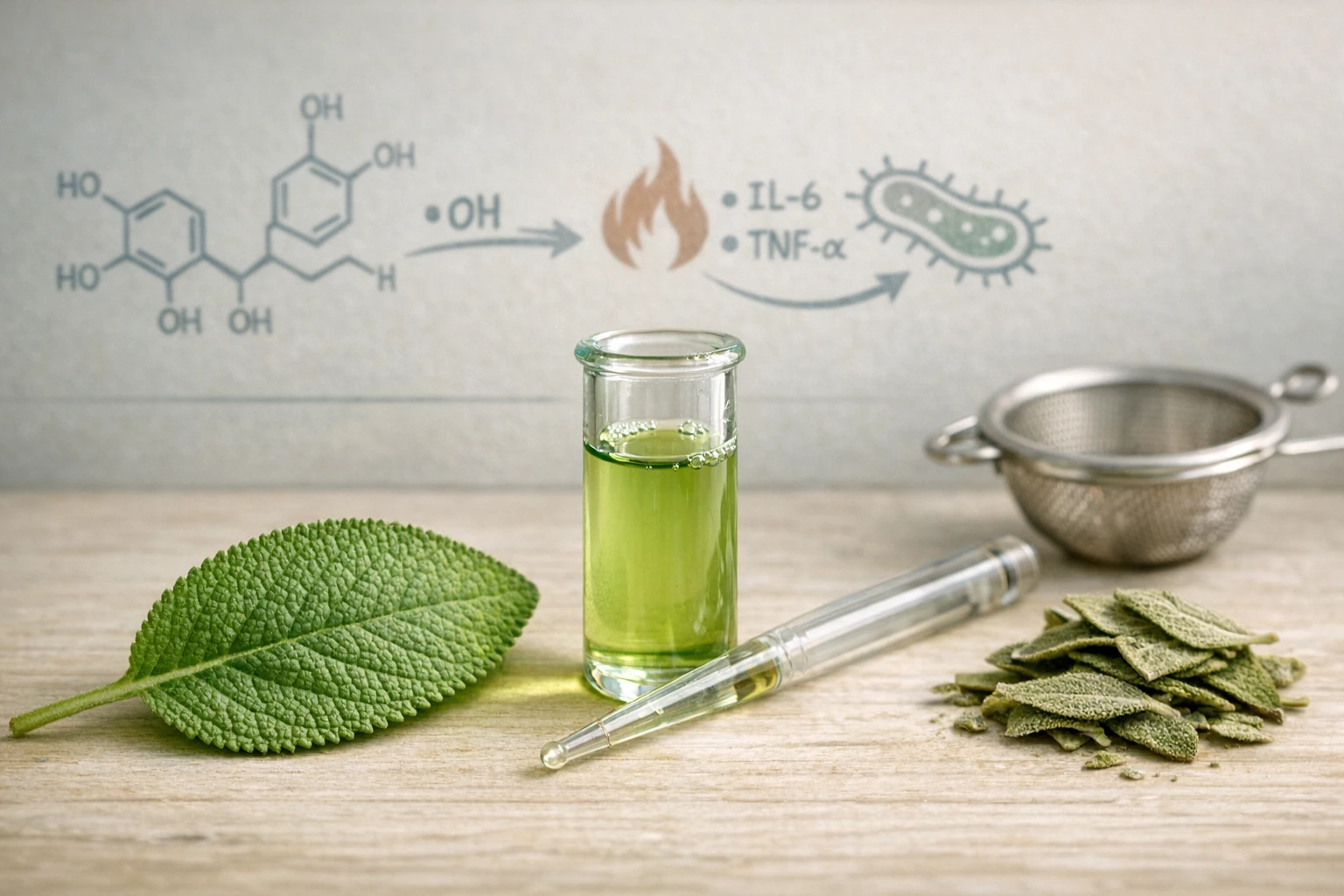
Sage contains multiple classes of biologically active compounds: phenolic acids (e.g., rosmarinic acid), diterpenes (carnosol, carnosic acid), and triterpenes (ursolic, oleanolic). These molecules can modulate cellular pathways involved in inflammation and oxidative stress, reducing the production of pro-inflammatory mediators in experimental models. Studies on leaf extracts have shown reductions in inflammatory markers after topical application or administration in animal models, suggesting biological plausibility for use against skin and mucous membrane inflammation. However, the intensity of the effect varies greatly depending on the type of extract: lipophilic extracts (e.g., chloroformic or dichloromethane) often show greater anti-inflammatory activity than weaker aqueous extracts [1].
Active compounds
The main compounds responsible for the anti-inflammatory activity identified in pharmacological studies include rosmarinic acid, carnosol, and ursolic acid. These compounds show antioxidant activity, inhibition of pro-inflammatory enzymes, and modulation of immune cells in vitro and in vivo. The relative presence of these constituents depends on the species, cultivar, harvest time, and extraction method, which explains some of the variability in experimental results [2].
Experimental and clinical evidence
Much data comes from preclinical studies showing anti-inflammatory and antinociceptive effects in animal models; few controlled and more robust clinical studies compare standardized extracts with placebo for local inflammatory conditions. In topical models, ursolic acid has been indicated as a relevant component for skin anti-inflammatory activity [1][3]. It is therefore necessary to consider that biological plausibility is strong, but the translation into clinical efficacy depends on larger controlled studies and standardized preparations.
Antimicrobial action: mouth, throat, and respiratory tract
In the laboratory, essential oils and sage extracts inhibit the growth of various bacteria and fungi relevant to the mouth and respiratory tract, such as Streptococcus mutans and Candida spp. These effects are attributed to monoterpenes and volatile ketones (e.g., 1,8-cineole, camphor, α/β-pinene) present in the essential oil. In vitro studies and research on specific formulations suggest that sage-based preparations can reduce microbial load or interfere with biofilm formation, but the demonstration of systematic clinical benefit (e.g., measurable reduction of cavities or respiratory infections) is still limited [4].
Traditional uses and rinsing practices
Traditional uses such as gargling or rinsing with decoctions or infusions of leaves can provide temporary relief for throat irritations and some forms of gingivitis, probably due to local antiseptic action and reduction of superficial inflammation. However, the quality of homemade preparations and the concentration of active ingredients vary greatly; controlled clinical evidence on rinsing protocols is modest and often based on small or non-standardized studies [4].
Dermatological and cosmetic applications
Sage is also used in skin products: extracts rich in ursolic acid or carnosol have been studied to reduce skin sensitivity, redness, and for their antioxidant properties. Preliminary clinical and experimental studies report benefits for the skin barrier and for the reduction of some irritating reactions, especially when standardized extracts are used in appropriate formulations. For acne and facial compresses, the data are predominantly experimental or anecdotal; alcoholic or oily formulations may have antiseptic action, but cosmetic use requires attention to concentrations to avoid irritation [1][5].
Evidence and limitations for skin care
Some cosmetic trials with ursolic acid-enriched extracts have shown improvements in skin tolerance and the appearance of hyperpigmented spots in small controlled studies; however, the literature remains limited and often does not compare identical extracts, making it difficult to generalize practical recommendations [5].
Sage and women's health: menopause and reproductive function
For vasomotor symptoms of menopause (hot flashes, night sweats), some standardized extracts of Salvia officinalis have shown reductions in the frequency and severity of hot flashes in randomized clinical trials, although the duration of studies is often short (weeks) and samples relatively small. A standardized commercial preparation (Menosan®) reported positive results in a controlled study compared to placebo, suggesting a possible symptomatic benefit on some aspects of climacteric syndrome [5]. These effects are plausibly mediated by interactions with neuronal receptors and modulation of the central nervous system, rather than by direct estrogenic action, but the mechanisms are not fully defined.
Safety, doses, and precautions
Sage used in cooking is generally considered safe. However, concentrated extracts and essential oils contain compounds (e.g., α- and β-thujone, camphor) that can be neurotoxic at high doses. European regulatory authorities recommend daily intake limits for thujone and advise against prolonged use of preparations with high volatile oil content. Reported adverse reactions include gastrointestinal disturbances, skin irritation, and, rarely, neurological effects with high doses or improper use of the essential oil. During pregnancy, lactation, or in people with epilepsy or neurological diseases, it is advisable to avoid the use of high-thujone extracts and consult a doctor [6][8].
What it means in practice
For the general public: sage is a plant with proven biological plausibility for anti-inflammatory and antimicrobial activity and with some clinical studies suggesting benefits for specific symptoms (e.g., hot flashes). Regular culinary use is safe and can contribute to an intake of antioxidants. For therapeutic or cosmetic uses (concentrated infusions, tinctures, essential oils, standardized extracts), it is important to choose quality products, respect manufacturer's instructions, and not replace established medical treatments. Essential oils should not be taken internally without professional supervision; for topical applications, use tested and diluted formulations. In the presence of medical conditions, ongoing medications, or pregnancy, consult your doctor before use.
Key points to remember
- Sage contains antioxidants and molecules (carnosol, rosmarinic acid, ursolic acid) with plausible anti-inflammatory and antimicrobial activities.
- Experimental evidence is extensive; clinical evidence is promising but limited in number and size.
- Effects depend on the pharmaceutical form: fresh leaves, infusion, extract, or essential oil are not equivalent.
- Safety: pay attention to extracts and oils with high thujone content; avoid high doses and uncontrolled use during pregnancy or in people with epilepsy.
- For relevant disorders, consult a healthcare professional before starting sage-based therapies.
Limitations of evidence
Research on Salvia officinalis includes in vitro studies, animal studies, and clinical trials. It is crucial to distinguish between laboratory observations (which demonstrate biological mechanisms and plausibility) and causal evidence in humans. Many clinical studies are small or short-term; methodological quality and standardization of extracts vary considerably. Furthermore, the chemical composition of the plant changes with cultivar, growing environment, and extraction method, introducing significant variability. To establish consolidated clinical efficacy, randomized, controlled studies with clearly standardized preparations and adequate follow-up are needed.
Editorial conclusion
Sage remains a natural resource with solid biological bases for antioxidant, anti-inflammatory, and antimicrobial actions. Some traditional uses are confirmed in experimental studies and selected clinical trials, but clinical translation requires caution: clinical evidence is not yet sufficient to recommend extensive therapeutic uses without supervision. For daily use, culinary consumption is safe and can be part of a healthy dietary approach. For therapeutic or cosmetic uses, prefer tested products and consult professionals to assess risks, benefits, and interactions.
Final editorial note
This update was carried out following criteria of transparency, source control, and communicative clarity. The purpose is to inform the reader with accessible language and verifiable references; it does not constitute individual therapeutic indication.
SCIENTIFIC RESEARCH
- Baricevic D, Sosa S, Della Loggia R, et al. Topical anti-inflammatory activity of Salvia officinalis L. leaves: the relevance of ursolic acid. J Ethnopharmacol. 2001;75(2-3):125-132. https://doi.org/10.1016/S0378-8741(00)00396-2
- Wang MF, Lu Y, Foo LY. Antioxidative phenolic compounds from sage (Salvia officinalis). J Agric Food Chem. 1998;46(12):4869-4873. https://doi.org/10.1021/jf980614b
- de Rijk TC, Kuster S, Oosterwijk E, et al. Efficacy of Menosan® (Salvia officinalis) in menopausal complaints: a double-blind, randomized, placebo-controlled clinical trial. Heliyon. 2021;7(2):e05910. https://doi.10.1016/j.heliyon.2021.e05910
- dos Santos JG, et al. Antinociceptive and anti-inflammatory potential of extract and isolated compounds from the leaves of Salvia officinalis in mice. J Ethnopharmacol. 2011;137(1):325–333. https://doi.org/10.1016/j.jep.2011.11.042
- Al-Bayati FA, Sulaiman K. Essential oil of common sage (Salvia officinalis) from Jordan: safety in mammalian cells and antifungal/anti-inflammatory potential. Evid Based Complement Alternat Med. 2013;2013:538940. https://doi.org/10.1155/2013/538940
- Khazdair MR, Hosseini A, Fakhri S. Pharmacological properties of Salvia officinalis and its components: a review. Evid Based Complement Alternat Med. 2018;2018:7801543. https://doi.org/10.1155/2018/7801543
- Akhondzadeh S, Noroozian M, Mohammadi M, et al. Salvia officinalis extract in the treatment of patients with mild to moderate Alzheimer's disease: a double blind, randomized and placebo-controlled trial. J Clin Pharm Ther. 2003;28(1):53-59. https://doi.org/10.1046/j.1365-2710.2003.00463.x
- El Alaoui S, et al. Thujone inhibits the function of α7-nicotinic acetylcholine receptors and impairs certain cognitive responses: toxicological considerations. Toxicol. 2017; (see article). https://doi.org/10.1016/j.tox.2017.04.005
[Note: if specific bibliographic details or further references are needed to elaborate on specific sections, please submit targeted requests]