Updated and contextualized version of an article originally published on June 29, 2014
The article retains its original focus by presenting it through a scholarly and accessible perspective, supported by verifiable references.
Authors
- Dr. A. Colonnese – Nutrition biologist
- Roberto Panzironi –Independent researcher
Note editoriali
- First publication: June 29, 2014
- Last update: April 20, 2026
- Version: 2026 narrative revision
Initial note: this article was originally published in the past and updated according to scientific and divulgative criteria. The purpose is informative: it does not replace medical advice. For clinical questions, consult your doctor.
IN BRIEF
- Turmeric (mainly its component curcumin) is the subject of research on cellular mechanisms relevant to cancer, particularly inflammation and proliferation signals.
- Extensive preclinical studies and some early-phase clinical trials are available, evaluating its safety, bioavailability, and potential as an adjuvant to chemotherapy.
- The oral bioavailability of curcumin is generally low; formulation strategies aim to improve it, with encouraging but not definitive preliminary results.
- Observational and experimental evidence suggests plausible biological effects; however, clinical proof of efficacy as an anticancer therapy is incomplete and requires further controlled trials.
Abstract: what does science say?
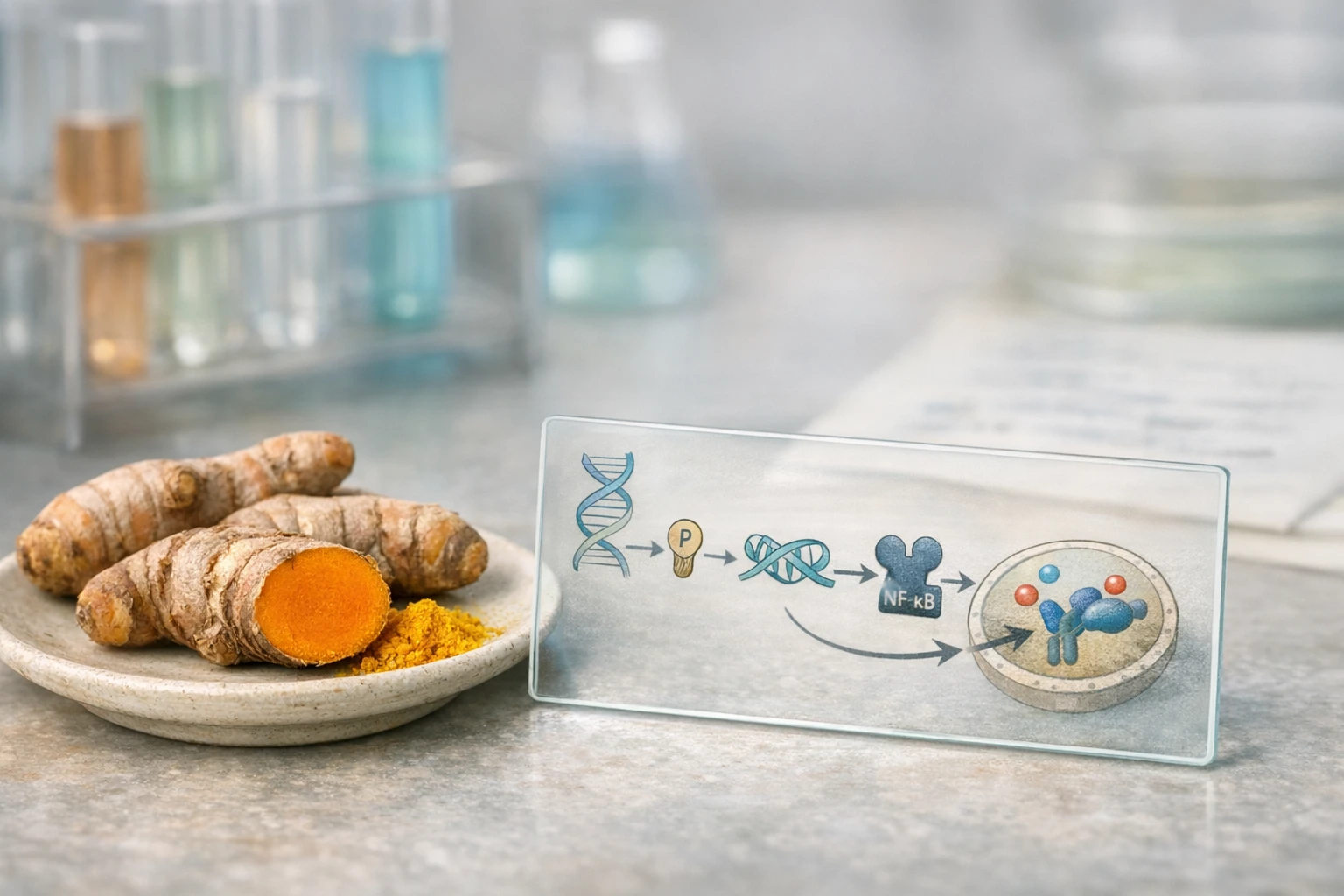
Turmeric (Curcuma longa) contains curcuminoids, substances studied for their anti-inflammatory, antioxidant, and modulating properties on cellular signaling pathways involved in tumor growth and survival. In vitro and animal model studies show that curcumin can interfere with pathways such as NF-κB, STAT3, and apoptosis pathways, as well as modulate oxidative stress and the microenvironment. In humans, early-phase trials have documented safety at relatively high doses and the presence of metabolites in digestive tissues; small clinical studies have also evaluated curcumin as an adjuvant to chemotherapy. The main limitations are the low systemic availability of the ingredient when taken orally, the heterogeneity of formulations and dosages studied, and the scarcity of large randomized trials on relevant clinical outcomes. Therefore, the literature supports biological plausibility and a potential adjuvant role, but does not allow definitive statements on anticancer therapeutic efficacy.
What it means in practice
For the general public, current evidence indicates that turmeric and curcumin have interesting and well-documented biological activities at the laboratory level and in animal models; these concern the reduction of inflammatory processes, the induction of cell death in tumor cell lines, and the modulation of metabolic pathways. However, "interesting" does not equate to "clinically effective" for cancer treatment. Some phase I-II clinical studies have verified that the use of curcumin is generally well-tolerated and that it can be safe when taken with chemotherapeutic agents in controlled settings, but benefits in terms of survival or reduction of progression need confirmation in larger, well-designed studies [4].
Studied forms and dosages
Research has used both turmeric food powders and standardized extracts (curcuminoids) and improved formulations (e.g., nanoparticles, phospholipid complexes). In human trials, dosages vary widely: from a few hundred milligrams per day up to several grams; high doses (several grams/day) have been safely tested in early-phase studies, but the absorbed amount and tissue concentrations often remain low without bioavailability-enhancing technologies [3][2].
Safety and interactions
In published trials, curcumin was generally well-tolerated; serious adverse effects are rare but not impossible, especially at very high doses or in the presence of drug interactions. Since curcumin can influence metabolic enzymes and possible inflammatory pathways, it is important for cancer patients to inform their oncologist before taking supplements during standard cancer therapies [3].
Key takeaways
- Biological plausibility exists: curcumin modulates molecular pathways relevant to inflammation and tumor growth, such as NF-κB. [1]
- Preclinical data are numerous and often consistent, but do not automatically translate into clinical efficacy.
- Early-phase clinical studies show safety at varying doses and some favorable signals as an adjuvant, but robust evidence on important outcomes (survival, remission) is lacking. [4]
- Oral bioavailability is a limitation; advanced formulations (nanoparticles, complexes) seek to improve tissue concentration. [7]
- Those undergoing cancer treatment should not independently start turmeric/curcumin-based supplements without consulting their doctor.
Limitations of the evidence
It is crucial to distinguish between different types of studies: in vitro and animal model data show plausible mechanisms of action and often anticancer effects; however, such studies do not prove clinical efficacy in humans. Observational studies may suggest associations between spice consumption or diet and disease risk, but are subject to confounding and do not establish causality. The available clinical studies are largely phase I/II or small RCTs and often differ in formulation, dose, and duration, reducing the possibility of robust synthesis. Furthermore, the low bioavailability of curcumin after oral intake limits the translation of in vitro results (where concentrations are much higher) into observable systemic effects in humans [3][2].
Methodological limitations and variability
Many trials have small sample sizes, surrogate or non-homogeneous endpoints, and different formulations that complicate comparison. Meta-analyses on inflammatory biomarkers show modest reductions in CRP, TNF-α, and IL-6, but with high heterogeneity between studies; therefore, interpreting these results as direct proof of anticancer efficacy would be inappropriate [8].
Editorial conclusion
Turmeric/curcumin represents an example of a natural substance with strong biological plausibility and a long series of preclinical studies documenting multiple cellular effects relevant to cancer. Clinical trials conducted so far support the hypothesis that the substance may be safe and, in some selected contexts, useful as an adjuvant; however, there is no definitive evidence that curcumin alone is an effective anticancer treatment. The useful path forward consists of randomized, well-sized clinical trials with standardized formulations and clinically relevant endpoints. In the meantime, the correct message for the public is caution: scientific interest and potential do not equate to therapeutic recommendation. Those taking or intending to take turmeric/curcumin-based supplements during cancer therapies should discuss this with their doctor to assess safety and possible interactions.
Editorial note
This article has been updated to reflect available peer-reviewed literature and to improve clarity and transparency. The information reported here does not constitute therapeutic indication. For personalized clinical information, consult a doctor or specialist.
SCIENTIFIC RESEARCH
- [1] The anti-inflammatory activity of curcumin is mediated by its oxidative metabolites. Journal of Biological Chemistry. DOI: https://doi.org/10.1074/jbc.RA117.000123.
- [2] Garcea G, Jones DJ, Singh R, et al. Detection of curcumin and its metabolites in hepatic tissue and portal blood of patients following oral administration. British Journal of Cancer (2004). DOI: https://doi.org/10.1038/sj.bjc.6601623.
- [3] Sharma RA, Euden SA, Platton SL, et al. Phase I clinical trial of oral curcumin: biomarkers of systemic activity and compliance. Clinical Cancer Research (2004). DOI: https://doi.org/10.1158/1078-0432.CCR-04-0744.
- [4] Howells LM, Iwuji COO, Irving GRB, et al. Curcumin combined with FOLFOX chemotherapy is safe and tolerable in patients with metastatic colorectal cancer in a randomized phase IIa trial. Journal of Nutrition (2019). DOI: https://doi.org/10.1093/jn/nxz029.
- [5] Effects and mechanisms of curcumin for the prevention and management of cancers: an updated review. Antioxidants (2022). DOI: https://doi.org/10.3390/antiox11081481.
- [6] A review of curcumin and its derivatives as anticancer agents. International Journal of Molecular Sciences (2019). DOI: https://doi.org/10.3390/ijms20051033.
- [7] Preclinical studies of the antitumor effect of curcumin-loaded polymeric nanocapsules: a systematic review and meta-analysis. Phytotherapy Research (DOI: https://doi.org/10.1002/ptr.7538).
- [8] Curcumin downregulates human tumor necrosis factor-α levels: a systematic review and meta-analysis of randomized controlled trials. Pharmacological Research (2016). DOI: https://doi.org/10.1016/j.phrs.2016.03.026.