Editorial Note
This article was originally published in the past and has been updated according to scientific and informative criteria to reflect recent knowledge and research. The text is for informational purposes only and does not replace the advice of a doctor or nutritionist. For personal clinical or nutritional decisions, professional consultation is recommended.
In brief
- The definition of "grass-fed" indicates cattle raised predominantly or exclusively on grass/forage during their life cycle; this affects the lipid profile and some micronutrients of the meat.
- Compared to meat from grain-finished animals, grass-fed meat tends to contain higher proportions of certain omega-3s and other compounds (e.g., some antioxidants), but the absolute content depends on the total fat quantity and the farming context.
- Production choices have multiple impacts: animal welfare and nutritional quality can improve with grazing, but environmental implications (emissions per kg of meat) are complex and depend on systems and practices.
- Available evidence is predominantly observational and experimental in animals: controlled human studies are needed to define effects on human health.
Abstract: what does science say?
Simple definition: "grass-fed meat" refers to meat from cattle fed primarily with grass and forage during the production cycle, without (or with minimal) grain supplementation for the finishing phase. This method can be practiced in different forms (extensive grazing, rotational grazing, seasonal supplementation).
What the available evidence shows
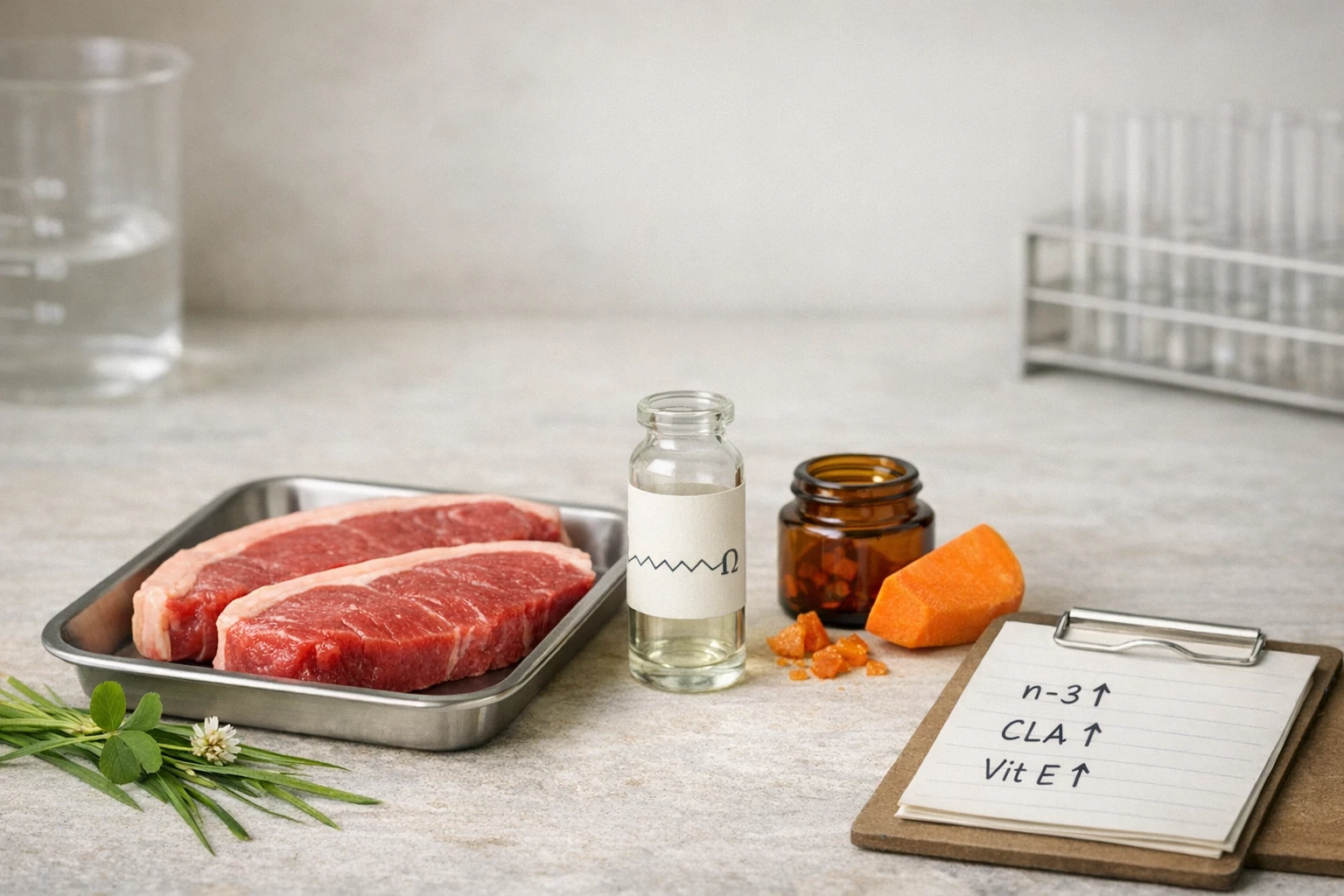
Comparative studies reveal consistent differences in fat profiles: meat from grazed animals tends to have a higher relative proportion of certain omega-3 fatty acids and conjugated linoleic acid (CLA) isomers, as well as higher levels of some fat-soluble antioxidants compared to grain-finished meat. However, many measurements express proportions (percentages within the fat) and the absolute content per serving depends on the total lipid quantity in the meat.
Factors influencing results
Nutritional profile varies by pasture plant species, grazing duration, animal breed, age at slaughter, and post-slaughter methods (e.g., aging). Seasonality and forage cultivation practices can modify the presence of carotenoids and vitamin E in animals, with implications for the meat.
Interpretive limitations
Most evidence comes from studies on the chemical composition of meat or animal studies; there are few randomized clinical trials on the effect of grass-fed meat consumption on long-term human health. Epidemiological data on cardiovascular health or cancer are sensitive to overall consumption quantity and frequency, not just the animal's finishing type.
Epidemiological framing
Compositional differences between grass-fed and grain-fed can be biologically plausible and nutritionally relevant, but do not automatically imply differences in health risk in the population: relevance depends on serving size, consumption frequency, and overall dietary context.
What it means in practice
For the consumer, the main information is that the type of farming modifies some components of the meat, but does not automatically transform the product into "healthy" or "unhealthy." Choosing grass-fed meat can be consistent with ethical goals or sensory preferences (flavor, texture), and can increase the intake of specific micronutrients or bioactive compounds per serving; however, the choice must fit into an overall dietary pattern that considers serving sizes and consumption frequency.
Consumption choices
If the goal is to increase certain short-chain omega-3s (e.g., ALA) or obtain meats with richer antioxidant profiles, grass-fed meat can contribute; however, for EPA/DHA intake, fish remains the primary source. Sensory quality (tender or firmer) also depends on aging: some grass-fed cuts may require longer aging times to achieve greater tenderness, as observed in artisanal practices and industry narratives.
Safety and residues
In extensive systems, the risk of routine antibiotic use is generally lower, but practices vary among farms. Some metabolomic studies have identified traces of metabolites related to pharmaceutical residues more often in meats from intensive systems; this does not automatically imply risk for the consumer but requires surveillance and traceability in the supply chain. [8]
Key points to remember
- "Grass-fed" primarily indicates the animal's diet type and predicts differences in fat profile and some micronutrients, not a guarantee of direct health effect.
- Grass-fed meats often show a higher proportion of certain omega-3s and CLA, but the nutritional value per serving depends on the total fat content. [2][3]
- Sensory quality and tenderness can vary: aging and cut affect the taste experience. (citation of technical practice and professional experiences)
- Environmental implications are not unequivocal: some LCAs show higher emissions per kg produced in pasture systems, while other benefits (animal welfare, soils) can be favorable; the evaluation depends on the parameters considered. [7]
- Evidence on direct human clinical effects is limited: nutritional recommendations should be based on the overall dietary pattern and not just the type of meat. [2]
Limitations of the evidence
The main limitations are related to the nature of the available studies. Many studies are chemical composition studies, experimental animal studies, or observational studies describing associations. Experimental animal studies show plausible mechanisms (e.g., effect of CLA or antioxidants on inflammatory processes), but direct translation to clinical outcomes in humans is uncertain. [6]
Common methodological problems: variability of farming protocols, differences in pasture plant species, seasonality, sample size, and lack of long-term randomized intervention studies in humans. In comparative literature on meat composition, relative percentages are often reported (e.g., % of total fatty acids) which do not always coincide with the absolute content per serving.
Finally, environmental assessments (LCAs) depend heavily on the functional unit used (kg of meat, kJ, or per protein unit), the time horizon, and the inclusion or exclusion of soil carbon sequestration; therefore, results are not always directly comparable between studies. [7]
Editorial conclusion
The choice of grass-fed meat can respond to ethical, organoleptic preferences and nutritional quality goals in relative terms: science indicates real differences in lipid profile and some micronutrients, but the relevance for public health depends on the overall dietary context and the quantities consumed. Environmental and animal welfare implications require multi-level assessments based on local production systems. For the informed consumer, it is useful to consider clear labels, traceable supply chain practices, and professional advice in case of specific clinical conditions.
Editorial Note
The article is updated with selected scientific references and verified DOIs to ensure transparency and traceability of sources. The information is provided for informational purposes: it does not constitute personalized clinical recommendations.
Scientific Research
- Mandell IB, et al. Effect of forage vs grain feeding on carcass characteristics. Journal of Animal Science. 1998;76(10):2619–2630. https://doi.org/10.2527/1998.76102619x
- Daley CA, et al. A review of fatty acid profiles and antioxidant content in grass-fed and grain-fed beef. Nutrition Journal. 2010;9:10. https://doi.org/10.1186/1475-2891-9-10
- Leheska JM, et al. Effects of conventional and grass-feeding systems on the nutrient composition of beef. Journal of Animal Science. 2008;86(12):3575–3585. https://doi.org/10.2527/jas.2007-0565
- Van Elswyk ME, McNeill SH. Impact of grass/forage feeding versus grain finishing on beef nutrients and sensory quality: the U.S. experience. Meat Science. 2014;96(1):535–540. https://doi.org/10.1016/j.meatsci.2013.08.010
- Realini CE, Duckett SK, Windham WR. Effect of vitamin C addition to ground beef from grass-fed or grain-fed sources on color and lipid stability. Meat Science. 2004;66(2):259–266. https://doi.org/10.1016/j.meatsci.2004.02.002
- Roche HM, et al. A conjugated linoleic acid-enriched beef diet attenuates lipopolysaccharide-induced inflammation in mice in part through PPARγ-mediated suppression of TLR4. The Journal of Nutrition. (Animal model study). https://doi.org/10.3945/jn.109.113035
- Pelletier N, Pirog R, Rasmussen R. Comparative life cycle environmental impacts of three beef production strategies in the Upper Midwestern United States. Agricultural Systems. 2010;103(6):380–389. https://doi.org/10.1016/j.agsy.2010.03.009
- Evans N, Cloward J, Ward RE, et al. Pasture-finishing of cattle in Western U.S. rangelands improves markers of animal metabolic health and nutritional compounds in beef. Scientific Reports. 2024;14:20240. https://doi.org/10.1038/s41598-024-71073-3