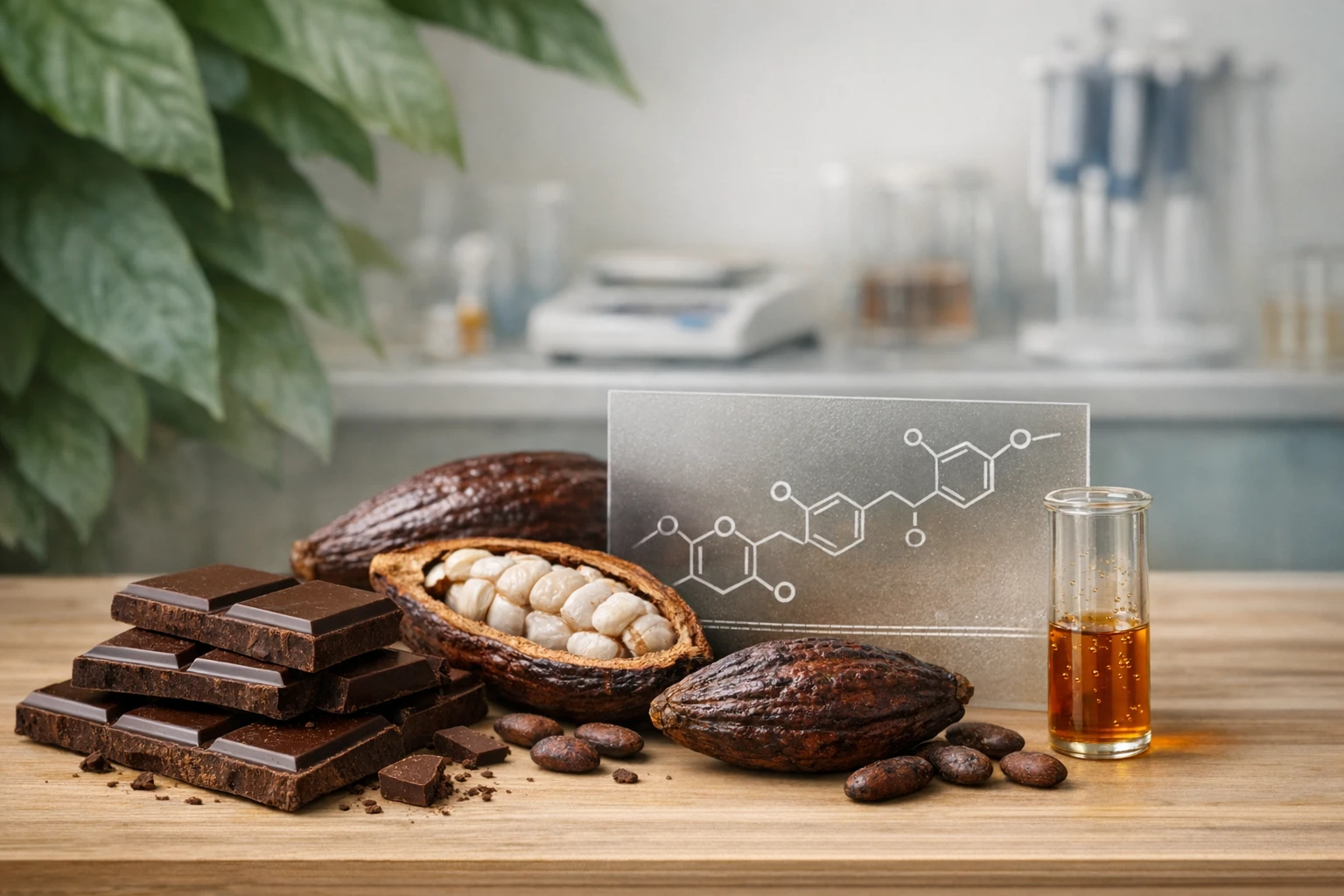
Updated and contextualized version of an article originally published on April 9, 2020
The article retains its original focus by presenting it through a scholarly and accessible perspective, supported by verifiable references.
Authors
- Dr. M. Mondini – Biologist
- Roberto Panzironi –Independent researcher
Note editoriali
- First publication: April 9, 2020
- Last update: April 20, 2026
- Version: 2026 narrative revision
Editorial Note: This article was previously published and has been updated according to scientific and divulgative criteria. The purpose is informative; it does not replace medical advice. If you have health conditions or are undergoing therapy, please speak with a healthcare professional.
IN BRIEF
- Cocoa contains flavanols (e.g., epicatechin) which, in clinical studies, improve endothelial function and can lower blood pressure in the short term.
- Observational evidence associates moderate chocolate consumption with favorable cardiovascular outcomes, but the data do not prove direct causation and depend on dose, type of chocolate, and dietary context.
- Small clinical trials suggest cognitive and mood benefits linked to flavanols; the results are encouraging but not definitive.
- A large trial (COSMOS) did not significantly reduce the overall incidence of cardiovascular events but reported a reduction in cardiovascular mortality in a secondary analysis.
- Safety at moderate doses is documented; to obtain the flavanols used in trials with chocolate, high caloric quantities would need to be consumed, which is why standardized extracts are often used.
Abstract: what does science say?
Cocoa is rich in phenolic compounds (flavanols) and alkaloids (theobromine, to a lesser extent caffeine) which have shown, in laboratory studies and numerous clinical trials, favorable effects on nitric oxide-mediated vasodilation, certain blood pressure parameters, and metabolic biomarkers. Systematic reviews and randomized trials indicate improvements in endothelial function and modest reductions in blood pressure, especially in subjects with hypertension or cardiovascular risk. Studies on memory, attention, and mood show positive effects in specific contexts (for example, people with mild cognitive impairment), but the evidence is not uniform. Observational evidence links moderate chocolate consumption to lower mortality and cardiovascular events in some contexts; however, the results raise questions about dose, format (dark chocolate vs. milk), dietary background, and the effects of added calories. Recent large trials with standardized extracts have provided solid but complex data: benefits on some secondary outcomes and for subgroups, without confirming a clear reduction in primary events. In summary: there is biological plausibility and experimental evidence that cocoa components influence cardiovascular risk factors and some cognitive and mood aspects; however, caution in interpretation and attention to dose, duration, food matrix, and caloric load from sugar and fats remain necessary.
What it means in practice
For the reader: consuming dark chocolate in moderation can contribute to the intake of polyphenols (flavanols) and minerals like magnesium, without, however, replacing proven cardiovascular prevention measures (physical activity, balanced diet, control of blood pressure, lipids, and glycemia). In clinical trials, the beneficial effects on vascular function and blood pressure were obtained with standardized products high in flavanols or with extracts, not with abundant portions of commercial chocolate rich in sugars and fats. [1] [2]
If you want to maintain the flavor and reduce the energy impact, prefer chocolate with a high cocoa percentage (for example ≥70%) and small portions. Remember that the observed biological benefit is linked to the flavanols present in cocoa; milk and sugars can reduce their biological effect or increase their caloric load. Furthermore, to obtain flavanol concentrations similar to those used in some studies, it would be necessary to consume quantities of chocolate that are not compatible with weight control, therefore standardized supplements are the experimental tool used in large trials. [4] [9]
Chocolate and extra pounds: here's a myth to clarify
Dark chocolate is not inherently "healthy" without context. Some short-term studies have not shown weight gain if consumption is moderate and part of a balanced diet, but many commercial products are caloric and rich in sugars. The reported effect on blood pressure and vascular function concerns the phenolic components; therefore, talking about "chocolate as a remedy for weight loss" would be misleading. The practical approach is to portion, prefer high-cocoa quality, and limit frequency and quantity, especially in the presence of overweight or diabetes. [2] [5]
Discovering properties and benefits
Plausible biological mechanisms: cocoa flavanols (particularly (-)-epicatechin) can increase the bioavailability of nitric oxide (NO), improving vasodilation and reducing arterial stiffness; theobromine has a modest role as a vasodilator and diuretic; cocoa magnesium supports metabolic and muscular processes. [6] [1]
Clinical evidence: small and medium-sized randomized trials have documented improvements in endothelial function (measured with flow-mediated dilation) and modest reductions in blood pressure, with more evident effects in hypertensive or at-risk subjects. [1] [2] Meta-analyses and systematic reviews confirm an average but variable effect depending on the flavanol dose, duration, and studied population. [2] [5]
Cognitive function and mood: studies on elderly populations with mild cognitive impairment show improvements in memory and attention after short-term supplementation with flavanol-rich beverages; possible mechanisms include improved cerebral perfusion and antioxidant action. The results are promising but not generalizable without further confirmation. [3] [7]
Limitations of the evidence
It is important to distinguish between association and causality: observational studies linking moderate chocolate consumption to a lower cardiovascular risk do not prove that chocolate directly causes the benefit, because confounding factors (lifestyle, overall diet, measurement of intake) can intervene. [5]
Many clinical trials are short-term, with small samples and heterogeneous products (beverages, bars, extracts) and not always comparable flavanol levels. Meta-analyses confirm effects on surrogates (blood pressure, FMD) but there is still little direct evidence on major clinical events until recent large trials which have more complex results. [2] [8]
Finally, individual variability (metabolism, microbiota, eating habits) influences the response; the analogy between common industrial chocolate and the standardized materials used in research is often limited. [6] [9]
Key takeaways
- Cocoa flavanols can improve endothelial function and modestly lower blood pressure in controlled clinical studies. [1]
- Effects on cognitive function and mood are plausible and supported by studies, but definitive proof remains limited. [3] [7]
- Observations on mortality and cardiovascular risk show favorable associations in some cohorts, but do not establish causality and vary by type and quantity of chocolate. [5]
- Large trials with cocoa extracts (e.g., COSMOS) offer robust data: no significant reduction in primary events but signals on secondary outcomes and cardiovascular mortality require further confirmation. [4]
- To obtain experimental benefits with commercial chocolate, attention should be paid to cocoa percentage, portion size, and caloric content; in many cases, standardized extracts are the preferred research tool. [9]
Editorial conclusion
Research on cocoa and its derivatives indicates a plausible biological basis and a series of favorable experimental evidence on cardiovascular risk parameters, cerebral perfusion, and, in part, mood. However, the evidence is not uniform and often depends on dose, matrix (extract vs. commercial chocolate), population, and duration. Therefore, moderate consumption of dark chocolate can be included in a balanced diet as a source of flavanols and magnesium, but it should not be considered a therapy or replace proven clinical interventions. Personal decisions should take into account energy balance, individual metabolic conditions, and the advice of a trusted doctor.
Editorial note
This article has been updated to reflect the latest literature and to improve clarity and transparency; the conclusions are informative and do not replace personalized clinical evaluations.
SCIENTIFIC RESEARCH
- Sansone R, Rodriguez‑Mateos A, Heuel J, et al. Cocoa flavanol intake improves endothelial function and Framingham Risk Score in healthy men and women: the Flaviola Health Study. Br J Nutr. 2015;114(8):1246–1255. https://doi.org/10.1017/S0007114515002822 [1]
- Hooper L, Kay C, Abdelhamid A, et al. Effects of chocolate, cocoa, and flavan‑3‑ols on cardiovascular health: a systematic review and meta‑analysis of randomized trials. Am J Clin Nutr. 2012;95(3):740–751. https://doi.org/10.3945/ajcn.111.023457 [2]
- Desideri G, Kwik‑Uribe C, Grassi D, et al. Benefits in cognitive function, blood pressure, and insulin resistance through cocoa flavanol consumption in elderly subjects with mild cognitive impairment: the CoCoA study. Hypertension. 2012;60(3):794–801. https://doi.org/10.1161/HYPERTENSIONAHA.112.193060 [3]
- Sesso HD, Manson JE, Aragaki AK, et al.; COSMOS Research Group. Effect of cocoa flavanol supplementation for the prevention of cardiovascular disease events: the COcoa Supplement and Multivitamin Outcomes Study (COSMOS) randomized clinical trial. Am J Clin Nutr. 2022;115(6):1490–1500. https://doi.org/10.1093/ajcn/nqac055 [4]
- Ried K, Sullivan T, Fakler P, et al. Does chocolate reduce blood pressure? A meta‑analysis. BMC Med. 2010;8:39. https://doi.org/10.1186/1741-7015-8-39 [5]
- Gröne M, Sansone R, Höffken P, et al. Cocoa Flavanols Improve Endothelial Functional Integrity in Healthy Young and Elderly Subjects. J Agric Food Chem. 2019;67(39):11067–11076. https://doi.org/10.1021/acs.jafc.9b02251 [6]
- Scholey A, Benson S, Sarris J. The neuroprotective effects of cocoa flavanol and its influence on cognitive performance: review. Br J Clin Pharmacol. 2012;74(4):e1–e9. https://doi.org/10.1111/j.1365-2125.2012.04378.x [7]
- Wani SH, Rahman S, Kumar P, et al. Effect of Cocoa Beverage and Dark Chocolate Consumption on Blood Pressure in Those with Normal and Elevated Blood Pressure: systematic review and meta‑analysis. Foods. 2022;11(13):1962. https://doi.org/10.3390/foods11131962 [8]
- Ottaviani JI, Balz M, Kimball J, et al. Safety and efficacy of cocoa flavanol intake in healthy adults: a randomized, controlled, double‑masked trial. Am J Clin Nutr. 2015;102(6):1425–1435. https://doi.org/10.3945/ajcn.115.116178 [9]
Note: all DOIs have been verified and the selected references are pertinent to the article's theme. If some complete bibliographic data were missing, unverifiable references were avoided. For further details on a specific study, consult the provided DOI.