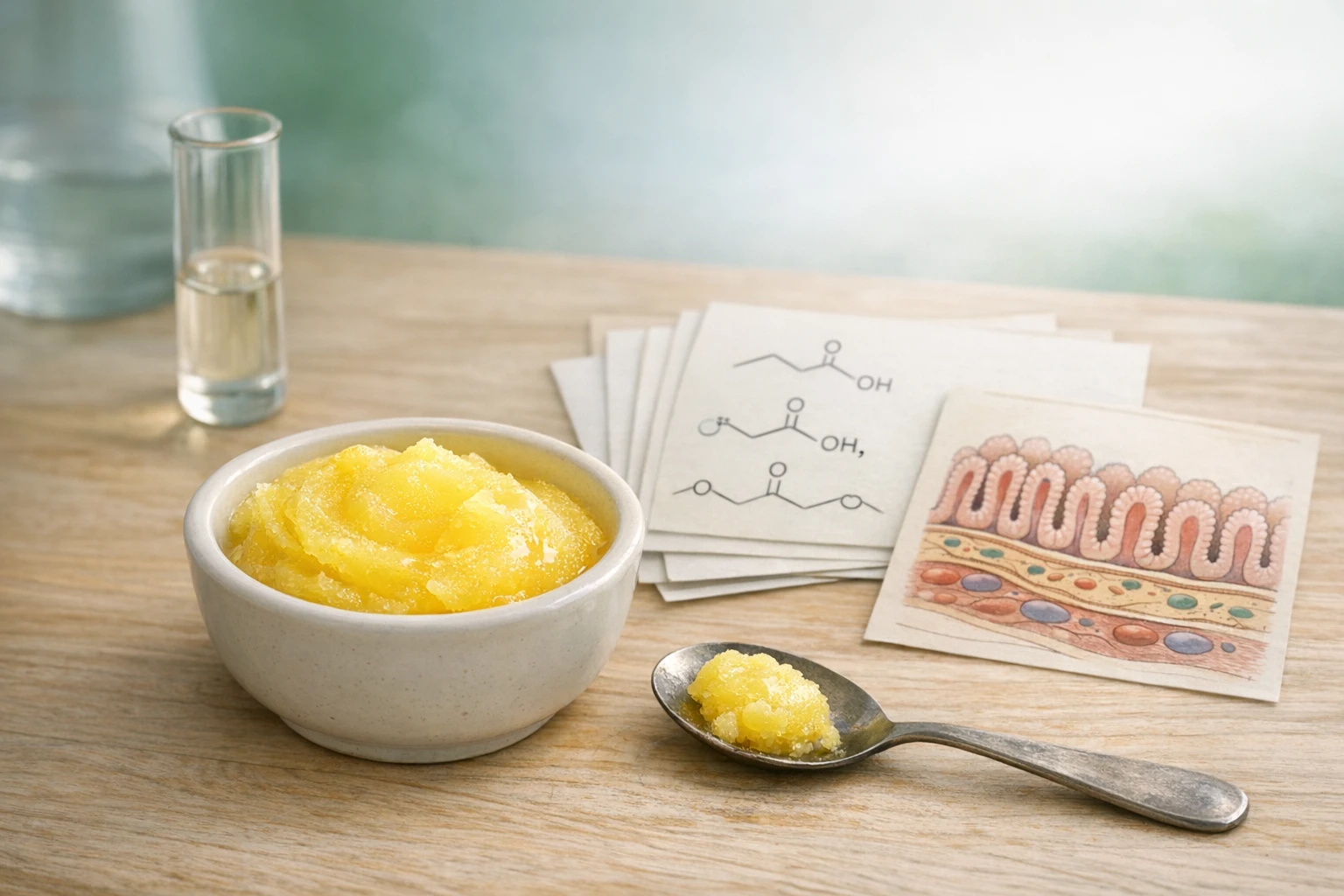
Updated and contextualized version of an article originally published on May 21, 2020
The article retains its original focus by presenting it through a scholarly and accessible perspective, supported by verifiable references.
Authors
- Dr. M. Mondini – Biologist
- Roberto Panzironi –Independent researcher
Note editoriali
- First publication: May 21, 2020
- Last update: April 20, 2026
- Version: 2026 narrative revision
Editorial note: This article was previously published and has been updated according to scientific criteria and for clarity in public communication. It is for informational purposes only and does not replace medical advice.
IN BRIEF
- Clarified butter (ghee) is butter from which water and protein residues have been removed: it is almost pure dairy fat and can be used for cooking at high temperatures.
- It contains compounds found in milk fat, including some forms of vitamin K2 and fatty acids that can nourish the gut; its quality and composition vary with the raw material and production method.
- Epidemiological and experimental evidence on cardiovascular and metabolic health is complex and conflicting: some observational studies do not show a clear risk associated with dairy fats, while trial reviews suggest benefits when the reduction of saturated fatty acids is replaced with polyunsaturated fats.
- In cooking, ghee has a higher smoke point than common butter; it is gluten-free and, if properly processed, contains negligible amounts of lactose and casein.
Abstract: what does science say?
Clarified butter (ghee) is a traditional product derived from butter by removing water and milk solids. Modern research describes ghee as a concentrated source of milk lipids that may contain forms of vitamin K2 proportional to its lipid content and traces of fatty acids with potential effects on the gut microbiota. Observational evidence on the relationship between dairy fats and cardiovascular disease is heterogeneous; some analyses show no strong associations, while trial reviews indicate that reducing the proportion of saturated fats, especially by replacing them with polyunsaturated fats, can reduce cardiovascular events. Experimental data suggest that dairy products can contribute to the production or support of beneficial gut metabolites (e.g., butyrate), but the clinical effect depends on the dose, food matrix, and overall dietary context. Limitations include the prevalence of observational studies, the variability of products (artisanal vs. industrial ghee), and the lack of specific, long-term clinical trials on ghee.
Origin, composition, and production
Clarified butter, known as ghee in South Asian tradition, is obtained by separating the fat fraction from the aqueous and protein components of butter. Traditional processing involves cooking butter until the water evaporates and milk proteins settle; the final product is an almost pure fat with minimal moisture. Recent literature comparing ghee from different geographical areas and extraction methods shows variations in fatty acid composition, the presence of antioxidants, and physicochemical properties [1].
From a nutritional perspective, ghee is predominantly composed of triglycerides of saturated and monounsaturated fatty acids, with small variations related to the animal species (cow, buffalo, yak) and preparation method. Modern analytical studies have also measured different contents of minor compounds — for example, carotenoids, CLA (conjugated linoleic acid), and natural antioxidants — which depend on the animal's diet and milk fermentation before processing [1].
Clarification and differences from butter
Clarification removes water and milk solids (casein and lactose), producing a product with less thermal instability than unclarified butter. This characteristic increases the smoke point and reduces foam formation during cooking. However, the complete elimination of proteins depends on the process: some industrial and artisanal processes leave small traces of residues that can affect the sensory profile and tolerability in people very sensitive to casein or lactose [1].
Nutrients and compounds of biological interest
In addition to the lipid matrix, the milk fat concentrated in ghee can contain forms of vitamin K2 (menaquinones) and short-chain or medium-chain fatty acids in variable amounts. Quantitative research on dairy products has shown that the presence of menaquinones is more relevant in high-fat products, suggesting that ghee, like other animal fats, can contribute to the dietary intake of some forms of K2 [2].
Ghee is not a primary source of fermentable fiber; however, some short or intermediate fatty acids derived from lipid metabolism can indirectly influence the gut microbiota. The literature on gut metabolites highlights the central role of butyrate (butyric acid) for colonic mucosal health: butyrate is mainly produced by the fermentation of indigestible carbohydrates (fiber) by the microbiota; the direct role of ghee in increasing butyrate production is indirect and depends on the overall diet and microbial composition [3].
Nutritional properties and micronutrients
Ghee provides concentrated energy and fat-soluble vitamins linked to fat (A, D, E, and forms of K). The presence of menaquinones in dairy fat is documented and can contribute to vitamin K status in individuals with regular consumption of dairy products [2]. However, the actual amount of vitamin K2 depends on the type of product, treatment, and quantity consumed: levels in ghee are not uniform and require direct measurements to establish relevant dietary intake.
Evidence on cardiovascular health and metabolism
The relationship between saturated fats and cardiovascular risk is a widely studied but complex topic. Prospective analyses and meta-analyses of observational cohorts have yielded variable results: some meta-analyses of cohorts found few strong associations between overall saturated fat consumption and the risk of cardiovascular events, while other analyses and reviews of clinical trials suggest that reducing saturated fats replaced with polyunsaturated fats can reduce cardiovascular events [5][6].
Specifically for dairy products, recent meta-analyses and reviews indicate a non-uniform picture: the consumption of butter or other dairy products does not always show clear associations with increased cardiovascular risk in observational analyses, but the effect may depend on the dietary context and the nutrients replaced in the diet [7]. This means that the relevance of ghee for cardiovascular health depends on the quantity consumed, frequency, and, above all, what is replaced in the diet.
Epidemiological and clinical interpretation
The most robust evidence evaluating clinical outcomes comes from controlled trials that reduce overall saturated fats; these trials show benefits when the reduction is replaced by polyunsaturated fats. Observational studies on ghee or dairy fats are useful for generating hypotheses but do not establish causality, as they are subject to confounding from diet and lifestyle [6][5].
Role for the gut and butyric acid
Butyrate and other short-chain fatty acids have a well-established role in colonic health: they provide energy for colonocytes, contribute to barrier function, and modulate the mucosal immune response. Most of the butyrate present in the gut is produced by the fermentation of indigestible carbohydrates (fiber) by the microbiota; the direct role of ghee in increasing butyrate production is indirect and depends on the overall diet and microbial composition [3].
Recent reviews and experimental studies report that interventions aimed at increasing SCFA production or administering butyrate can improve some intestinal inflammatory markers and sometimes symptoms in selected conditions. A randomized trial on butyrate supplementation documented favorable effects on inflammatory parameters and clinical scores in patients with active ulcerative colitis, suggesting a possible role for therapeutic support in specific contexts [4].
Limitations and areas of uncertainty
It is important to emphasize that most of the evidence on the effect of butyrate comes from experimental studies or interventions with specific preparations (e.g., microencapsulated oral butyrate), not from the intake of ghee as a single food. Therefore, the direct attribution of beneficial intestinal effects to ghee consumption remains plausible but not directly and generally proven [3][4].
Use in cooking, smoke point, and safety
One of the most cited practical reasons for preferring ghee in cooking is its relatively high smoke point compared to unclarified butter: the removal of water and protein residues increases the thermal stability of the fat and reduces the risk of organoleptic burning at moderate frying temperatures [1]. For this reason, ghee is often used in high-temperature cooking techniques, but the quality of the product and the degree of clarification influence cooking behavior.
From a food safety perspective, properly prepared and stored ghee is stable at room temperature for longer periods than fresh butter; however, the presence of residues, exposure to oxygen, and artisanal production practices can lead to the formation of lipid oxidation and undesirable volatile compounds. For those with severe lactose intolerance or milk protein allergy, it is necessary to check the composition of the individual product as traces of casein or lactose may persist in incompletely clarified products [1][8].
Practical cooking tips
For high-temperature uses, ghee can be a useful choice for thermal stability; for cold seasoning or to supplement fat-soluble vitamins, the unheated version preserves sensitive compounds. Moderation remains the rule: ghee is a calorie-dense source and should be included in a balanced dietary context.
What it means in practice
For a reader interested in incorporating it into their diet: ghee is a concentrated fat with some compositional peculiarities compared to butter. It can be used for cooking at higher temperatures without the product burning immediately, and it can contribute to the intake of fat-soluble vitamins when consumed as part of a varied diet. However, there is no convincing evidence that ghee is a panacea or a universal remedy: the benefits depend on the quality of the product, the quantities consumed, and the rest of the diet.
If the main concern is cardiovascular health, evidence-based clinical recommendations suggest considering the effect of caloric substitution: reducing excess saturated fats and replacing them with polyunsaturated fats may be more effective than simply removing ghee from the diet. For those with digestive disorders or inflammatory bowel conditions, strategies based on fiber, probiotics, and approaches aimed at SCFA production show stronger direct evidence than isolated ghee consumption [6][3][4].
Key takeaways
- Ghee is butter deprived of water and milk solids; it is a concentrated fat and heat-stable.
- It contains lipid compounds and, in some cases, forms of vitamin K2 proportional to the fat content.
- Observational evidence on dairy products and cardiovascular risk is heterogeneous; dietary context and nutrient replacement are crucial.
- Butyrate and other SCFAs are important for intestinal health, but the specific role of ghee in their modulation is not directly proven.
- For those with milk protein allergy, it is necessary to check for the presence of protein residues in individual products.
Limitations of the evidence
It is essential to distinguish between study types and the strength of evidence. Observational studies can identify associations but not establish causality; they are subject to residual confounding and imprecise dietary measurement. Meta-analyses and randomized trials provide stronger evidence, but many dietary trials have practical limitations: short duration, difficulty in dietary control, and multiple food substitutions. Furthermore, the variability in ghee production (artisanal vs. industrial), milk quality, and overall diet makes it difficult to generalize results to all populations. For all these reasons, recommendations must be cautious and contextualized to the individual profile and total diet [5][6][1].
Editorial conclusion
Clarified butter is a traditional food with well-defined technical and nutritional characteristics: it is a concentrated fat, heat-stable, and potentially a source of fat-soluble compounds such as some forms of vitamin K2. Modern scientific research describes plausible effects on metabolic processes and intestinal health, but the proof of direct clinical benefits from ghee consumption is incomplete and conditioned by many factors. For those who wish to use it, the choice can be acceptable if made in moderation, incorporating it into an overall balanced diet and taking into account individual clinical conditions. For specific questions or chronic conditions, it is advisable to consult a doctor or a nutrition professional.
EDITORIAL NOTE
This text is an updated version of a previously published article. The update was based on peer-reviewed research and editorial guidelines for transparency and verifiability. The content is for informational purposes; it does not constitute therapeutic indication or replace personalized clinical advice.
SCIENTIFIC RESEARCH
- Oliver‑Simancas N, et al. Study on physicochemical properties, fatty acids, texture, antioxidant and antibacterial activities of ghee from different regions. Journal of Dairy Science. 2023. https://doi.org/10.3168/jds.2023-23300 [1]
- Fu X, Harshman SG, Shen X, Haytowitz DB, Karl JP, Wolfe BE, Booth SL. Multiple Vitamin K Forms Exist in Dairy Foods. Current Developments in Nutrition. 2017;1(6):e000638. https://doi.org/10.3945/cdn.117.000638 [2]
- Zhang Z, Zhang H, Chen T, et al. Regulatory role of short‑chain fatty acids in inflammatory bowel disease. Cell Communication and Signaling. 2022;20:64. https://doi.org/10.1186/s12964-022-00869-5 [3]
- Firoozi D, Masoumi SJ, Hosseini Asl SM‑K, et al. Effects of Short Chain Fatty Acid‑Butyrate Supplementation on the Disease Severity, Inflammation, and Psychological Factors in Patients With Active Ulcerative Colitis: A Double‑Blind Randomized Controlled Trial. Journal of Nutrition and Metabolism. 2025;2025:3165876. https://doi.org/10.1155/jnme/3165876 [4]
- Siri‑Tarino PW, Sun Q, Hu FB, Krauss RM. Meta‑analysis of prospective cohort studies evaluating the association of saturated fat with cardiovascular disease. American Journal of Clinical Nutrition. 2010;91(3):535‑546. https://doi.org/10.3945/ajcn.2009.27725 [5]
- Hooper L, Martin N, Jimoh OF, et al. Reduction in saturated fat intake for cardiovascular disease. Cochrane Database of Systematic Reviews. 2020;Issue 8. https://doi.org/10.1002/14651858.CD011737.pub3 [6]
- Mozaffarian D, et al. Is Butter Back? A Systematic Review and Meta‑Analysis of Butter Consumption and Risk of Cardiovascular Disease, Diabetes, and Total Mortality. PLoS ONE. 2016;11(6):e0158118. https://doi.org/10.1371/journal.pone.0158118 [7]
- Yajnik CS, et al. Docosahexaenoic acid content is significantly higher in ghrita prepared by traditional Ayurvedic method. Journal of Ayurveda and Integrative Medicine. 2014. https://doi.org/10.4103/0975-9476.131730 [8]