Updated and contextualized version of an article originally published on October 22, 2020
The article retains its original focus by presenting it through a scholarly and accessible perspective, supported by verifiable references.
Authors
- Dr. M. Bitonti – Biologist
- Roberto Panzironi –Independent researcher
Note editoriali
- First publication: October 22, 2020
- Last update: April 18, 2026
- Version: 2026 narrative revision
Initial note
This article has been previously published and updated according to scientific and informative criteria. The purpose is informational: it does not replace medical advice. For personalized advice, consult a healthcare professional.
IN BRIEF
- High-oleic sunflower oil is rich in oleic acid (a monounsaturated fat) and has a different lipid composition than traditional sunflower oil.
- Compared to conventional sunflower oil, it shows greater resistance to oxidation during high-temperature cooking, but it is not immune to degradation if repeatedly reused.
- Enriching the lipid profile with more monounsaturated fats can modestly improve some biomarkers (e.g., HDL), but evidence on clinical cardiovascular events is complex and depends on what is replaced in the diet.
- Degradation products formed at high temperatures also exist with high-oleic oils; the final quality depends on the oil's composition, the antioxidants present, and the method of use.
Abstract: what does science say?
High-oleic sunflower oil is a variant that contains a high proportion of oleic acid (monounsaturated) and fewer polyunsaturated acids like linoleic acid. This composition increases its chemical stability during storage and cooking compared to high-linoleic sunflower oils. Laboratory studies and work on frying processes show less formation of certain oxidative products compared to oils rich in polyunsaturated fats, while still allowing for degradation at high temperatures and with prolonged use. Clinically, increasing monounsaturated fats in the diet can improve some lipid profiles (e.g., HDL), but the effect on cardiovascular outcomes depends on the dietary context and the type of intervention; the literature includes observational studies, trials, and meta-analyses with not always consistent results. In summary, high-oleic oil is interesting for its stability and for some biomarkers, but it should be considered within the overall framework of diet and cooking methods.
Composition and chemical characteristics
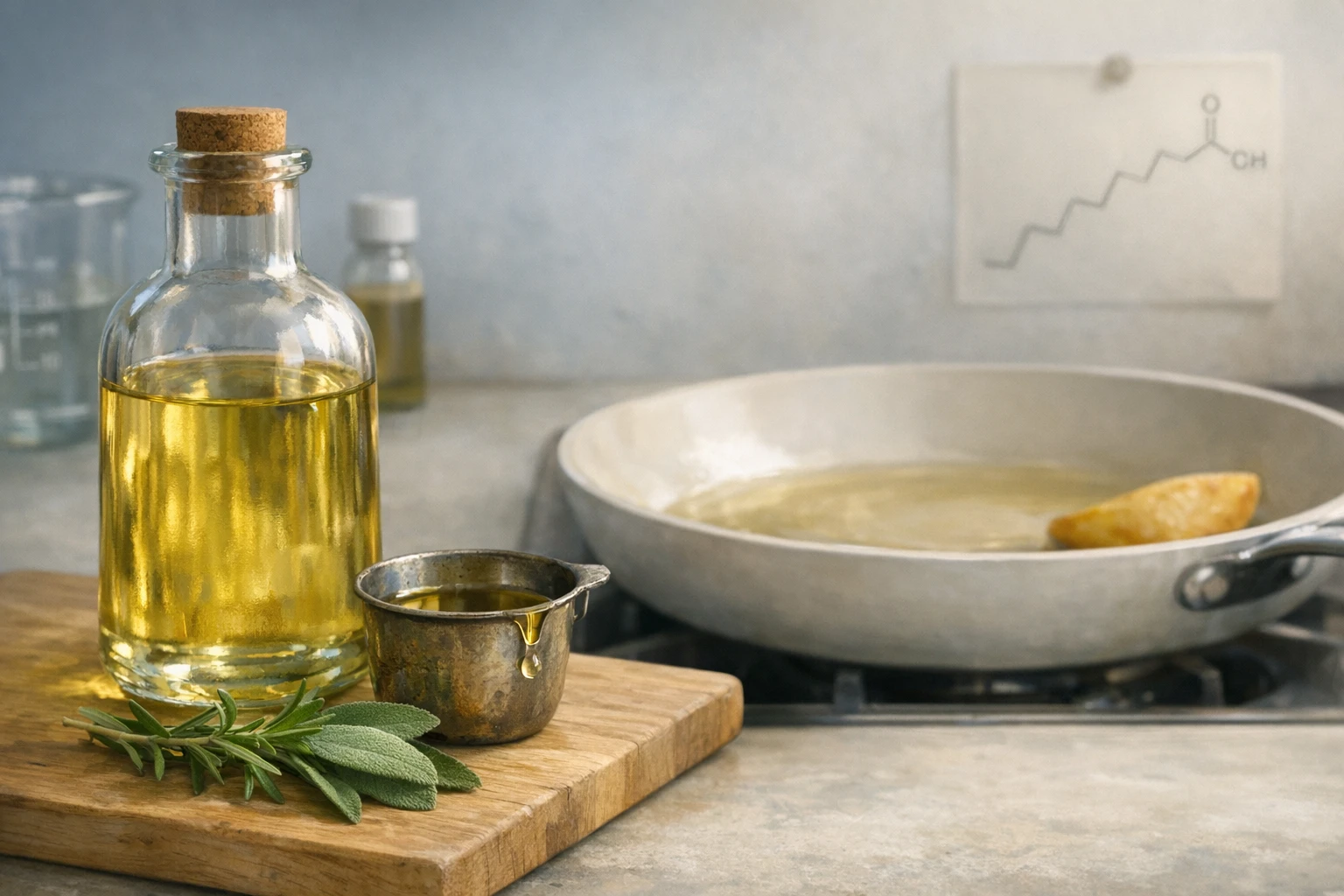
High-oleic sunflower oil is defined by a high percentage of oleic acid (C18:1) compared to traditional sunflower oils, in which linoleic acid (C18:2) predominates. This difference makes the oil more similar, in terms of its fat fraction, to other monounsaturated oils like olive oil. Oleic acid is a monounsaturated fatty acid (omega-9) which, structurally, has only one double bond; this makes it less susceptible to oxidation than polyunsaturated fatty acids, which have more double bonds and are therefore more reactive with oxygen. Modern cultivars and industry process the seed to obtain variable oleic acid fractions (usually between 70% and 90% in the high-oleic version), and during refining, natural antioxidants or vitamin E can be added to increase shelf life. However, fatty acid composition is only one of the factors influencing quality, stability, and nutritional impact: the presence of minor compounds (tocopherols, phenols, triterpenes), the refining process, and storage and cooking conditions also matter [3].
Thermal stability and use in cooking
The higher proportion of oleic acid makes high-oleic oil more resistant to thermal oxidation than oils rich in polyunsaturated acids. Laboratory experiments and frying simulation studies show that, under the same conditions, high-oleic oils accumulate peroxides, aldehydes, and other degradation products more slowly than conventional sunflower oil and other polyunsaturated oils [1][2]. However, stability is not unlimited: degradation increases with heat exposure time, oxygen quantity, impurities present, and repeated reuse of the oil. Furthermore, the residual linoleic acid content, the presence of vitamin E, and the composition of tocopherols influence the useful life during frying [2]. Experimental studies on real frying processes document that high-oleic oil, while remaining among the most stable options, still accumulates carbonyl products and oxidative compounds over time: the frequency of oil changes and temperature control are therefore fundamental practical elements to limit the formation of potentially harmful substances [3].
Smoke point and interpretations
The smoke point is a practical but not exhaustive measure of stability: a higher smoke point indicates that the oil produces smoke at higher temperatures, but it does not quantify the rate of oxidation or the formation of toxic products over time. High-oleic oils tend to have smoke points comparable to or higher than many refined seed oils, which makes them more suitable for frying than traditional sunflower oil; however, laboratory studies always recommend limiting heat exposure time and avoiding repeated reuse without filtration or regeneration of the oil [1][2].
Frying: what experimental studies say
Analyses conducted on simulated frying cycles show that high-oleic oil maintains its fatty acid profile better than many linoleic-rich oils and generates smaller quantities of peroxides and aldehydes in the early stages of use [1][3][7]. However, with prolonged use without replacement, even high-oleic oils accumulate oxidative products and can form compounds that require toxicological evaluation. In summary: they are a more stable choice, but safety depends on cooking practices.
Metabolic and cardiovascular impact
From a nutritional perspective, increasing the proportion of monounsaturated fats (such as oleic acid) in the diet instead of saturated fats can lead to improvements in lipid biomarkers, particularly a modest increase in HDL and favorable changes in triglycerides in some clinical and dietary contexts. Meta-analyses of clinical studies report positive effects on lipid composition when the substitution is isocaloric and MUFA is the main component of the substitution [4]. However, the relationship between MUFA consumption and the clinical risk of cardiovascular events is complex: observational analyses and systematic reviews show heterogeneous results depending on the type of study, the measure of exposure (dietary intake vs. circulating biomarkers), and the nutritional substitution made in the diet [5][6]. A consolidated line of evidence comes from studies that consider the replacement of energy from saturated fats with unsaturated fats (particularly PUFA), with a reduction in coronary risk in some trials; the direct comparison of MUFA vs PUFA remains a subject of debate and depends on practical substitution choices [8].
Safety: oxidation, degradation products, and limits
During high-temperature cooking, various products derived from the oxidation and decomposition of triglycerides are formed: peroxides, volatile aldehydes, polymers, and, in some cases, trans fatty acids. Analytical studies on high-oleic oil document a lower initial formation of some oxidative products compared to linoleic-rich oils, but with prolonged exposure, high-oleic oils also show an accumulation of potentially toxic carbonyl compounds [3][7]. The presence of natural antioxidants (tocopherols, rosemary extracts, and similar) can slow down degradation, but it does not completely eliminate the phenomenon. From a public health perspective, the main recommendation derived from the evidence is to limit the frequency of consumption of heavily fried foods, reduce the reuse of oil, and control cooking temperature: these measures reduce exposure to products derived from lipid degradation. Finally, the effect on health also depends on the overall diet and what nutrients are replaced with high-oleic oil [3][1][2].
What it means in practice
For the consumer interested in domestic and daily use, some operational, non-prescriptive conclusions emerge from the evidence: 1) high-oleic sunflower oil is a sensible choice if you are looking for a more stable seed oil for occasional frying or oven cooking; 2) it is not a "philosopher's stone": safety depends on the methods of use — temperature, time, and amount of reuse — and the antioxidants present in the formulation; 3) from a nutritional point of view, the increase of monounsaturated fats in the diet can improve some lipid biomarkers, but it does not automatically guarantee a reduction in cardiovascular risk if the rest of the diet is poor in protective elements or rich in saturated fats and refined sugars; 4) for raw seasoning, extra virgin olive oil remains the choice with the most evidence on overall health effects, particularly when considering minor phenolic compounds that are not present in refined seed oils; 5) if high-oleic oil is used for frying, prioritize short cooking times, avoid repeated reuse, and filter or replace the oil as needed [2][3][4].
Key points to remember
- High-oleic oil is rich in oleic acid (MUFA) and, compared to traditional sunflower oil, offers greater resistance to oxidation during cooking.
- It is useful for occasional frying, but the final quality depends on how and how much the oil is used.
- Modifying the diet by increasing MUFA can improve some biomarkers (e.g., HDL), but the effects on clinical outcomes depend on the context and the type of energy substitution.
- The presence of natural antioxidants and proper kitchen management (temperature, time, replacement) reduce the formation of degradation products.
Limitations of the evidence
Available evidence includes food chemistry studies, laboratory frying experiments, short-term clinical trials, and observational studies on diet-disease relationships. Each category has specific limitations: laboratory studies describe chemical processes but cannot alone define clinical effects; controlled clinical trials are often short-term or evaluate biomarkers instead of clinically relevant clinical events; observational studies can show associations but do not prove causality due to possible confounders and imprecise measures of dietary exposure. Meta-analyses and systematic reviews report sometimes conflicting results, partly because the effects depend on what is replaced in the diet (e.g., MUFA instead of SFA or carbohydrates) and the overall quality of the diet [4][5][6][8]. For these reasons, any interpretation requires caution and contextualization.
Editorial conclusion
High-oleic sunflower oil is a product with chemical and technological characteristics that make it interesting in cooking and for some nutritional profiles. Its high proportion of oleic acid improves thermal stability compared to traditional sunflower oil and can positively affect some lipid biomarkers when it replaces saturated fats. However, clinical evidence on long-term outcomes is nuanced: much depends on what is replaced in the diet, cooking practices, and the overall dietary context. For safe and sensible consumption, it is appropriate to consider its limitations: moderation, temperature control, limiting oil reuse, and incorporating the product into an overall balanced diet. Individual nutritional decisions should be discussed with a healthcare professional when personalized advice is needed.
Editorial note
This text updates a previous article and integrates scientific evidence published in peer-reviewed literature. The update has respected criteria of transparency, clarity, and verifiable references. It does not represent therapeutic indication nor does it replace clinical consultation.
SCIENTIFIC RESEARCH
- Dobarganes MC, Marquez‑Ruiz G, Perez‑Camino MC. Thermal stability and frying performance of genetically modified sunflower seed (Helianthus annuus L.) oils. J Agric Food Chem. 1993;41(4):678–681. https://doi.org/10.1021/jf00028a033
- Barrera‑Arellano D, et al. Frying stability of high oleic sunflower oils as affected by composition of tocopherol isomers and linoleic acid content. Food Chem. 2013;141(3):2129–2136. https://doi.org/10.1016/j.foodchem.2013.05.061
- Chen J, et al. Changes in the Quality of High‑Oleic Sunflower Oil during the Frying of Shrimp (Litopenaeus vannamei). Foods. 2023;12(6):1332. https://doi.org/10.3390/foods12061332
- Cao Y, et al. The Effect of MUFA‑Rich Food on Lipid Profile: A Meta‑Analysis of Randomized and Controlled‑Feeding Trials. Foods. 2022;11(13):1982. https://doi.org/10.3390/foods11131982
- Harris WS, et al. Circulating Fatty Acids and Risk of Coronary Heart Disease and Stroke: Individual Participant Data Meta‑Analysis in Up to 16 126 Participants. J Am Heart Assoc. 2020;9:e013131. https://doi.org/10.1161/JAHA.119.013131
- Hooper L, et al. Association of dietary, circulating, and supplement fatty acids with coronary risk: a systematic review and meta‑analysis. Ann Intern Med. 2014;160(6):398–406. https://doi.org/10.7326/M13-1788
- Guil‑Guerrero JL, et al. Contribution to Further Understanding of the Evolution of Sunflower Oil Submitted to Frying Temperature in a Domestic Fryer: Study by 1H Nuclear Magnetic Resonance. J Agric Food Chem. 2009;57(18):8544–8551. https://doi.org/10.1021/jf900510k
- Mozaffarian D, Micha R, Wallace S. Effects on Coronary Heart Disease of Increasing Polyunsaturated Fat in Place of Saturated Fat: A Systematic Review and Meta‑Analysis of Randomized Controlled Trials. PLoS Med. 2010;7(3):e1000252. https://doi.org/10.1371/journal.pmed.1000252
Note: where literature data were used, only sources with verifiable DOI and relevant to the topic were included. If any essential contextual element is missing, it is indicated in the text with the placeholder [missing information].