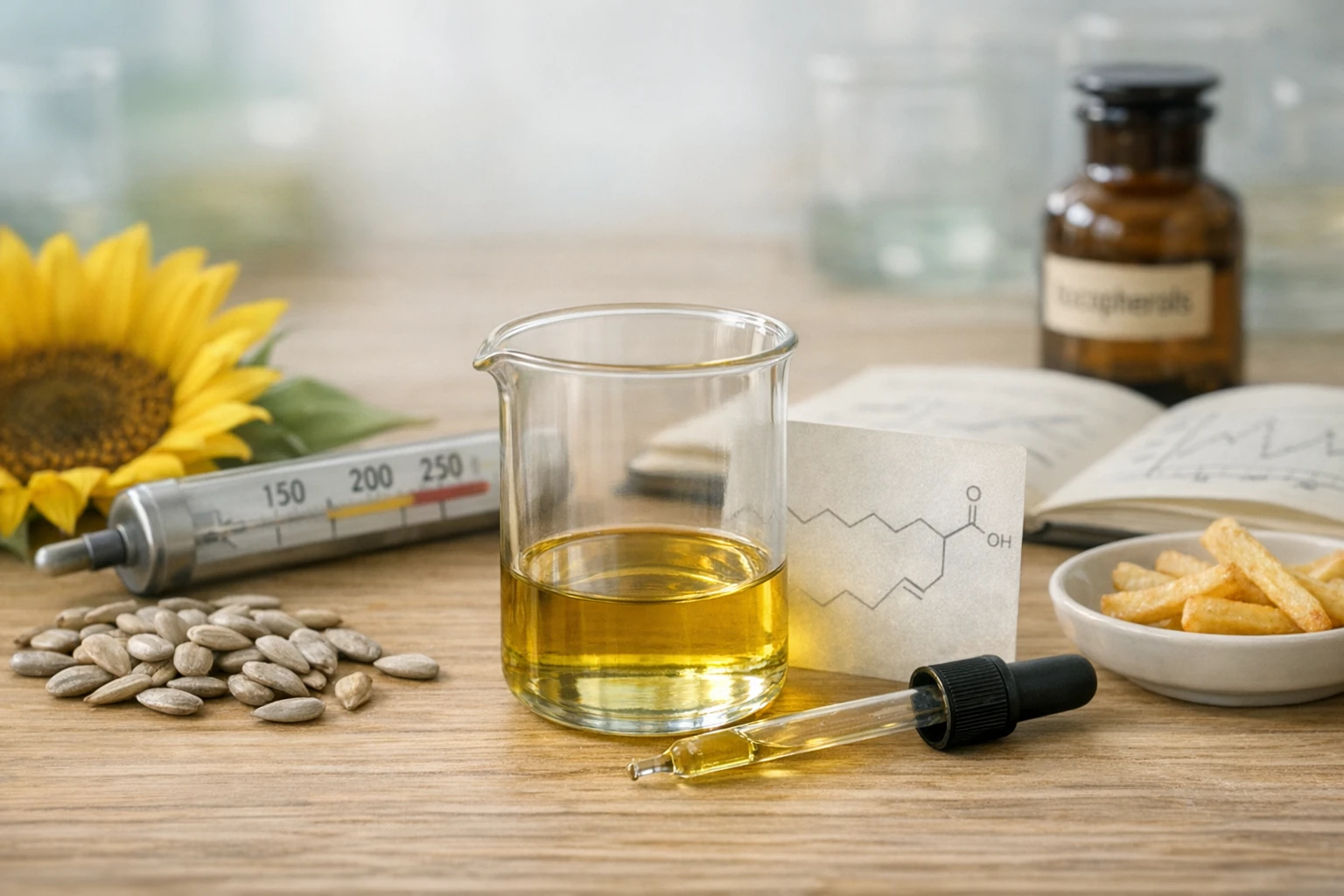
Updated and contextualized version of an article originally published on February 24, 2021
The article retains its original focus by presenting it through a scholarly and accessible perspective, supported by verifiable references.
Authors
- Dr. D. Iodice – Biologist
- Roberto Panzironi –Independent researcher
Note editoriali
- First publication: February 24, 2021
- Last update: April 18, 2026
- Version: 2026 narrative revision
Initial note: this article was previously published and has been updated according to scientific and informative criteria. It is for informational purposes only and does not replace personalized medical advice.
IN BRIEF
- "High oleic" sunflower oil is a variant with a high proportion of oleic acid (monounsaturated fat), which increases its thermal stability compared to traditional sunflower oil.
- For frying, greater stability reduces the rate at which oxidation products form; however, safety depends on temperature, time, food type, and oil reuse.
- Evidence on metabolic effects (cholesterol, glycemia) is consistent with known mechanisms of monounsaturated fats: they promote a more favorable lipid profile if they replace saturated fats in the diet.
- The presence of tocopherols (vitamin E) and phytosterols varies by variety and refining process and contributes to the oil's preservation and nutritional value.
- Limitations: much information comes from in vitro chemical stability studies and nutritional trials on biomarkers; interpret with caution and within the context of the overall diet.
Abstract: what does science say?
High-oleic sunflower oil is a type obtained from selected varieties that contain a higher percentage of oleic acid compared to conventional sunflower. From a chemical point of view, this composition reduces the polyunsaturated fraction susceptible to thermal oxidation, increasing heat resistance and delaying the formation of degradation compounds during frying. Experimental evidence shows that, under controlled cooking conditions (adequate temperature, limited reuse), these oils degrade less rapidly than oils rich in linoleic acid. Metabolically, replacing saturated fats with monounsaturated fats (such as oleic acid) is associated with improvements in the lipid profile; however, the translation into a reduction in cardiovascular events depends on the overall dietary context and doses. Natural antioxidants (tocopherols) present in the seeds can contribute to stability and nutritional value, but the content varies by variety and refining process. The main limitations concern the variability of experimental frying protocols, the different composition among commercial products, and the prevalence of studies on biomarkers rather than long-term clinical outcomes. In summary: biological plausibility and laboratory data support a functional role of high-oleic oil in more stable frying and in food choices that replace saturated fats with unsaturated fats; however, consumer choice must be guided by correct cooking practices and a balanced dietary framework.
Main section
Definition and composition
High-oleic sunflower oil comes from sunflower seeds selected to contain a high proportion of oleic acid (C18:1), a monounsaturated fatty acid. Compared to conventional sunflower oil, which is richer in linoleic acid (C18:2, polyunsaturated), high-oleic has fewer double bonds susceptible to oxidative attack. This chemical characteristic translates into greater resistance to heat and oxidation processes during both storage and cooking. The micronutrient profile includes tocopherols (vitamin E) and phytosterols: their concentration depends on variety, agronomic conditions, and processing. The predominance of monounsaturated fats structurally resembles some aspects of olive oil, albeit without the polyphenols typical of extra virgin olive oil.
Smoke point, cooking stability, and production of harmful compounds
The fatty acid composition influences the smoke point and stability at high temperatures. Laboratory studies on simulated frying cycles show that high-oleic oils resist degradation longer before accumulating degradation products compared to high-linoleic sunflower oils or other polyunsaturated oils [1]. Similar results, controlling temperature and time, confirm greater thermal stability and less formation of secondary oxidation compounds [2]. Volatile compounds like acrolein are formed by the degradation of unsaturated chains, particularly from intermediates derived from hydroperoxides of polyunsaturated fatty acids; isotopic studies have clarified the chemical pathways leading to acrolein formation during oil heating [3]. Measurements under domestic frying conditions show that concentrations of volatile aldehydes vary greatly depending on the type of oil, temperature, and number of reuses: oils with a high polyunsaturated fraction tend to produce higher acrolein emissions if not managed correctly [4][5].
Biological mechanisms and plausibility of cardiovascular and metabolic effects
From a metabolic perspective, oleic acid modifies the composition of plasma lipoproteins and can reduce the total/HDL ratio and LDL cholesterol when it replaces saturated fats in the diet. Meta-analyses of controlled trials and intervention studies suggest that replacing saturated fatty acids with unsaturated fats (cis-MUFA or PUFA) improves lipid biomarkers [6]. Evidence from trials that increase the proportion of unsaturated fats compared to saturated fats suggests reductions in cardiovascular risk when the replacement is consistent and maintained over time [7]. Randomized clinical trials of intermediate duration (e.g., interventions replacing SFA with MUFA) show improvements in lipids and some blood pressure markers, but direct evidence of event reduction requires longer studies contextualized within the overall diet [8].
Practical section
How to use high-oleic sunflower oil in cooking
To leverage the stability advantages of high-oleic oil, some simple practical rules must be followed: maintain the frying temperature within the recommended range (generally 160–180 °C for most home frying), avoid overheating to the smoke point, and limit reusing the oil for multiple cycles without filtration and control. Simulated frying studies indicate that, under the same operating conditions, high-oleic oil accumulates fewer polar compounds and aldehydes compared to varieties richer in linoleic acid [1][2]. However, the final quality also depends on how the oil is treated: filtration after use, storage away from light and oxygen, and using dry foods reduce the degradation rate.
Dietary choices and dietary context
From a nutritional perspective, high-oleic oil is not a "cure" but a choice that can fit into a dietary pattern where saturated fats are limited and vegetables, whole grains, legumes, and fruit are adequately present. Replacing saturated fats with unsaturated fats (including MUFAs like oleic acid) is consistent with nutritional recommendations for reducing cardiovascular risk [6][7]. In daily practice, this means preferring dressings based on unsaturated vegetable oils and limiting the regular consumption of preparations rich in saturated fats.
KEY POINTS TO REMEMBER
- The high oleic acid content makes the oil more stable at high temperatures compared to traditional sunflower oil.
- Stability reduces, but does not eliminate, the formation of degradation compounds: temperature, time, and reuse are decisive.
- Replacing saturated fats with monounsaturated fats can improve the lipid profile; the effect on cardiovascular events depends on the overall diet and duration of exposure.
- Tocopherols (vitamin E) present in the oil contribute to antioxidant protection but vary between products.
- For safer frying: control the temperature, do not let the oil smoke visibly, filter and store the oil correctly if reusing it rarely.
Limitations of the Evidence
It is important to distinguish between study types and methodological limitations. Much of the evidence on oil stability comes from laboratory experiments and simulated frying tests that measure chemical parameters (polar compounds, aldehydes, peroxide values), which are useful for assessing oxidation resistance but not directly equivalent to clinical outcomes on human health [1][2]. Evidence on metabolic effects comes from controlled trials on biomarkers (total cholesterol, LDL, HDL, triglycerides) and meta-analyses: these are robust for mechanisms of lipid profile modification but less definitive regarding the reduction of major events when fat replacement is partial or temporary [6][7]. Other limitations include the variability in the commercial composition of oils, differences in the refining process and the presence of natural antioxidants, and variability in the frying protocols used in different studies. For these reasons, practical recommendations must balance experimental results with the overall dietary framework and caution in the repeated use of oil for prolonged frying.
Editorial Conclusion
High-oleic sunflower oil represents a valid option among vegetable oils: its composition promotes greater stability at high temperatures and, when used correctly, can reduce the formation of degradation compounds compared to high-linoleic versions. From a nutritional perspective, replacing saturated fats with monounsaturated fats is consistent with guidelines for promoting a more favorable lipid profile. However, there are no magic bullets: cooking choices (temperature and oil management), product quality, and overall diet remain crucial. Using high-oleic oil in an informed and moderate way is the most prudent strategy to combine taste and reduce chemical risk during frying.
Editorial note
This summary is updated according to criteria of evidence and transparency. The information is not intended to replace personalized medical or nutritional advice. For clinical insights, consult a healthcare professional.
SCIENTIFIC RESEARCH
- Aladedunye F, Przybylski R. Frying stability of high oleic sunflower oils as affected by composition of tocopherol isomers and linoleic acid content. Food Chemistry. 2013;141:2373–2378. https://doi.org/10.1016/j.foodchem.2013.05.061
- Smith SA, King RE, Min DB. Oxidative and thermal stabilities of genetically modified high oleic sunflower oil. Food Chemistry. 2007;102:1208–1213. https://doi.org/10.1016/j.foodchem.2006.06.058
- Girotti S, et al. Isotope‑labeling studies on the formation pathway of acrolein during heat processing of oils. Journal of Agricultural and Food Chemistry. 2014; (Isotope‑labelling study). https://doi.org/10.1021/jf501527u
- Chen YC, et al. Determination of acrolein in french fries by solid‑phase microextraction GC‑MS. Journal of Chromatography A. 2011; (method for acrolein measurement). https://doi.org/10.1016/j.chroma.2010.11.068
- Comparative studies on the generation of acrolein and aroma compounds during deep‑frying with different edible fats and oils. ACS Symposium Series. 2012. https://doi.org/10.1021/bk-2012-1098.ch009
- Mensink RP, Zock PL, Kester AD, Katan MB. Effects of dietary fatty acids and carbohydrates on the ratio of serum total to HDL cholesterol: a meta‑analysis of 60 controlled trials. Am J Clin Nutr. 2003;77(5):1146–1155. https://doi.org/10.1093/ajcn/77.5.1146
- Mozaffarian D, Micha R, Wallace S. Effects on coronary heart disease of increasing polyunsaturated fat in place of saturated fat: a systematic review and meta‑analysis of randomized controlled trials. PLoS Med. 2010. https://doi.org/10.1371/journal.pmed.1000252
- Replacement of saturated with unsaturated fats had no impact on vascular function but beneficial effects on lipid biomarkers: the DIVAS randomized controlled trial. Am J Clin Nutr. 2015. https://doi.org/10.3945/ajcn.114.097089
- Investigating the thermal stability of vegetable oils and the formation of harmful compounds during frying: recent comparative reviews (Foods, MDPI). 2024;13:2961. https://doi.org/10.3390/foods13182961
[Note: for some bibliographic entries, the full title or author list has been abbreviated for editorial clarity; the DOI remains the verifiable and clickable reference for full information verification.]