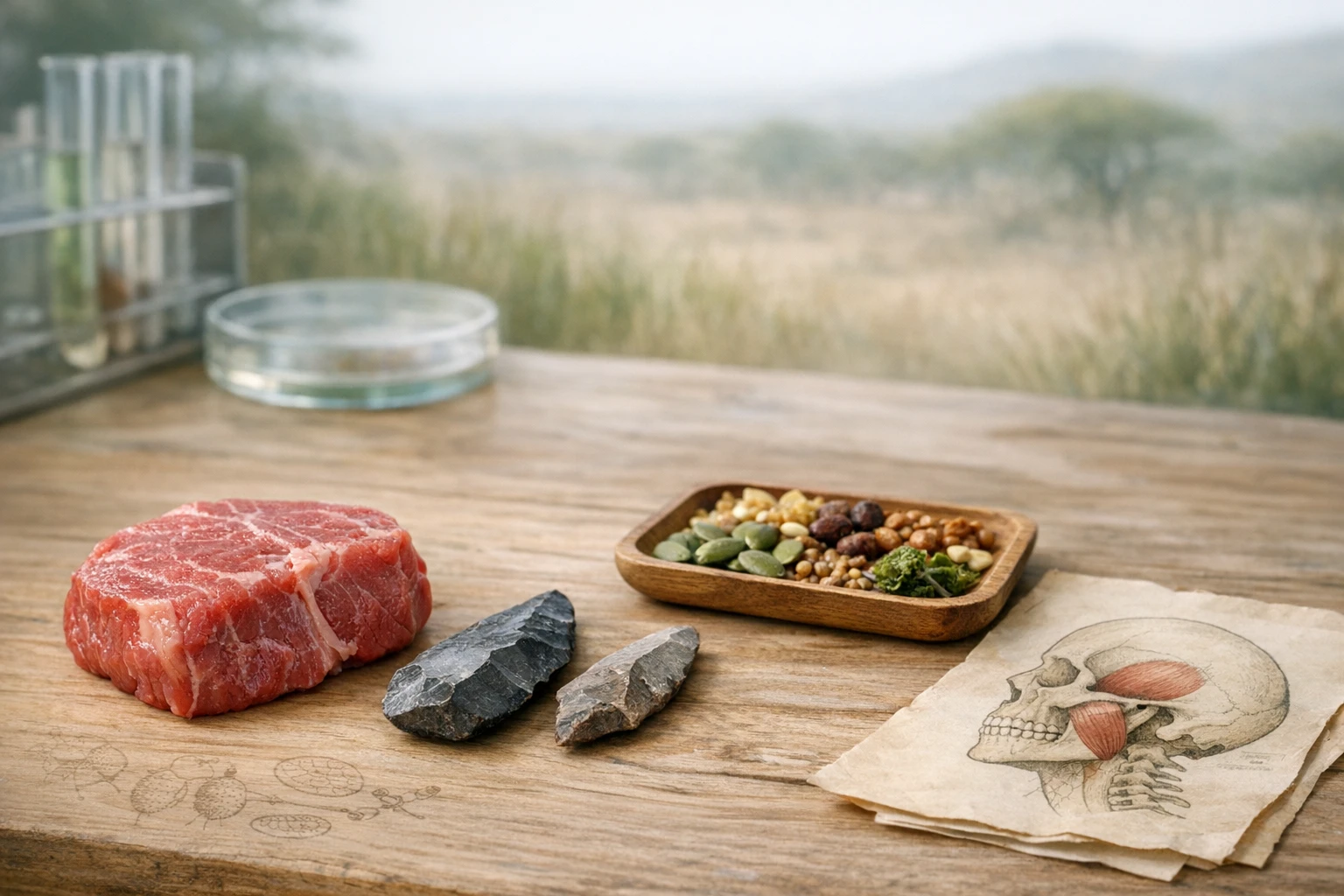
Updated and contextualized version of an article originally published on May 10, 2020
The article retains its original focus by presenting it through a scholarly and accessible perspective, supported by verifiable references.
Authors
- Dr. M. Mondini – Biologist
- Roberto Panzironi –Independent researcher
Note editoriali
- First publication: May 10, 2020
- Last update: May 7, 2026
- Version: 2026 narrative revision
Initial note: this article was previously published and has been updated according to scientific and informative criteria. The text is for informational purposes only and does not replace medical or professional advice.
In brief
- Paleoanthropological and experimental research suggests that the introduction of meat into the diet and food processing techniques contributed to changes in chewing, dentition, and likely to the energy availability for the brain.
- Modern experiments indicate that meat consumption associated with processing (cutting, mincing, cooking) reduces chewing time and effort and can increase the net energy derived from food.
- Theories such as the "expensive-tissue hypothesis" link reductions in the digestive tract to increased energy available for the brain, but evidence is not unequivocal and depends on context and paleontological data.
- The current picture is complex: archaeological data, experimental, and comparative models offer support, but strong causal interpretations require caution.
Abstract: what does science say?
Definition: the central hypothesis explores if and how the introduction of meat and processing techniques (cutting, mincing, cooking) influenced anatomical characteristics and energy resources available for human brain development. What the evidence shows: biomechanical experiments and comparative studies indicate that meat consumption, especially when associated with processes that reduce hardness or the need to chew, can lower masticatory work and increase digestibility. What it depends on: effects vary depending on the quantity and frequency of consumption, the presence of processing techniques (e.g., cutting, cooking), and the ecological and social context. Interpretive limitations: most of the evidence is inferential, derived from observational studies, archaeological data with heterogeneous spatial and temporal distribution, and experimental models on modern systems; therefore, it is difficult to attribute a single causal factor to the complex human evolutionary history. Framework: the evidence supports biological plausibility and consistent mechanisms but requires critical integration between anthropology, physiology, and modern experimentation.
Experimental and comparative evidence on chewing and food processing
Recent experimental studies have directly measured how different types of food and processing techniques influence the force and number of chews. A study simulating Paleolithic conditions showed that introducing meat and using tools to process it reduces the masticatory load compared to a diet based on harder or unprocessed foods [1]. These experimental results suggest a plausible mechanistic chain: by reducing the time and effort required to chew, functional changes are reflected in the resizing of the jaw and teeth over many generations, as observable in the fossil record.
Comparative research between species and experimentation with animal models add details on energy gain: thermal or mechanical treatment of food tends to increase the digestibility of proteins, starches, and lipids, resulting in greater net energy available to the consumer [2][4]. In summary, modern experimental data provide physical and physiological explanations consistent with some anatomical transformations observed in human fossils and place food processing as an important factor in the evolutionary framework [8].
Central theories: meat, cooking, and energy balance
The idea that the increase in high-energy-density foods supported brain expansion is expressed by several complementary hypotheses. The "expensive-tissue hypothesis" proposes that, to support a larger brain, energy adjustments occurred in other tissues, particularly a relative reduction in the gastrointestinal tract [3]. This theory provides a framework for energy trade-offs: more energy available for the brain can come from a richer and more easily digestible diet, partly thanks to the consumption of animal resources.
Cooking as an energy amplifier
One line of research proposes that cooking increases the energy availability of food by making it more digestible and reducing the cost of digestion. Experiments on modern and animal models have documented increases in net energy derived from cooked foods compared to their raw counterparts, especially for tubers, lean meat, and oilseeds [2][4]. This mechanism could have amplified the effects of the simple introduction of meat, if and when cooking became habitual.
Archaeological evidence and spatio-temporal variability
The archaeological record shows evidence of carcass exploitation and the use of stone tools in multiple regions and at different periods; phylogenetic analyses suggest changes in feeding duration and molar size in the human lineage, with reconstructions placing many transformations in the Lower Pleistocene [5]. However, the distribution of zooarchaeological evidence and butchery marks is irregular and depends on preservation, conducted research, and the geography of the sites. Recent studies that have recompiled zooarcheological data emphasize that there is no uniform net growth in traces of carnivory after the appearance of Homo erectus, calling for a more cautious reading of the temporal correlations between meat consumption and evolutionary changes [6].
What it means in practice
For the general public, the main implications do not concern dietary prescriptions, but rather an understanding of the historical and biological role of food. Evidence shows that the human ability to process and transform food — cutting it, mincing it, cooking it — has changed how we derive energy from food and has had progressive anatomical impacts. This does not imply that meat consumption is absolutely necessary for individual health today: the relationship between diet, health, and the environment is complex and depends on numerous contemporary factors (meat quality, production methods, quantity, alternation with plant-based foods, individual needs).
In educational and cultural terms, research helps to interpret why food technologies (cooking, utensils) have been so central in human societies. From a modern nutritional perspective, however, clinical recommendations remain based on current public health evidence and not on evolutionary inferences: dietary choices must consider nutritional composition, health risks, sustainability, and personal preferences.
Key takeaways
- Meat and food processing offer a plausible way to increase net available energy and reduce masticatory effort, with observable anatomical effects in the fossil record [1][4].
- Cooking and other forms of processing (cutting, reduced chewing) improve the digestibility of macronutrients and can amplify the energetic benefits associated with meat and plant consumption [2][4].
- Evolutionary theories such as the "expensive-tissue hypothesis" offer useful but not exhaustive interpretive frameworks: they are integrated hypotheses that require multiple data for validation [3].
- Archaeological data show temporal and geographical variability: there is no single linear narrative that explains all human evolution [5][6].
- To decide what to eat today, clinical evidence and modern nutritional guidelines apply, not evolutionary deductions in a strict sense.
Limitations of the evidence
It is important to distinguish between types of evidence: archaeological and paleontological observations document patterns and temporal correspondences, but alone do not prove causality. Modern experimental studies show plausible mechanisms (increased digestibility, reduced masticatory work), but only indirectly refer to the evolutionary processes that occurred in the Pleistocene [1][2][4].
Methodological limitations include differential preservation of materials (bones are better preserved than plant remains), variability of excavations and research in different regions, and the difficulty of reconstructing long-term consumption frequencies. Recent re-analyses of zooarcheological data highlight that the apparent increase in traces of carnivory in some periods may reflect sampling bias or research concentration, rather than a uniform global change [6]. Consequently, interpretations must remain cautious and multi-disciplinary: "being human" cannot be attributed to a single food or isolated practice.
Editorial conclusion
Modern research combines experimental, comparative, and archaeological data to build a coherent picture: introducing meat into the diet and developing processing and cooking techniques likely contributed to anatomical changes and a different energy balance in human evolution. However, the process is multifactorial, influenced by environmental, behavioral, and cultural changes. Current literature supports the biological plausibility of these mechanisms but does not allow for reducing evolutionary complexity to a single cause. For the contemporary reader, the main interest is to understand the relationships between food technology, energy, and anatomy, knowing that valid dietary choices today must be based on current evidence of efficacy and safety, not on simplified evolutionary deductions.
Editorial note
This article has been updated in light of peer-reviewed scientific studies and critical literature reviews. The goal is to offer a balanced, transparent, and verifiable synthesis. The content is informative and does not replace the advice of a healthcare professional. For methodological insights and to verify original sources, consult the "Scientific research" section that follows.
Scientific research
List of cited research (with verified DOI). For the correspondence between claim and source, see the numerical citations in the text.
- Zink, K. D., & Lieberman, D. E. Impact of meat and Lower Palaeolithic food processing techniques on chewing in humans. Nature. https://doi.org/10.1038/nature16990
- Carmody, R. N., & Wrangham, R. W. The energetic significance of cooking. Journal of Human Evolution. https://doi.org/10.1016/j.jhevol.2009.02.011
- Aiello, L. C., & Wheeler, P. The expensive‑tissue hypothesis: The brain and the digestive system in human and primate evolution. Current Anthropology. https://doi.org/10.1086/204350
- Groopman, E. E., Carmody, R. N., & Wrangham, R. W. Cooking increases net energy gain from a lipid‑rich food. American Journal of Physical Anthropology. https://doi.org/10.1002/ajpa.22622
- Organ, C., et al. Phylogenetic rate shifts in feeding time during the evolution of Homo. Proceedings of the National Academy of Sciences (PNAS). https://doi.org/10.1073/pnas.1107806108
- Barr, W. A., Pobiner, B., et al. No sustained increase in zooarchaeological evidence for carnivory after the appearance of Homo erectus. Proceedings of the National Academy of Sciences (PNAS). https://doi.org/10.1073/pnas.2115540119
- Review: Costs and Benefits of Meat‑Eating in Human Evolution. Frontiers in Ecology and Evolution. https://doi.org/10.3389/fevo.2022.834638
- Human feeding biomechanics: performance, variation, and functional constraints. PeerJ. https://doi.org/10.7717/peerj.2242