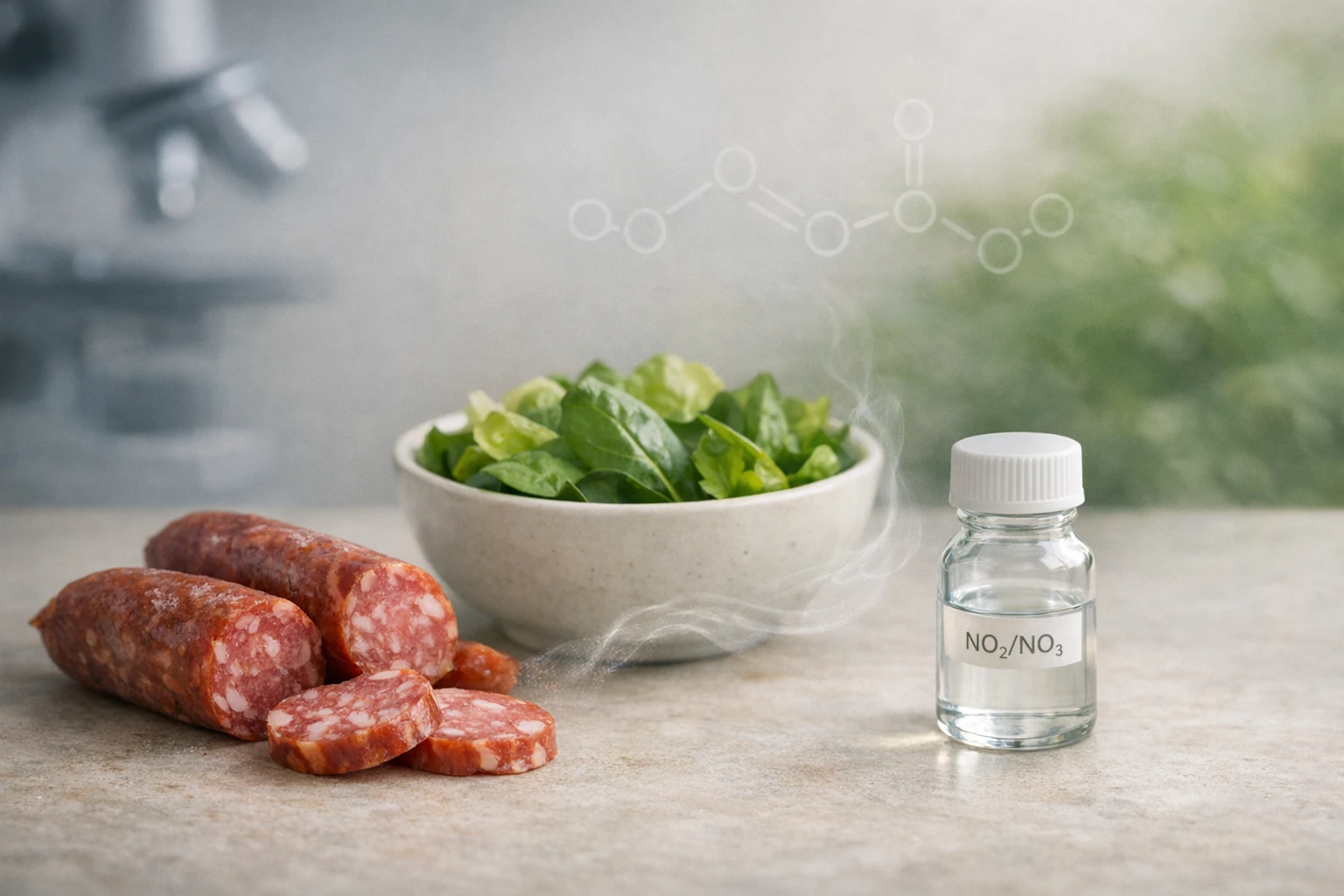
Updated and contextualized version of an article originally published on October 22, 2021
The article retains its original focus by presenting it through a scholarly and accessible perspective, supported by verifiable references.
Authors
- Dr. D. Iodice – Biologist
- Roberto Panzironi –Independent researcher
Note editoriali
- First publication: October 22, 2021
- Last update: April 18, 2026
- Version: 2026 narrative revision
Preservation and coloring between nitrites and nitrates: the carcinogenic side of cured meats
Editorial note
This article was originally published in the past and has been updated according to scientific and divulgative criteria. The text is for informational purposes only and does not replace medical advice. For specific concerns, contact your doctor or a qualified healthcare professional.
In brief
- Nitrites and nitrates are additives used to preserve and color processed meats; they can promote the formation of nitrosamines, compounds with carcinogenic potential.
- Epidemiological evidence links the consumption of processed meats to an increased risk of certain cancers, but the risk depends on dose, frequency, and dietary context.
- The presence of antioxidants (e.g., vitamin C) can reduce the formation of nitrosamines under specific conditions, but the effect varies depending on fat content and food matrix.
- In infants, exposure to nitrates through contaminated water can cause methemoglobinemia; the risk and thresholds are well documented in the literature.
Abstract: What does science say?
Simple definition: Nitrates (NO3-) and nitrites (NO2-) are chemical compounds naturally present in the environment, water, and food, and also used as additives to prolong preservation and stabilize the color of cured meats. What the evidence shows: Epidemiological data and reviews indicate an association between high consumption of processed meats (often a source of nitrites/nitrates as additives) and an increased risk of certain cancers, particularly colorectal cancer; similar associations have been observed for gastric and esophageal cancers in specific studies. What depends on dose, frequency, and context: The risk appears linked to the quantity and regularity of consumption, the source (nitrites derived from processed foods vs. natural nitrates from vegetables), and the presence of protective factors in the diet, such as antioxidants. Interpretive limitations: Most evidence comes from observational studies, which are subject to confounding and exposure measurement; furthermore, the endogenous formation of nitrosamines is influenced by meal composition (fat, antioxidants) and oral/gastrointestinal microbiota. Epidemiological framework: The data support caution in the use and frequent consumption of cured meats treated with nitrites/nitrates, but do not establish simple causal equations; more precise studies are still needed on specific sources, doses, and dietary interactions.
Storage, chemistry, and use in food
Nitrites and nitrates are used in industrial and artisanal production to protect meats from microbial growth, maintain the typical red-pink color of cured meats, and develop aroma and flavor during aging. From a chemical perspective, nitrates can be reduced to nitrites (for example, by oral flora or bacteria), and nitrites can react with amines and amides to form N-nitroso compounds, including nitrosamines, some of which have been classified as carcinogenic in experimental models and considered potentially harmful to humans [1][2].
In the context of food production, nitrites also play a role in preventing botulism by reducing the likelihood of Clostridium botulinum growth, a significant hygienic advantage that has historically explained their widespread use. However, the quantity and form of administration vary: nitrates naturally present in vegetables are chemically identical but act in a different nutritional context compared to nitrites added as preservatives in cured meats. Regulations establish maximum limits for their use and require labeling indications (codes E249–E252) to inform consumers [2][3].
Epidemiological Evidence and Risk Assessments
In 2015, a group of experts convened by IARC classified the consumption of processed meat as carcinogenic to humans, based on cohorts and observational studies showing a relationship between regular consumption of processed products and an increased risk of colorectal cancer [1]. This assessment does not indicate that every single serving causes cancer, but rather that, at a population level, a consistent increase in consumption is associated with a measurable increase in risk.
Subsequent and prior reviews and meta-analyses have attempted to separate the specific role of nitrates/nitrites from other components of processed meat, with variable results: some analyses show stronger associations for nitrites and nitrosamines with gastric or esophageal cancers [3][6], while others indicate differences depending on the source (water, vegetables, processed meats) and the presence of antioxidants in the diet [2][4]. Recent systematic reviews with pooling of observational studies have reported significant associations for some cancer sites, but with heterogeneity among studies and methodological limitations that require caution in interpretation [2][4].
Biological mechanisms: nitrosation, nitrosamines, and the role of antioxidants
Nitrosamine formation and biological plausibility
Nitrites can react with amines and amides in the acidic environment of the stomach or in food microenvironments to form N-nitroso compounds (NOCs), including nitrosamines recognized for their ability to damage DNA in experimental models. This reaction is the most plausible biological mechanism linking nitrites/nitrates to carcinogenic effects observed in animals and, indirectly, in exposed populations [6].
Antioxidants and risk modulation
Vitamin C and other antioxidants can inhibit nitrosation reactions in aqueous conditions, reducing NOC formation; this principle has experimental basis and justifies attention to the overall meal profile: meals rich in fruits and vegetables (sources of vitamin C and phytocompounds) can attenuate endogenous nitrosation [7]. However, the protective effect can be modulated by the food matrix: in the presence of lipids, ascorbate's ability to inhibit nitrosation may decrease or, under experimental conditions, reverse, increasing nitrosamine formation in particular situations [8]. These observations explain part of the heterogeneity of epidemiological studies and emphasize that vitamin C intake alone does not automatically negate the possible risks associated with high and repeated exposure to nitrites/nitrates from processed foods.
What it means in practice
For the general public: nitrates and nitrites are not all equivalent from a health perspective. Nitrates found in fruits and vegetables are part of a food matrix rich in fiber, vitamins, and phytochemicals and are not associated with consistent increases in risk in overall reviews; in fact, nitrate-rich vegetables are often associated with cardiovascular benefits. Conversely, nitrites added as preservatives in processed meats are often accompanied by a matrix rich in fats and compounds formed during processing that can promote nitrosation and exposure to NOCs. In practical terms, this means it is reasonable to reduce the frequency and portions of cured meats and processed meats in the diet, favoring unprocessed proteins and combining meals with sources of fruits and vegetables that provide antioxidants. For families with young children or well water users, it is important to check nitrate levels in the water: exposure to nitrates in drinking water is the most well-known factor associated with the risk of infant methemoglobinemia and requires specific precaution.
Key points to remember
- Regular and abundant consumption of processed meats is associated, at a population level, with an increased risk of certain cancers; the relationship is not simple proof of causality but is supported by biological consistency and epidemiological studies [1][2].
- The formation of nitrosamines is the plausible biological mechanism linking nitrites/nitrates (especially from processed meats) to potential DNA damage [6].
- Antioxidants like vitamin C can reduce nitrosation in aqueous conditions, but the effect depends on meal composition (presence of fats, food matrix) [7][8].
- In infants, exposure to nitrates through contaminated water remains a concrete health emergency (methemoglobinemia) and requires water control and surveillance measures.
- Regulations and production practices limit the quantities of added nitrites/nitrates; reading labels can help identify products preserved with these additives [3].
Limitations of the Evidence
Most associations between nitrates/nitrites and cancer risk come from observational studies, which can show correlations but do not prove causality. These studies are susceptible to confounding (e.g., lifestyle, overall meat consumption, smoking), measurement error in exposure (estimating nitrite/nitrate content in foods), and heterogeneity among populations. Furthermore, the wide variability in the source of nitrates/nitrites (vegetables vs. meats vs. water), meal composition, and individual microbial composition makes it difficult to isolate a single, uniform effect. To better understand the risk, prospective studies with more precise exposure measurements, integrated assessments of dietary sources, and controlled mechanistic studies are needed.
Editorial Conclusion
Scientific literature suggests that nitrites and nitrates play a complex role in human health: useful for food preservation and microbiological safety, but also linked to the formation of potentially harmful nitrosamines, especially when derived from processed meats and consumed frequently. Informed consumer choice, regulation of additive levels, and a diet rich in unprocessed foods and antioxidants seem to be reasonable measures to minimize potential risks. The most prudent approach is based on moderating the consumption of processed meats, paying attention to potentially contaminated water sources, and promoting balanced diets that include abundant fruits and vegetables.
Final Note
If you wish for technical insights or to check your exposure (e.g., well water analysis), please contact local health services or qualified professionals. This article does not replace personalized medical advice.
SCIENTIFIC RESEARCH
- Bouvard V, Loomis D, Guyton KZ, et al. Carcinogenicity of consumption of red and processed meat. Lancet Oncology. 2015. https://doi.org/10.1016/S1470-2045(15)00444-1 [1]
- Abasse Said et al. Association between dietary nitrate, nitrite intake, and site-specific cancer risk: A systematic review and meta-analysis. Nutrients. 2022. https://doi.org/10.3390/nu14030666 [2]
- Xie L, Mo M, Jia HX, et al. Association Between Nitrite and Nitrate Intake and Risk of Gastric Cancer: A Systematic Review and Meta-Analysis. Medical Science Monitor. 2019. https://doi.org/10.12659/MSM.914621 [3]
- H. (et al.) Association of Dietary Nitrate, Nitrite, and N‑Nitroso Compounds Intake and Gastrointestinal Cancers: A Systematic Review and Meta‑Analysis. Toxics. 2023. https://doi.org/10.3390/toxics11020190 [4]
- Long X, et al. The relationship between consumption of nitrite or nitrate and risk of non‑Hodgkin lymphoma. Scientific Reports. 2020. https://doi.org/10.1038/s41598-020-57453-5 [5]
- Vinson JA, Shapiro S, et al. Dietary Nitrates, Nitrites, and Nitrosamines Intake and the Risk of Gastric Cancer: A Meta‑Analysis. Nutrients. 2015. https://doi.org/10.3390/nu7125505 [6]
- Tannenbaum SR, Wishnok JS, Leaf CD. Inhibition of nitrosamine formation by ascorbic acid. American Journal of Clinical Nutrition. 1991. https://doi.org/10.1093/ajcn/53.1.247S [7]
- Mirvish SS, et al. Fat transforms ascorbic acid from inhibiting to promoting acid‑catalysed N‑nitrosation. Gut. 2007. https://doi.org/10.1136/gut.2007.128587 [8]
- Diet, nutrition, and cancer risk. BMJ. 2020. https://doi.org/10.1136/bmj.m511 [9]