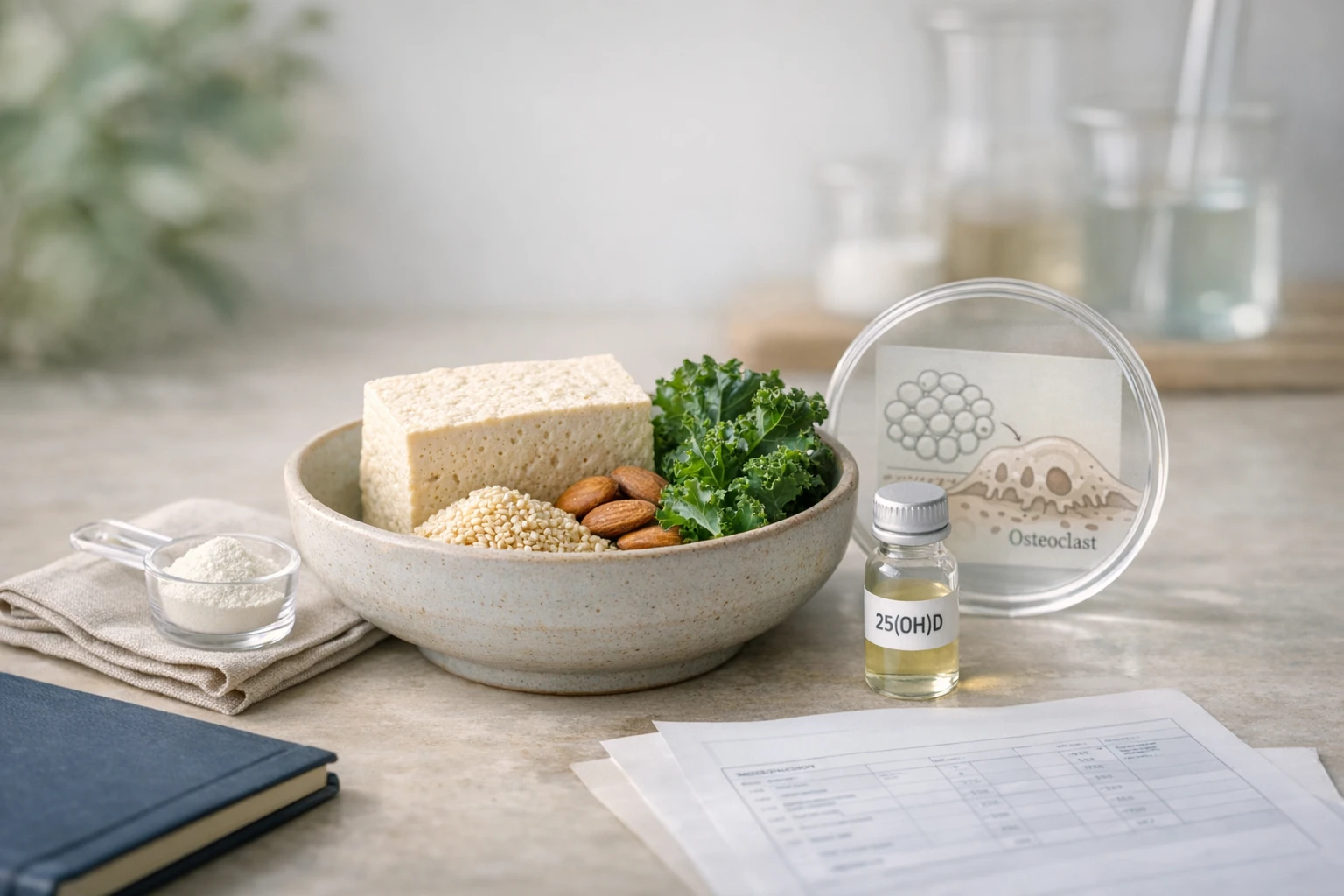
Updated and contextualized version of an article originally published on February 17, 2021
The article retains its original focus by presenting it through a scholarly and accessible perspective, supported by verifiable references.
Authors
- Dr. M. Bitonti – Biologist
- Roberto Panzironi –Independent researcher
Note editoriali
- First publication: February 17, 2021
- Last update: April 18, 2026
- Version: 2026 narrative revision
Initial Note
This article has been previously published and updated according to scientific and informative criteria. The purpose is informational: it does not replace the judgment of a doctor or healthcare professional. For personal or clinical choices, consult a qualified professional.
In brief
- Observational studies indicate an association between vegetarian/vegan diets and an increased risk of certain fractures, particularly hip fractures; results vary by diet type and fracture site.
- Plausible factors include lower intake or absorption of calcium, vitamin D, and protein, as well as average differences in body mass index (BMI) and body composition.
- Available evidence is predominantly observational: it suggests associations but does not prove direct causal relationships for all contexts.
- Practical strategies: attention to diet quality (protein sources, calcium, vitamin D), weight-bearing exercise, and body weight management; individual assessment with a healthcare professional.
Abstract: what does science say?
Published research indicates that, compared to meat-eaters, individuals following vegetarian or vegan diets may have a higher observational risk of total fractures and specific sites (especially the hip). These associations emerge from large cohorts and meta-analyses but are attenuated after adjustment for BMI, calcium, and protein intake: this suggests that the observed risk largely depends on nutritional and bodily factors rather than an "all or nothing" effect of the vegetarian choice. Experimental evidence (clinical trials) directly testing the effect of dietary choices on fracture risk is scarce; however, meta-analyses on supplements (vitamin D and calcium) and many studies on protein and BMD exist. The main limitations are the observational nature, variability in diet quality, and possible non-generalizability to different populations.
What the main evidence shows
A large British cohort with participants classified as meat-eaters, pescatarians, vegetarians, and vegans found a higher risk of total fractures and some sites (especially the hip) in non-meat consumers; the highest values were observed in vegans [1]. More recent meta-analyses aggregating studies on vegetarians/vegans confirm an increased risk of hip fractures but highlight great heterogeneity among studies [5]. In parallel, reviews and meta-analyses on protein, calcium, and vitamin D show that adequate protein and calcium/vitamin D intake are factors correlated with better bone mass or lower incidence of certain fractures in particular settings, although results are not entirely consistent [3][2][4].
Biological plausibility: possible mechanisms
Bones depend on nutrients (calcium, protein, vitamin D, zinc, good quality protein) and mechanical stimuli. Reduced calcium or protein intake, or poor vitamin D status, can reduce bone mineral density or muscle mass, increasing the risk of falls and fractures [3][4]. The lower average BMI observed in vegetarians/vegans reduces mechanical protection around the bone and may contribute to the observed risk [1]. However, many of these connections are associative: the possible protective effect of protein could also be mediated by muscle mass and lower fall risk [4].
What it means in practice
For those following or considering a vegetarian or vegan diet, the main message is not that the diet is inherently dangerous: the choice is feasible and often associated with cardiometabolic benefits. However, to reduce the potential risk related to bone health, it is advisable to pay attention to the quality of the diet and certain measurable factors.
General nutritional guidelines
Ensuring adequate protein intake (quality and quantity), dietary patterns rich in calcium (calcium-rich vegetables, fortified products, dairy if present), and attention to vitamin D status are reasonable measures. Observational studies and cohorts suggest that higher protein intake is associated with higher BMD and fewer vertebral fractures in some groups [4][3]. Supplementation should be evaluated on a case-by-case basis; meta-analyses on vitamin D and calcium show that the combination can reduce the risk of some fractures in specific groups, while vitamin D alone has shown inconsistent results [2].
Other practical and lifestyle interventions
Weight-bearing exercise and strength training promote bone and muscle mass; controlling BMI if too low and reducing fall risk factors (sedative medications, hazardous home environments) are effective and evidence-based strategies. The quality of the overall dietary pattern (including the presence of fruits, vegetables, and fermented foods) can positively influence bone health [8][6].
Key points to remember
- Observational evidence shows associations between vegetarian/vegan diets and an increased risk of some fractures, especially hip fractures; the evidence is more consistent for vegans [1][5].
- Many factors mediate this risk: lower average BMI, calcium and protein intake, vitamin D status, and overall diet quality [1][3][4].
- Direct experimental evidence on whole diets is scarce; practical recommendations are based on plausible biological mechanisms and observational and interventional studies on specific nutrients [2][7].
- Effective and sustainable interventions include: ensuring adequate quality protein, calcium and vitamin D sources when necessary, weight-bearing exercise, and controlling fall risk factors [4][6][8].
Limitations of the evidence
It is important to distinguish between observational studies and causal evidence. Most of the available information comes from prospective cohorts and meta-analyses: these designs are useful for identifying associations but cannot unequivocally establish causality. Among the main limitations are possible residual confounding (different lifestyles among dietary groups), variability in the definition of "vegetarian" or "vegan," the quality and nutritional richness of the diets studied, and the representativeness of the populations (some studies predominantly include European individuals) [1][5].
Furthermore, studies on the supplementation of single nutrients (calcium, vitamin D) have yielded mixed results: the combination of calcium + vitamin D in some RCTs has shown marginal reductions in fracture risk, but the benefits are not universally demonstrated and depend on the context and dosage [2][7].
Editorial conclusion
Current evidence suggests that some individuals adopting vegetarian or vegan diets may have a higher observational risk of specific fractures, particularly if the diet is not planned to ensure adequate intake of key nutrients or if it is associated with a very low BMI. However, it cannot be stated that eliminating meat is inherently detrimental to bone health: prevention is based on informed dietary choices, targeted supplementation if necessary, physical exercise, and control of risk factors. For personal or therapeutic decisions, it is advisable to consult a healthcare professional or a dietitian for an individual assessment.
Editorial note
This update has been prepared taking into account the main research and systematic reviews available. The article is for informational purposes and does not replace a medical consultation. For clinical concerns or therapeutic choices, consult a doctor or a nutrition professional.
SCIENTIFIC RESEARCH
- Vegetarian and vegan diets and risks of total and site-specific fractures: results from the prospective EPIC-Oxford study. BMC Medicine. (DOI: https://doi.org/10.1186/s12916-020-01815-3). [Used for cohort data and analysis by dietary groups].
- Vitamin D and Calcium for the Prevention of Fracture: A Systematic Review and Meta-analysis. JAMA Network Open. (DOI: https://doi.org/10.1001/jamanetworkopen.2019.17789). [Used for evidence on vitamin D and calcium supplementation].
- The relationship between dietary protein consumption and risk of fracture: a subgroup and dose-response meta-analysis of prospective cohort studies. Scientific Reports. (DOI: https://doi.org/10.1038/srep09151). [Meta-analysis on protein and fracture risk].
- Effect of Dietary Protein Intake on Bone Mineral Density and Fracture Incidence in Older Adults in the Health, Aging, and Body Composition Study. The Journals of Gerontology: Series A. (DOI: https://doi.org/10.1093/gerona/glab068). [Cohort study on protein and BMD in older adults].
- Vegetarian and Vegan Diets and the Risk of Hip Fracture in Adults: A Systematic Review and Meta-analysis. Nutrition Reviews. (DOI: https://doi.org/10.1093/nutrit/nuaf241). [Review on hip fracture risk in plant-based diets].
- Dairy products and bone health. Aging Clinical and Experimental Research. (DOI: https://doi.org/10.1007/s40520-021-01970-4). [Review on the role of dairy products in bone health].
- Calcium intake and risk of fracture: systematic review. The BMJ. (DOI: https://doi.org/10.1136/bmj.h4580). [Systematic review on calcium and fractures].
- Dietary Patterns, Bone Mineral Density, and Risk of Fractures: A Systematic Review and Meta-Analysis. Nutrients. (DOI: https://doi.org/10.3390/nu10121922). [Review on dietary patterns and bone health].