Updated and contextualized version of an article originally published on July 26, 2020
The article retains its original focus by presenting it through a scholarly and accessible perspective, supported by verifiable references.
Authors
- Dr. M. Mondini – Biologist
- Roberto Panzironi –Independent researcher
Note editoriali
- First publication: July 26, 2020
- Last update: April 18, 2026
- Version: 2026 narrative revision
Initial note: This article was previously published and has been updated according to scientific and informative criteria. The content is for informational purposes only and does not replace medical advice. If you have specific health conditions, consult a healthcare professional.
In brief
- Observational studies show a possible reduction in the risk of coronary heart disease in vegetarian/pescetarian diets but have reported, in some samples, a modest increase in the risk of total stroke, particularly hemorrhagic stroke.
- The results do not prove causality: nutritional factors (e.g., vitamin B12), very low lipid profiles, and the overall quality of the diet can contribute to the observed associations.
- Synthesis of meta-analyses and studies on large cohorts show heterogeneous results: the quality of the plant-based dietary pattern (healthy vs. less healthy) is an important determinant.
- Evidence supports attention to nutritional assessment (supplementation or control of B12, vitamin D, omega-3) in meat-free diets, but does not justify drastic generalized changes based on a single study.
Abstract: what does science say?
Definition: this refers to dietary patterns that exclude (vegan) or limit (vegetarian) foods of animal origin, compared to diets that include meat or fish. What the evidence shows: large observational cohorts and meta-analyses indicate consistency in reducing the risk of coronary heart disease associated with more plant-based patterns, while the association with stroke risk is more variable: some studies have found a slight increase in hemorrhagic stroke in specific populations, while others have not shown significant differences. Plausible mechanisms: lower lipid profiles, nutritional deficiencies (e.g., vitamin B12, long-chain omega-3) and the overall quality of the plant-based diet can influence the results. Interpretive limitations: most evidence is observational; dietary classification and food quality vary between studies; residual confounding factors and ethnic/geographic differences can influence the data. In summary, the evidence suggests cardiovascular benefits linked to some plant-forward patterns but requires caution in interpreting stroke risk: the risk/benefit balance depends on diet quality, critical nutrient supplementation, and individual context.
Main section – Evidence and interpretation
Main results from large cohorts
A large prospective study conducted on approximately 48,000 adults reported a reduced risk of ischemic coronary disease among vegetarians and pescetarians compared to meat-eaters, but also an increased risk of total stroke, particularly hemorrhagic stroke, for vegetarians/vegans. These results were published in a peer-reviewed journal and remain cited as an example of an observational association between dietary pattern and cerebro-cardiovascular outcomes [1].
Meta-analyses and systematic reviews
Broader reviews and meta-analyses show non-uniform results: some syntheses do not show significant associations between vegetarian diet and overall stroke risk, while other meta-analyses exploring the quality of the plant-based pattern find that a high-quality plant-based diet is associated with a slightly lower risk of total stroke [2][3]. The variability between meta-analyses depends on study selection, the definition of "vegetarian," and the geographical context of the samples.
Quality of plant-based diet as a critical factor
Studies that distinguish between a "healthy plant-based diet" (rich in fruits, vegetables, legumes, whole grains, nuts) and a "less healthy" one (rich in ultra-processed products, refined sugars, and refined flours) show that only high-quality plant-based dietary patterns are consistently associated with a reduction in the risk of ischemic and total stroke [3]. This emphasizes that it is not just the presence or absence of meat that determines outcomes, but the overall composition of the diet.
Plausible biological mechanisms
Three plausible mechanisms emerge to explain the observations: (1) very low lipid levels, particularly total and LDL cholesterol, are associated with a lower atherosclerotic risk but in some contexts may correlate with a higher risk of cerebral hemorrhage; meta-analyses show an inverse association between cholesterol and hemorrhagic stroke [4][6]. (2) deficiencies of nutrients typically supplied by animal products — particularly vitamin B12 and, in some cases, long-chain omega-3 fatty acids — can increase biomarkers associated with cerebrovascular risk (e.g., homocysteine) and modify risk [5]. (3) non-nutritional and confounding factors (socioeconomic profile, health behaviors) can partially explain the observed differences.
What it means in practice
For those who choose to follow a vegetarian or vegan diet, current evidence suggests that the primary cardiovascular benefit (reduced risk of coronary heart disease) can be real when the diet is rich in unprocessed plant foods. However, some studies indicate a small increase in the risk of hemorrhagic stroke in specific populations; this does not imply that meat is "protective" for everyone, but that adopting a diet without animal products requires attention to nutrient quality and lipid profile [1][2][3].
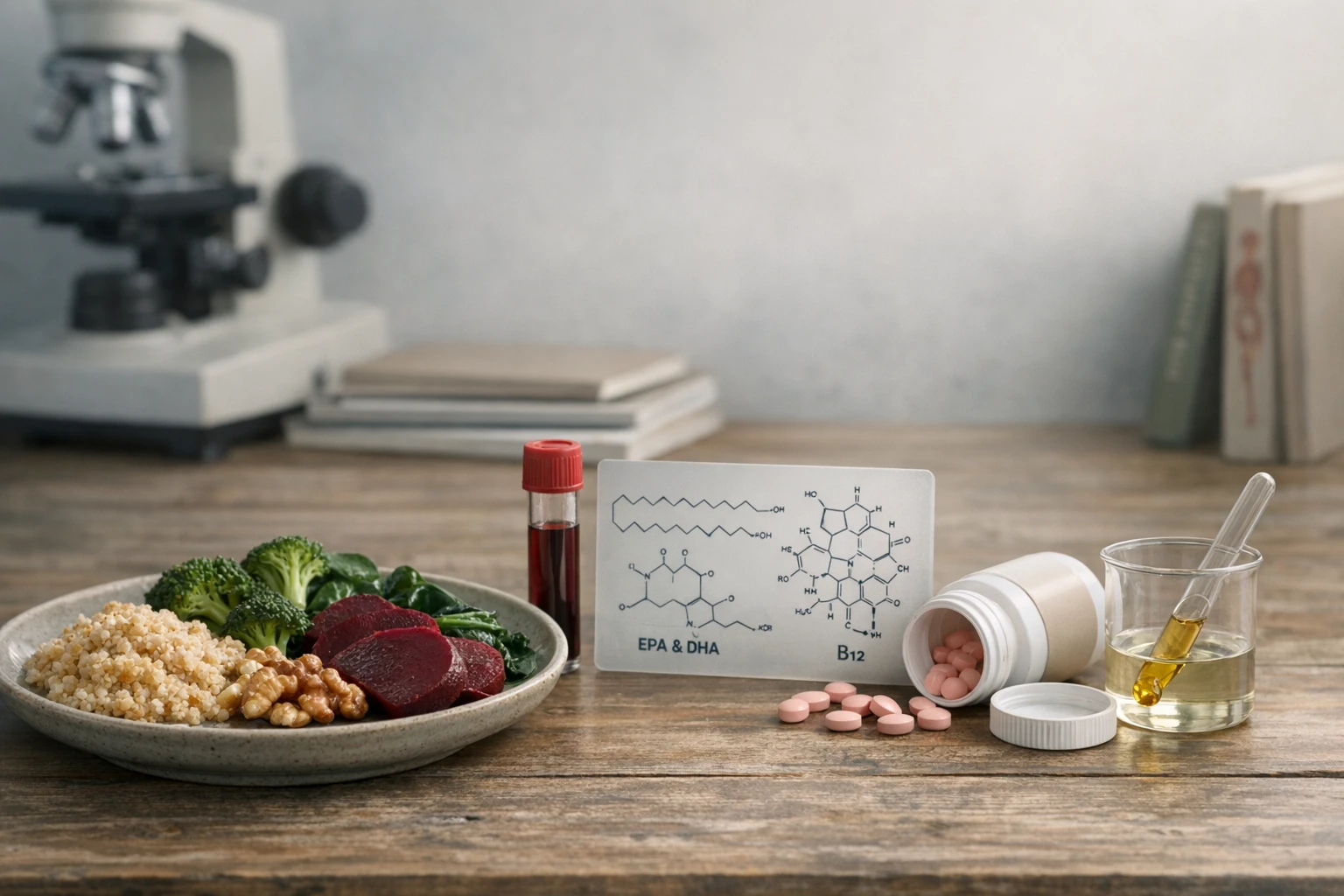
In practical terms: assess vitamin B12 status (serum or via functional markers when appropriate), consider individual supplementation if necessary, include plant sources rich in omega-3 (e.g., walnuts, flax seeds) or consider DHA/EPA supplementation in at-risk individuals, and monitor plasma lipids with your doctor. Public strategies based solely on reducing meat without attention to diet quality and deficiency prevention may not maximize benefits. The conclusions are based on observations and literature reviews; for preventive or therapeutic interventions, personalized clinical advice is necessary.
Key takeaways
- Vegetarian/vegan diets are associated with more favorable lipid profiles and a lower risk of coronary heart disease in many analyses [1][7].
- Some observational studies have reported a small increase in the risk of total or hemorrhagic stroke among vegetarians/vegans in specific cohorts; the results are not uniform and do not prove causality [1][2].
- The overall quality of the plant-based diet (healthy vs. less healthy) modulates stroke risk: a high-quality plant-based diet is generally protective [3].
- Relevant nutritional characteristics: vitamin B12, vitamin D, long-chain omega-3 fatty acids, and careful monitoring of lipids can be important for those who eliminate animal products [5][6].
- Individual dietary decisions should consider risks, benefits, and the need for supplementation or clinical monitoring; public health recommendations must be based on robust syntheses of evidence.
Limitations of the evidence
The available studies are mostly observational: they indicate associations but cannot establish cause-and-effect relationships. The main limitations include dietary classification often based on self-reported questionnaires, variability in the definition of "vegetarian/vegan," changes in habits over time, and the presence of possible residual confounders (e.g., lifestyle, socioeconomic status). Meta-analyses show heterogeneity between studies and differentiated results by geographical areas and diet quality [2][3].
From a methodological point of view, little evidence comes from long-term randomized trials on primary prevention in healthy individuals; controlled experiments are complex for ethical and practical reasons. Some randomized trials on supplementation (e.g., folic acid) have shown reductions in stroke in specific contexts where deficiency was prevalent, indicating that correcting certain deficiencies can modify risk [5]. Finally, generalizability is limited: results observed in European or Asian populations may not be identical in other contexts due to genetic, environmental, and food fortification factors.
Editorial conclusion
The current literature carries two main and consistent messages: (1) a transition to more plant-based dietary patterns can reduce the risk of coronary heart disease when the diet is of good quality; (2) the association with stroke risk is complex and not uniform: in some samples, a slightly higher incidence of hemorrhagic stroke has been observed among those who do not consume animal products, likely mediated by very low lipid profiles or specific nutritional deficiencies. Therefore, the most prudent approach for professionals and citizens is to evaluate the overall quality of the diet, prevent known deficiencies (particularly vitamin B12), and personalize clinical monitoring. Public health recommendations should promote high-quality plant-based diets, combining cardiovascular health benefits with measures to ensure sufficient intake of critical nutrients.
Editorial note
This article has been updated based on systematic reviews, meta-analyses, and large-sample cohort studies. The update follows criteria of transparency and verifiability: the cited references are available in the "Scientific Research" section with verified DOIs. The information provided is general in nature and does not replace an individual medical evaluation.
SCIENTIFIC RESEARCH
- Risks of ischaemic heart disease and stroke in meat eaters, fish eaters, and vegetarians over 18 years of follow-up: results from the prospective EPIC‑Oxford study. BMJ. 2019;366:l4897. https://doi.org/10.1136/bmj.l4897 [1]
- Risk of incident stroke among vegetarians compared to nonvegetarians: a systematic review and meta-analysis of prospective cohort studies. Nutrients. 2021;13:3019. https://doi.org/10.3390/nu13093019 [2]
- Quality of plant‑based diet and risk of total, ischemic, and hemorrhagic stroke. Neurology. 2021;96:e1940–e1953. https://doi.org/10.1212/WNL.0000000000011713 [3]
- Cholesterol levels and risk of hemorrhagic stroke: a systematic review and meta‑analysis. Stroke. 2013;44(7):1833–1839. https://doi.org/10.1161/STROKEAHA.113.001326 [4]
- Efficacy of folic acid therapy in primary prevention of stroke among adults with hypertension in China: the CSPPT randomized clinical trial. JAMA. 2015;313(13):1325–1335. https://doi.org/10.1001/jama.2015.2274 [5]
- Low‑density lipoprotein cholesterol and risk of hemorrhagic stroke: a systematic review and dose‑response meta‑analysis of prospective studies. Curr Atheroscler Rep. 2019;21(12):52. https://doi.org/10.1007/s11883-019-0815-5 [6]
- Association of vegetarian and vegan diets with cardiovascular health: an umbrella review of meta‑analysis of observational studies and randomized trials. Nutrients. 2023;15:4103. https://doi.org/10.3390/nu15194103 [7]
- Vegetarian and vegan diets: benefits and drawbacks. European Heart Journal. 2023;44(36):3423–3439. https://doi.org/10.1093/eurheartj/ehad436 [8]
Note: references are listed in order of citation in the text. For additional information or copies of articles, consult scientific databases or your reference medical library.