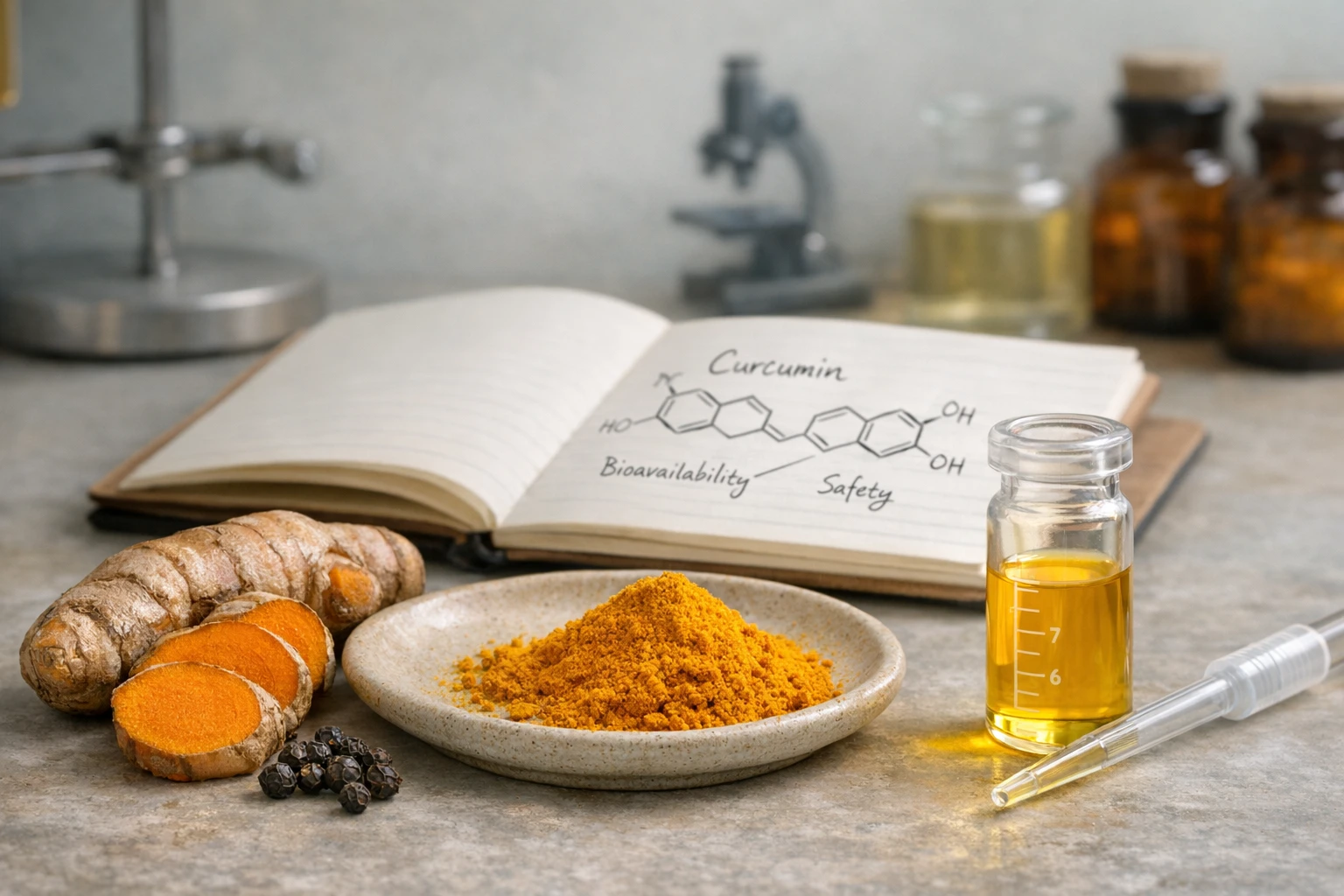
Updated and contextualized version of an article originally published on April 13, 2022
The article retains its original focus by presenting it through a scholarly and accessible perspective, supported by verifiable references.
Authors
- Dr. A. Colonnese – Nutrition biologist
- Roberto Panzironi –Independent researcher
Note editoriali
- First publication: April 13, 2022
- Last update: April 17, 2026
- Version: 2026 narrative revision
In brief
- Turmeric (Curcuma longa) is a spice that contains curcuminoids, including curcumin, the most studied component.
- Meta-analyses and reviews indicate favorable effects on some biomarkers of inflammation and oxidative stress, with variable results depending on dose, duration, and formulation.[1]
- The oral bioavailability of curcumin is limited; formulations with piperine or extraction technologies increase absorption but modify the pharmacological profile.[4]
- Although generally well-tolerated in dietary use, rare cases of liver damage associated with some high-concentration supplements have been reported; caution is advised in the presence of diseases or concomitant therapies.[6]
- Evidence supports a supportive role in selected contexts (e.g., joint symptoms), but the quality and heterogeneity of studies require cautious interpretation.[1][5]
Abstract: what does science say?
Turmeric is a spice rich in curcuminoids; curcumin is the most studied compound for its anti-inflammatory and antioxidant properties. Reviews and meta-analyses document improvements in some biomarkers (e.g., C-reactive protein, pro-inflammatory cytokines) and symptoms in certain disorders such as osteoarthritis, but the effect depends on dose, duration, formulation, and the population studied. The oral bioavailability of curcumin is often low; strategies such as the addition of piperine or patented formulations increase absorption but can also modify risks and interactions. The literature includes both randomized clinical trials and mechanistic reviews; however, methodological limitations, heterogeneity of products, and rare risks associated with concentrated supplements persist. Therefore, turmeric can be considered a dietary support with potential, not a proven therapy for specific conditions.
What is turmeric and why is research interested in it?
Turmeric (Curcuma longa) is a root used as a spice and a traditional ingredient in many local medicines. Chemically, it contains a family of compounds called curcuminoids; curcumin is the main one among these and is at the center of most modern research.[2] The growing scientific interest stems from experimental evidence that curcumin interacts with cellular pathways involved in inflammation and oxidative stress, and from clinical observations that some supplements can affect detectable biomarkers. However, dietary turmeric and concentrated supplements are not equivalent: purified extracts, high-bioavailability formulations, and whole root powders have different compositions and concentrations, with implications for efficacy and safety.[2]
What clinical and mechanistic evidence says
Meta-analyses of randomized studies have reported favorable effects of curcumin on some pro-inflammatory parameters and oxidative stress indices, with variations depending on the dose, duration of treatment, and formulation used.[1] Preclinical studies and mechanistic reviews show that curcumin modulates key inflammation pathways, including NF-κB, MAPK, and inflammasome components, offering biological plausibility for the clinically observed effects.[3][8] In the osteoarticular field, reviews and meta-analyses on patients with osteoarthritis have shown improvements in pain and some inflammatory biomarkers with standardized extracts, although studies differ greatly in preparation and dosage.[5][7]
Bioavailability: why the form matters
Orally administered curcumin has limited bioavailability due to poor solubility, rapid metabolism, and elimination. Pharmacokinetic studies have shown that combination with piperine (an alkaloid from black pepper) significantly increases the plasma concentration of curcumin, improving oral absorption in animal and human volunteer studies.[4] In recent years, various strategies (phospholipids, nanoemulsions, polymer complexes, standardized extracts) have been developed to increase the amount of bioavailable curcumin; these technologies can amplify the effects but can also change the safety profile and possible drug interactions.[8]
Safety and Critical Issues in Supplement Use
The culinary use of turmeric is generally safe. However, the increasing prevalence of high-concentration supplements and products that enhance bioavailability has led to reports of adverse events, including cases of liver damage associated with turmeric/curcumin-based products.[6] Evidence indicates that, although rare, these events require attention: in the presence of liver diseases, therapy with drugs with high metabolic interaction, or suggestive symptoms (jaundice, dark urine, itching, persistent nausea), it is advisable to discontinue use and consult a doctor.[6] Furthermore, increased bioavailability through piperine or other technologies can alter interaction with drugs metabolized by the liver, so it should be considered with caution.[4]
What it means in practice
For those wishing to incorporate turmeric into their daily diet, current evidence suggests an informed and cautious approach. Consuming turmeric as a spice within a varied diet contributes to the nutritional profile without exposure to the risks associated with concentrated supplements. When considering a supplement, it is important to: check the composition and dose, understand the formulation technology (presence of piperine or patented systems), evaluate potential drug interactions, and discuss with a healthcare professional in case of existing conditions or concomitant therapies. In contexts such as supporting joint symptoms, some standardized formulations have shown benefits, but they do not replace established therapies and should be considered as part of a comprehensive management plan. [5][7]
How to choose a product (general guidelines)
Choose transparent products: specify the quantity of curcuminoids, presence or absence of piperine, quality certifications, and independent laboratory analyses. Prefer formulations with published clinical data for the specific preparation. Avoid absolute therapeutic promises and consult your doctor if you are taking concomitant medications or have chronic conditions.
Key points to remember
- Turmeric contains curcuminoids; curcumin is the most studied compound but it is not the only active one.[2]
- There is evidence of effects on inflammatory and oxidative biomarkers, but clinical effects vary by dose and formulation.[1]
- Oral bioavailability is limited; piperine and modern technologies increase it but can alter safety and interactions.[4][8]
- High-concentration supplements may be associated with rare cases of liver damage; caution in fragile individuals or those on concomitant therapies.[6]
- Dietary turmeric is safe; supplements should be chosen with transparency and under professional advice.
Limitations of the Evidence
It is important to distinguish between study types: observational studies show associations and cannot prove causality; RCTs provide stronger evidence but are often small, with heterogeneous products and dosages. Many studies differ in duration, measured endpoints, and included populations, making it difficult to generalize results. Furthermore, the diversity of formulations (extracts, purified curcuminoids, combined products) complicates interpretation: it cannot be assumed that the results of a specific extract are applicable to all turmeric-containing products.
Editorial Conclusion
Research on turmeric and curcumin is extensive and expanding. Experimental and clinical evidence supports biological plausibility and shows measurable effects on some inflammatory biomarkers and quality of life in certain contexts, such as osteoarthritis. However, the variability of formulations, limited oral bioavailability, and rare safety signals associated with some supplements necessitate caution. For the general public, the most reasonable approach is to incorporate turmeric as a spice within a balanced diet, carefully evaluate any supplements, and consult a healthcare professional in the presence of medical conditions or pharmacological therapies.
Editorial Transparency
This update was drafted following transparent editorial standards: the cited references are peer-reviewed publications with verified DOIs; the names of the article's authors are those provided in the original version. No references or claims unsupported by verifiable literature have been included. Any conflicts of interest of the original authors or reviewers must be reported separately (placeholder: [conflict of interest information not provided]).
Frequently Asked Questions (FAQ)
Is turmeric truly anti-inflammatory?
Reviews and meta-analyses indicate that turmeric/curcumin extracts can reduce certain inflammation biomarkers in adults; the extent of the effect depends on dose, duration, population, and formulation. These results suggest a modulating effect but do not prove that turmeric is a definitive therapy for chronic inflammatory diseases.[1]
How can curcumin absorption be improved?
Absorption can be increased with the addition of piperine (black pepper) or with specific technological formulations (e.g., phospholipid complexes, nanoparticles). Pharmacokinetic studies have documented significant increases in bioavailability with piperine in human volunteers.[4]
Are there any contraindications?
In dietary use, turmeric is generally well-tolerated. Concentrated supplements may interact with medications or, rarely, be associated with hepatotoxicity: discontinue in case of suggestive symptoms and consult a doctor, especially if you have liver diseases or are taking chronic therapies.[6]
Scientific research
- Dehzad MJ, Ghalandari H, Nouri M, Askarpour M. Antioxidant and anti-inflammatory effects of curcumin/turmeric supplementation in adults: A GRADE-assessed systematic review and dose–response meta-analysis of randomized controlled trials. Cytokine. DOI: https://doi.org/10.1016/j.cyto.2023.156144.
- Hewlings SJ, Kalman DS. Curcumin: A Review of Its’ Effects on Human Health. Foods. 2017;6(10):92. DOI: https://doi.org/10.3390/foods6100092.
- Hasanzadeh S, Read MI, Bland AR, et al. Curcumin: an inflammasome silencer. Pharmacological Research. 2020;159:104921. DOI: https://doi.org/10.1016/j.phrs.2020.104921.
- Shoba G, Joy D, Joseph T, Majeed M, Rajendran R, Srinivas PS. Influence of piperine on the pharmacokinetics of curcumin in animals and human volunteers. Planta Medica. 1998;64(4):353-356. DOI: https://doi.org/10.1055/s-2006-957450.
- Zhang Y, et al. Efficacy and Safety of Curcumin and Curcuma longa Extract in the Treatment of Arthritis: A Systematic Review and Meta-Analysis of Randomized Controlled Trial. Frontiers in Immunology. 2022. DOI: https://doi.org/10.3389/fimmu.2022.891822.
- Halegoua-DeMarzio D, Navarro V, Ahmad J, et al. Liver Injury Associated with Turmeric—A Growing Problem: Ten Cases from the Drug-Induced Liver Injury Network (DILIN). The American Journal of Medicine. 2022. DOI: https://doi.org/10.1016/j.amjmed.2022.09.026.
- Tzeng K-H, Liang Y-S, Horng Y-S. Effects of curcumin on serum inflammatory biomarkers in patients with knee osteoarthritis: a systematic review and meta-analysis of randomized controlled trials. BMC Complementary Medicine and Therapies. 2025. DOI: https://doi.org/10.1186/s12906-025-04951-6.
- Liu M, Wang J, Song Z, Pei Y. Regulation mechanism of curcumin mediated inflammatory pathway and its clinical application: a review. Frontiers in Pharmacology. 2025. DOI: https://doi.org/10.3389/fphar.2025.1642248.
- Hu P, Li K, Peng X-X, et al. Curcumin derived from medicinal homologous foods: its main signals in immunoregulation of oxidative stress, inflammation, and apoptosis. Frontiers in Immunology. 2023;14:1233652. DOI: https://doi.org/10.3389/fimmu.2023.1233652.
Reliability Note: This content is for informational and educational purposes only. It does not replace the advice of a doctor or other qualified healthcare professionals.