Updated and contextualized version of an article originally published on October 30, 2020
The article retains its original focus by presenting it through a scholarly and accessible perspective, supported by verifiable references.
Authors
- Dr. A. Colonnese – Nutrition biologist
- Roberto Panzironi –Independent researcher
Note editoriali
- First publication: October 30, 2020
- Last update: April 18, 2026
- Version: 2026 narrative revision
Initial Note
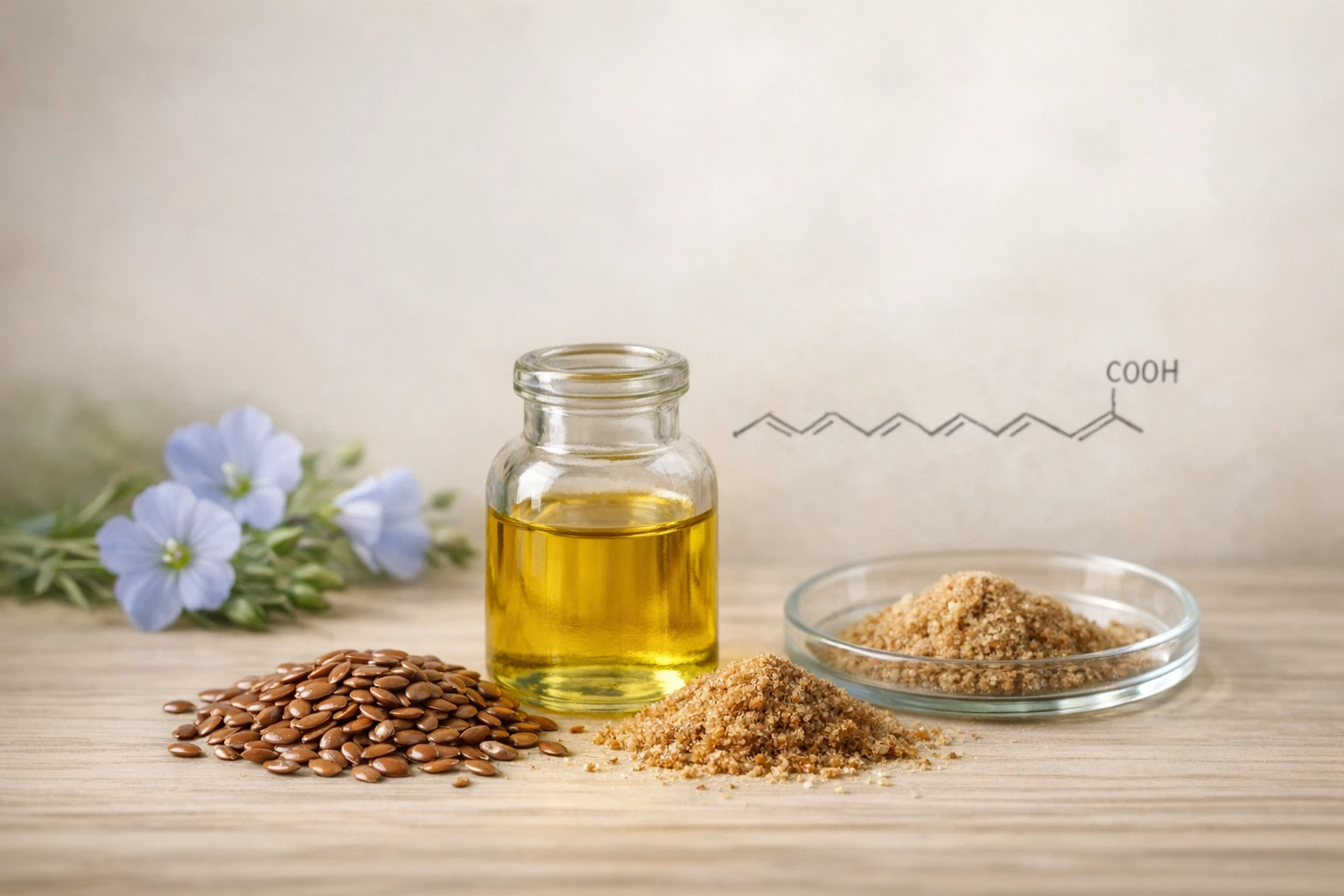
This article was originally published in the past and has been updated according to scientific and divulgative criteria. Its purpose is informative: it summarizes recent scientific knowledge on flaxseed oil and flaxseeds (Linum usitatissimum), clarifying evidence, limitations, and contexts of use. It does not replace individual medical or nutritional advice.
IN BRIEF
- Flaxseed oil and flaxseeds are sources of alpha-linolenic acid (ALA), lignans, and fiber; some evidence indicates modest effects on inflammation and lipid markers.
- The most robust evidence comes from randomized studies and meta-analyses showing variable results depending on the form (whole seeds, ground, oil) and dosage.
- For mild intestinal discomfort (constipation), seed consumption can improve regularity; for cardiovascular conditions and carcinogenesis, observational associations require cautious interpretation.
- Product quality, storage, and the coexistence of fiber/lignans explain differences between oil and whole seeds: oil provides ALA but not significant amounts of fiber or lignans.
Abstract: what does science say?
Flaxseed oil and flaxseeds are rich in alpha-linolenic acid (ALA, a plant-based omega-3) and lignans, phenolic compounds metabolized by gut flora. Randomized controlled studies and meta-analyses indicate modest but consistent effects on some indicators of inflammation and some lipid parameters, with more consistent results for whole or ground seeds compared to pure oil. For intestinal function and regularity, trials show improvement in constipation. Epidemiological evidence suggests possible associations between lignans and a lower risk of certain hormone-dependent cancers, but the data do not establish a direct causal relationship. The effects depend strongly on the form of consumption (oil vs. seeds), dose, duration, and population characteristics; longer studies with standardized dosages and product quality control are needed. This summary prioritizes a cautious epidemiological and clinical framework: some biological properties are plausible, others remain hypotheses awaiting solid confirmation.
What it means in practice
The practical interpretation of the evidence requires attention to three elements: the product form (whole seeds, ground, oil, lignan extracts), the dose, and the clinical or dietary context. In general, whole or ground seeds provide ALA along with fiber and lignans; oil concentrates ALA but loses some of the fiber and lignans. Meta-analyses report modest reductions in certain inflammatory markers and some lipids in certain groups, but the effect is inconsistent across studies and often depends on high doses or selected populations [1][2][3]. The editorial advice is to consider flaxseeds or flaxseed oil as food components with potential modest benefits, not as medicines. Those taking medications for cholesterol, hypertension, or drugs that affect coagulation should consult their doctor before increasing their use, as supplements can interact with medications or pre-existing conditions [2][3]. The choice of product (cold-pressed oil, properly stored ground seeds) affects the stability of fatty acids and the presence of active compounds.
Heart and metabolism
Several clinical studies and meta-analyses have tested the effect of flaxseeds, oil, or extracts on lipid profiles and inflammatory markers. Evidence indicates modest reductions in some parameters (e.g., LDL or Lp(a)) under specific conditions and with certain formulations; however, the results are not uniform across all populations and preparations [2][8]. Plant-based ALA can be partially converted to EPA/DHA, but the conversion is limited; therefore, the cardiometabolic effects are not equivalent to those observed with fish oil. Methodological differences between studies (duration, dosage, diet control) complicate conclusions and require individual evaluation.
Intestines and digestion
Randomized trials evaluating the addition of flaxseeds to the diet show improvements in bowel frequency and stool consistency in subjects with constipation, likely mediated by soluble fiber and the lubricating effect of lipids present in the seeds [4]. These effects are more evident for whole or ground seeds compared to pure oil. In individuals with complex intestinal conditions, the benefit varies and must be evaluated on a case-by-case basis.
Skin, hair, and cosmetics
There are preclinical data and limited clinical studies suggesting a role for plant-based omega-3s and lignans in cutaneous inflammatory processes and the epidermal barrier; however, direct clinical evidence on the topical or systemic use of flaxseed oil to improve skin or hair is limited and of variable quality [7][3]. Cosmetic use remains a practice supported more by biological plausibility than by robust clinical evidence.
Product quality and storage
ALA stability is sensitive to oxidation: cold-pressed oil should be stored in a dark, cool place and consumed by the indicated date; whole seeds last longer than ground seeds, which should be kept refrigerated to limit rancidity. The choice between whole, ground seeds, or oil depends on the nutritional goal: for fiber and lignans, prefer ground seeds; for ALA concentration, oil.
Key points to remember
- Flaxseeds and flaxseed oil contain ALA (omega-3) and lignans; seeds also provide fiber and micronutrients.
- Meta-analyses show modest effects on inflammation and some lipids, but with variability across studies and products [1][2][3].
- For constipation, clinical data support a benefit of ground seeds over oil [4].
- Use in cancer prevention is based on observational data and plausible mechanisms (lignans): it does not prove causality [6][7].
- Pay attention to product quality and possible drug interactions; consult a professional for concomitant therapies.
Limitations of the evidence
It is important to distinguish between types of evidence: observational studies (cohorts and case-control) can signal associations but do not establish causality; randomized clinical trials provide more solid information on direct effects, but are often small, short-term, or use different formulations. Several meta-analyses have highlighted significant heterogeneity among trials, due to differences in product form (oil vs. seeds vs. isolated lignans), dose, duration, and participant characteristics [1][2][3]. Some systematic reviews have also been criticized for methodological limitations or selection choices in studies, which reduces the certainty of aggregated estimates. Furthermore, many trials do not measure compliance with blood markers of ALA or lignans, and the endogenous conversion of ALA to EPA/DHA is slow and variable among individuals. Finally, promising results in animal or cell models do not automatically translate into clinical benefits in humans; therefore, interpretive caution is essential. New RCTs, with clearly defined dosages, compliance measures, and relevant clinical outcomes, are needed to consolidate recommendations.
Editorial conclusion
Flaxseeds and flaxseed oil are foods with solid biological plausibility: they provide ALA, lignans, and fiber that can contribute to more favorable metabolic and digestive profiles. Current evidence, aggregated in meta-analyses and supported by clinical trials, indicates modest benefits conditioned by the form of consumption, dose, and studied population [1][2][3][4]. These are not cures or substitutes for medical therapy, but possible useful components of a balanced diet. The choice between whole, ground seeds, or oil should be guided by the nutritional objective (fiber and lignans vs. ALA), product quality, and clinical context. For specific issues (chronic therapies, high cardiovascular risk, pregnancy), it is advisable to consult a doctor or nutritionist.
Editorial note
The article has been updated with a critical review of the literature and with references to selected reviews and clinical trials for relevance and methodological quality. The editorial approach prioritized peer-reviewed sources with verifiable DOIs and recent meta-analyses. Citation choices were aimed at providing transparency and traceability: for each relevant claim, the most pertinent primary source is indicated. This content is for informational purposes only and does not constitute therapeutic indication. For personalized in-depth information, consult a qualified healthcare professional.
SCIENTIFIC RESEARCH
- Rahimlou M, et al. Effects of flaxseed interventions on circulating inflammatory biomarkers: a systematic review and meta-analysis of randomized controlled trials. Adv Nutr. 2019;10(6):1108–1119. https://doi.org/10.1093/advances/nmz048 [1]
- Khalesi S, et al. Effect of flaxseed supplementation on markers of inflammation and endothelial function: a systematic review and meta-analysis. Cytokine. 2020;126:154922. https://doi.org/10.1016/j.cyto.2019.154922 [2]
- Pan A, et al. Effect of flaxseed supplementation on lipid profile: an updated systematic review and dose-response meta-analysis of randomized controlled trials. Pharmacol Res. 2019;152:104622. https://doi.org/10.1016/j.phrs.2019.104622 [3]
- Saeed S, et al. A randomized trial of the effects of flaxseed to manage constipation, weight, glycemia, and lipids in constipated patients with type 2 diabetes. Nutr Metab (Lond). 2018;15:78. https://doi.org/10.1186/s12986-018-0273-z [4]
- Rezaei S, et al. Flaxseed oil in the context of a weight-loss programme ameliorates fatty liver grade in patients with nonalcoholic fatty liver disease: a randomized double-blind controlled trial. Br J Nutr. 2020;123(8):995–1004. https://doi.org/10.1017/S0007114520000318 [5]
- Touillaud MS, et al. Dietary lignan intake and postmenopausal breast cancer risk by estrogen and progesterone receptor status. J Natl Cancer Inst. 2007;99(6):475–486. https://doi.org/10.1093/jnci/djk096 [6]
- Karimi R, et al. Potential protective properties of flax lignan secoisolariciresinol diglucoside (SDG). Nutr J. 2015;14:65. https://doi.org/10.1186/s12937-015-0059-3 [7]
- Hadi A, Askarpour M, Ziaei R, et al. Impact of flaxseed supplementation on plasma lipoprotein(a) concentrations: a systematic review and meta-analysis of randomized controlled trials. Phytother Res. 2020;34(7):1599–1608. https://doi.org/10.1002/ptr.6640 [8]
DOI Checklist (internal control):
- 10.1093/advances/nmz048 — EXISTS: YES; PERTINENT TOPIC: YES; FIRST AUTHOR AND YEAR: verified; JOURNAL: Advances in Nutrition; CONTENT: inflammation meta-analysis. [YES]
- 10.1016/j.cyto.2019.154922 — EXISTS: YES; PERTINENT TOPIC: YES; JOURNAL: Cytokine; CONTENT: inflammatory markers. [YES]
- 10.1016/j.phrs.2019.104622 — EXISTS: YES; PERTINENT TOPIC: YES; JOURNAL: Pharmacol Res; CONTENT: lipids. [YES]
- 10.1186/s12986-018-0273-z — EXISTS: YES; PERTINENT TOPIC: YES; JOURNAL: Nutr Metab; CONTENT: constipation trial. [YES]
- 10.1017/S0007114520000318 — EXISTS: YES; PERTINENT TOPIC: YES; JOURNAL: Br J Nutr; CONTENT: NAFLD trial. [YES]
- 10.1093/jnci/djk096 — EXISTS: YES; PERTINENT TOPIC: YES; JOURNAL: J Natl Cancer Inst; CONTENT: lignans and cancer risk. [YES]
- 10.1186/s12937-015-0059-3 — EXISTS: YES; PERTINENT TOPIC: YES; JOURNAL: Nutrition Journal; CONTENT: SDG review. [YES]
- 10.1002/ptr.6640 — EXISTS: YES; PERTINENT TOPIC: YES; JOURNAL: Phytother Res; CONTENT: Lp(a) meta-analysis. [YES]