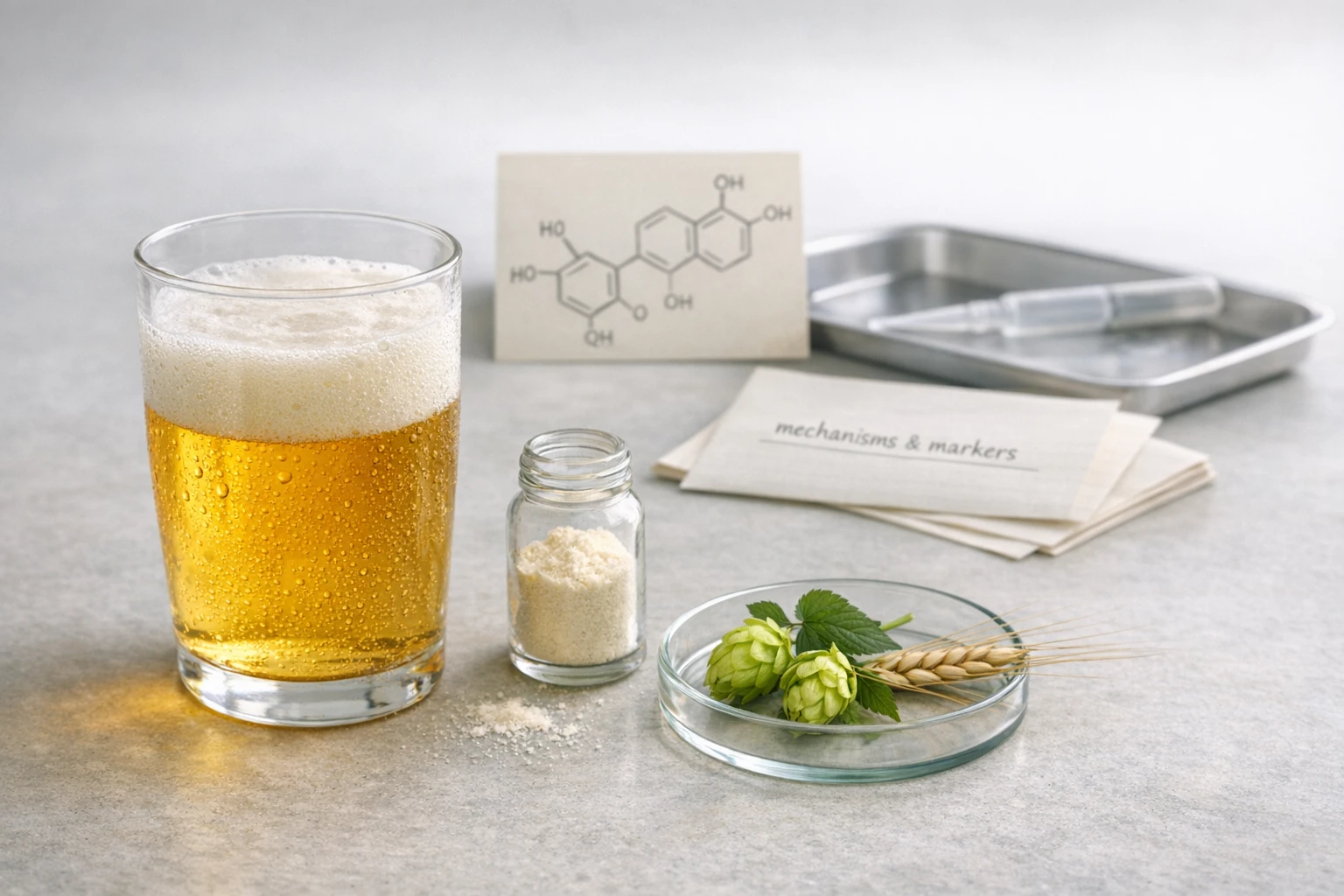
Updated and contextualized version of an article originally published on July 26, 2021
The article retains its original focus by presenting it through a scholarly and accessible perspective, supported by verifiable references.
Authors
- Dr. M. Bitonti – Biologist
- Roberto Panzironi –Independent researcher
Note editoriali
- First publication: July 26, 2021
- Last update: April 18, 2026
- Version: 2026 narrative revision
Initial note: this article was previously published and updated according to scientific and informative criteria. The information is for informational purposes only and does not replace medical advice. The topics presented are based on peer-reviewed scientific studies indicated in the bibliography.
IN BRIEF
- Beer contains compounds (silicon, polyphenols, B vitamins, hop compounds) that have plausible biological effects, but the health value depends on dose, frequency, and context.
- Substances present in malt and hops can modulate biological signals (e.g., hordenine on D2 receptor; xanthohumol antioxidant/anti-angiogenic effects), but clinical evidence in humans is limited.
- Epidemiological observations show associations between moderate alcohol consumption and some indicators (e.g., HDL, diabetes risk), but recent studies and global analyses advise caution; the risk changes with quantity and consumption patterns.
- For athletes or after exertion, low/zero alcohol beers or those with added salts can contribute to rehydration; alcoholic beer has a dose-dependent diuretic effect.
Abstract: what does science say?
Beer is a complex beverage: in addition to alcohol, it contains silicon (especially in barley-based beers), B vitamins, polyphenols, and specific molecules from hops and malt. Laboratory studies identify compounds such as the alkaloid hordenine (associated with activity on the dopamine D2 receptor) and xanthohumol (a hop derivative) with possible biological effects. Epidemiological investigations indicate non-linear relationships: mild-moderate consumption has been associated with differences in cardiometabolic markers and a lower incidence of some events in certain cohorts, while large-scale analyses remind us that the overall risk increases with increasing consumption. In sports, non-alcoholic or low-alcohol beer can promote rehydration; alcohol, on the other hand, reduces water retention. The results are often observational: they do not establish definitive causality and depend strongly on quantity, consumption patterns, individual characteristics, and type of beer.
Main section
Composition and biological mechanisms
Beer is made from water, barley malt, hops, and yeast; the production process determines the presence of nutrients and bioactive molecules. Silicon is present as orthosilicic acid, a form available for absorption and experimentally linked to bone formation. Nutritional studies have measured the silicon content in beers and its bioavailability in humans, suggesting that beer can be a significant source of silicon in the diet [8]. Some hop compounds, such as xanthohumol, show antioxidant activity and anti-tumor effects in experimental models [10]. Finally, the alkaloid hordenine (present in barley and beer) has been identified as a selective agonist of the dopamine D2 receptor in preclinical studies; subsequent studies have evaluated its pharmacokinetics after beer consumption in humans [1][2]. This evidence clarifies biological plausibility but does not automatically imply generalized clinical benefits.
Epidemiological and clinical evidence
Many observational studies document associations between moderate consumption of alcoholic beverages and some cardiometabolic outcomes. Cohort studies have found increases in HDL ("good" cholesterol) associated with moderate alcohol consumption and reductions in coronary risk in some groups, with plausible mechanisms related to lipids and hemostatic factors [4]. However, meta-analyses and subsequent reviews show a more complex picture: analyses of large international databases indicate that optimal risk levels are low and that, at the population level, alcohol consumption is associated with a burden of disease that cannot be ignored [5]. For type 2 diabetes, systematic reviews report a U-shaped relationship, with reduced risk at moderate consumption but increased risk at high consumption [6]. For kidney stones, prospective studies have associated beer consumption with a lower risk in some cohorts; interpretation requires attention to confounding factors and the type of analysis [7].
Dose, frequency, and form of consumption
The amount of alcohol, frequency, and context (e.g., consumption spread over days vs. binge drinking) are essential determinants. Many observed benefits refer to light-moderate consumption and regular patterns, not to episodes of abuse. Furthermore, the content of non-alcoholic compounds varies greatly among beers (craft vs. industrial, unpasteurized, non-alcoholic), altering potential intakes of silicon, polyphenols, and hop compounds. In molecular mechanisms, acute exposure to certain ingredients (e.g., hordenine) can produce transient effects on brain receptors, but the actual clinical relevance depends on blood concentrations reached and the rate of metabolism [1][2].
Practical section
What it means in practice
For the reader: beer is both a food and a source of alcohol. It can contain nutrients and biologically active compounds that explain favorable observations in certain studies, but it is not a medicine. If you choose to drink, moderation is key: the potential benefits reported in the literature concern moderate consumption and do not replicate the harmful effects associated with excess. For those who engage in physical activity, non-alcoholic or low-alcohol options are more consistent with rehydration and reduction of post-exercise inflammation; if alcoholic beer is consumed after exertion, it is important to balance it with water and electrolyte-containing foods [11].
Indications for specific groups
Pregnancy, liver diseases, history of addiction, drug therapy that interacts with alcohol, and certain medical conditions are contraindications to alcohol consumption; in these cases, the best choice is to abstain or consult a doctor. For the prevention of chronic diseases at the population level, health authority recommendations prioritize reducing alcohol consumption; interpreting individual studies on potential protective effects requires caution [5].
Key takeaways
- Beer contains nutrients and bioactive compounds (silicon, B-vitamins, polyphenols, hop compounds) with plausible biological effects.
- Specific substances like hordenine and xanthohumol have demonstrated activity in the laboratory; their clinical relevance in humans is not definitively proven [1][10].
- Observational associations indicate possible reductions in some risks with moderate consumption, but large-scale studies and global analyses highlight overall risks associated with alcohol and the need for caution [5][6].
- For post-exercise rehydration, non-alcoholic or low-alcohol beers are more appropriate; alcohol reduces fluid retention dose-dependently [11].
Limitations of the evidence
It is crucial to distinguish between study types: observational studies (cohorts, case-control) show associations but do not prove causality; experimental studies in humans are less numerous and often short-term. Many studies fail to fully control for confounding factors (diet, physical activity, socioeconomic status, consumption patterns), and the so-called "sick-quitter effect" can influence results if not adequately considered. In nutritional pharmacology, bioavailability and metabolism (e.g., rapid conjugation and degradation of hordenine) limit the direct translation from in vitro results to clinical effects [2]. Furthermore, the variability of non-alcoholic compound content among beer types makes it difficult to generalize results obtained with a specific beverage to all beers. Finally, recent large population analyses suggest that, at the public health level, even small amounts of alcohol can contribute to the burden of disease; for this reason, public health recommendations remain cautious [5].
Editorial conclusion
Beer is a culturally and nutritionally complex beverage that contains substances with biological potential. The scientific literature offers elements of plausibility for some benefits (bone, lipid markers, changes in sociality) but also clear signs of risk with increased consumption. For a non-specialist reader, the practical recommendation is simple and prudent: if you choose to drink, do so in moderation, prefer low-alcohol or non-alcoholic solutions in sports contexts or when seeking a hydrating effect, and always discuss with your doctor if you have clinical conditions. Science continues to investigate specific beer molecules (e.g., hordenine, xanthohumol) that could have future applications, but today they do not justify health claims or therapeutic assumptions.
Editorial note (at the bottom)
This article was published in a previous version and updated based on recent bibliographic reviews and scientific sources. The purpose of the update is informative and educational: it does not replace personalized medical advice. For therapeutic choices, prevention, or disease management, always consult a healthcare professional.
SCIENTIFIC RESEARCH
- Sommer C, et al. Identification of the beer component hordenine as food-derived dopamine D2 receptor agonist by virtual screening a 3D compound database. Scientific Reports. 2017;7:44201. https://doi.org/10.1038/srep44201
- Wölfer J, et al. Absorption, biokinetics, and metabolism of the dopamine D2 receptor agonist hordenine (N,N-dimethyltyramine) after beer consumption in humans. Journal of Agricultural and Food Chemistry. 2020;68:1998–2006. https://doi.org/10.1021/acs.jafc.9b06029
- Thiel F, Ostafin BD, Uppendahl JR, Wichmann LJ, Schlosser M, Aan Het Rot M. A moderate dose of alcohol selectively reduces empathic accuracy. Psychopharmacology. 2018;235:1479–1486. https://doi.org/10.1007/s00213-018-4859-y
- Rimm EB, et al. Moderate alcohol intake and lower risk of coronary heart disease: meta-analysis of effects on lipids and haemostatic factors. BMJ. 1999;319:1523–1528. https://doi.org/10.1136/bmj.319.7224.1523
- Wood AM, Kaptoge S, Butterworth AS, et al. Risk thresholds for alcohol consumption: combined analysis of individual-participant data for 599,912 current drinkers in 83 prospective studies. Lancet. 2018. https://doi.org/10.1016/S0140-6736(18)30134-X
- Baliunas DO, Taylor BJ, Irving H, et al. Alcohol as a risk factor for type 2 diabetes: a systematic review and meta-analysis. Diabetes Care. 2009;32:2123–2132. https://doi.org/10.2337/dc09-0227
- Curhan GC, Willett WC, Rimm EB, Stampfer MJ. Prospective study of beverage use and the risk of kidney stones. American Journal of Epidemiology. 1996;143:240–247. https://doi.org/10.1093/oxfordjournals.aje.a008734
- Sripanyakorn S, Jugdaohsingh R, Elliott H, et al. The silicon content of beer and its bioavailability in healthy volunteers. British Journal of Nutrition. 2004;91:403–409. https://doi.org/10.1079/BJN20031082
- Jugdaohsingh R, Tucker KL, Qiao N, Cupples LA, Kiel DP, Powell JJ. Dietary silicon intake is positively associated with bone mineral density in men and premenopausal women of the Framingham Offspring Cohort. Journal of Bone and Mineral Research. 2004;19:297–307. https://doi.org/10.1359/JBMR.0301225
- Girisa S, Saikia Q, Bordoloi D, et al. Xanthohumol from hop: hope for cancer prevention and treatment. IUBMB Life. 2021;73:1016–1044. https://doi.org/10.1002/iub.2522
- Protzner JD, et al. Post-Exercise Rehydration: Effect of Consumption of Beer with Varying Alcohol Content on Fluid Balance after Mild Dehydration. Frontiers in Nutrition. 2016;3:45. https://doi.org/10.3389/fnut.2016.00045