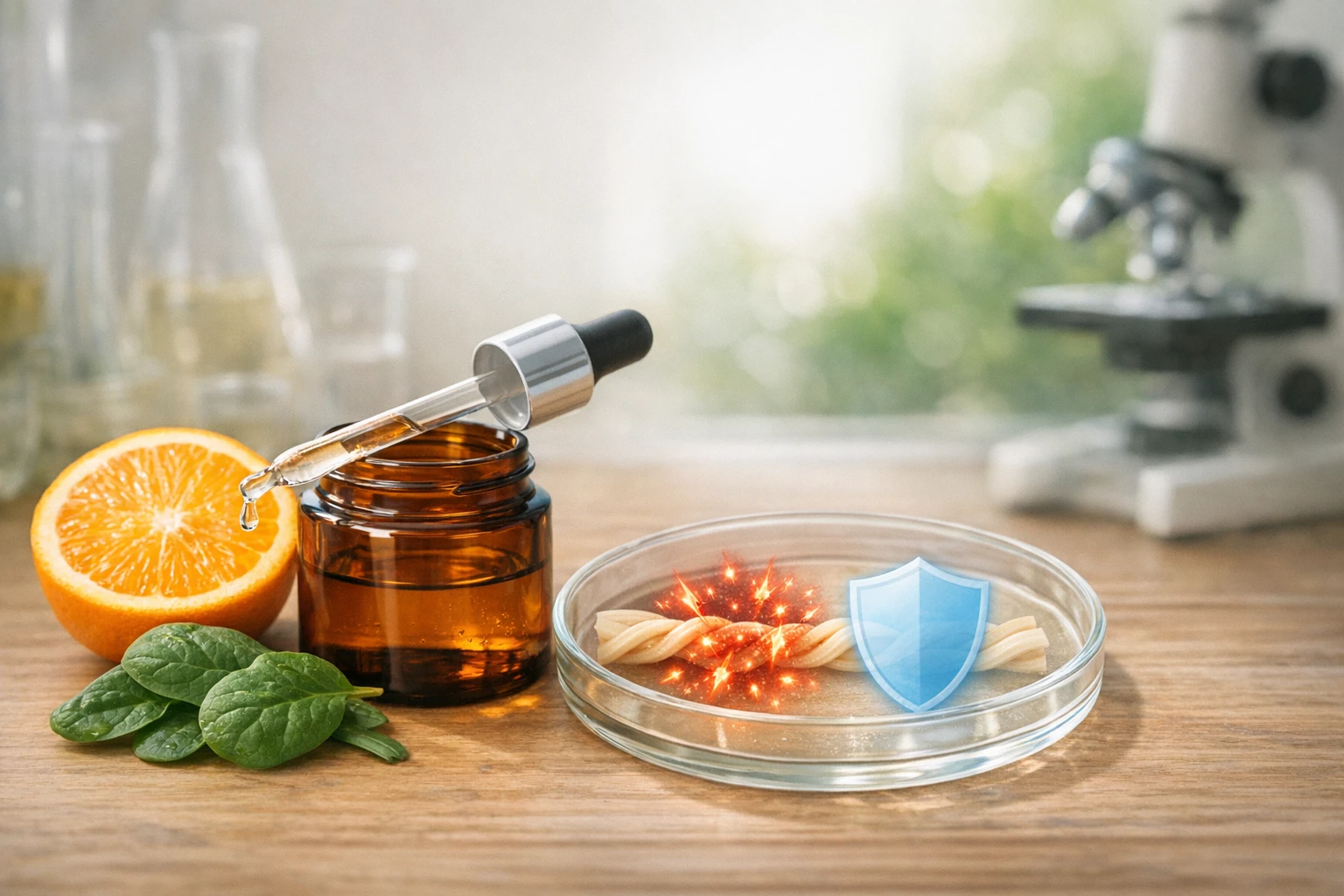
Updated and contextualized version of an article originally published on June 11, 2021
The article retains its original focus by presenting it through a scholarly and accessible perspective, supported by verifiable references.
Authors
- Dr. D. Iodice – Biologist
- Roberto Panzironi –Independent researcher
Note editoriali
- First publication: June 11, 2021
- Last update: April 18, 2026
- Version: 2026 narrative revision
Editorial Note
This article was previously published and has been updated according to scientific and informative criteria. The purpose is informational: it does not replace medical advice. For personal clinical issues, consult a healthcare professional.
IN BRIEF
- Free radicals (reactive oxygen species and related) contribute to molecular damage that promotes skin aging and dermal alterations.
- External factors such as UV radiation, air pollution, and smoking increase oxidative stress; insufficient sleep also affects redox markers.
- Sun protection, a cosmetic routine with stabilized topical antioxidants, and a diet rich in polyphenols appear beneficial; evidence on oral supplements is heterogeneous and requires caution.
- Available evidence is largely observational or experimental: prudent interpretations and choices based on context, dosage, and formulation quality are needed.
Abstract: what does science say?
Free radicals are reactive molecules produced both by cellular metabolism and external sources. Experimental and clinical evidence shows that the accumulation of reactive species can damage lipids, proteins, and DNA in skin tissue, contributing to collagen and elastin loss, wrinkle formation, and hyperpigmentation. Factors such as UV rays, atmospheric particulate matter, smoking, and certain behaviors (e.g., insufficient sleep) increase oxidative stress. Topical application of stabilized antioxidants (vitamin C, vitamin E, ferulic acid) and sun protection measures have shown protective effects in controlled studies; the effect of oral supplements is more variable. Methodological limitations and variability among formulations and dosages require caution in interpretation.
Fundamental mechanisms: how radicals damage the skin
Reactive species (including ROS — reactive oxygen species) are naturally formed during mitochondrial energy production and in response to external agents. These molecules can oxidize lipid membranes, fragment collagen and elastin, and promote the activation of tissue metalloproteinases that degrade the extracellular matrix. The free radical theory of aging, proposed by Denham Harman, remains a historical reference for understanding how cumulative oxidative damage can influence cellular function over time.[1]
External factors and lifestyle that increase skin oxidative stress
Exposure to ultraviolet (UV) radiation is among the main activators of ROS in the skin; UV light induces DNA damage and an increase in degradative enzymes that reduce dermal quality.[2] Air pollution — particularly fine particulate matter (PM2.5), ozone, and organic compounds — interacts with the skin and can induce cellular senescence and oxidative lesions, accelerating the signs of skin aging.[3] Other relevant factors include smoking, excessive alcohol, unbalanced diets, and unbalanced extreme physical activity, while sleep deprivation has been associated with signs of redox imbalance in human studies.[9]
Topical antioxidants: evidence and limitations
Some topically applied antioxidants show evidence of efficacy in protecting the skin from oxidative stress and supporting collagen synthesis. Studies on formulations containing L-ascorbic acid (vitamin C) have described necessary formulation criteria for skin penetration and support for collagen regeneration in clinical and explanted models.[4][5] The combination of vitamin C, vitamin E, and ferulic acid has been shown to improve the stability of active ingredients and double photoprotection compared to individual vitamins in experimental human models.[6] However, efficacy largely depends on concentration, vehicle, pH, and formulation stability; not all creams or serums on the market guarantee the same benefits.
Role of diet and supplements
A diet rich in fruits, vegetables, and polyphenols provides exogenous antioxidants that can contribute to systemic redox balance. Some clinical studies have evaluated specific supplements (e.g., coenzyme Q10 associated with hydrolyzed collagens) showing limited improvements in parameters such as dermal density and wrinkle areas in controlled trials.[7] However, large-scale meta-analyses have shown that antioxidant supplements do not reduce mortality and, in some cases, may be neutral or potentially harmful if used indiscriminately: the choice and dose must therefore be based on evidence and individual clinical evaluations.[8]
Sun protection: the most robust measure
Protection from UV rays with broad-spectrum sunscreens is the behavior with the most solid basis of efficacy in preventing photoaging. Topical antioxidants can complement but do not replace sun protection: the most effective approach combines physical/chemical shielding and control of other exposure factors.[2]
Cosmetic integration and formulation quality
To obtain a real skin benefit, the quality of the formulation is crucial: stability of the active ingredient (e.g., vitamin C), vehicle allowing penetration, preservation of antioxidant activity, and clinical data supporting the product. Generic claims on products without published data remain unverifiable.
What it means in practice
For the public, reading the evidence translates into concrete but not prescriptive choices. Reducing exposure to known factors (daily sun protection, avoiding smoking and exposure to pollution when possible) is a practical and reasonable strategy based on solid foundations. The use of topical products containing stabilized antioxidants (for example, tested formulations of vitamin C associated with vitamin E and ferulic acid) can offer an additional benefit documented in controlled studies; it is important to choose products with published data and clear indications on concentration and preservation.[4][5][6] The Intake of antioxidant supplements should be considered on a case-by-case basis: some controlled studies show positive effects on skin parameters for specific combinations (e.g., CoQ10 + collagen), but the general literature on supplements is heterogeneous, and in some meta-analyses, no benefits on mortality are observed, or risks are highlighted for certain vitamins at high doses.[7][8] Furthermore, the overall Nutritional value of the diet is more relevant than the isolated use of individual supplements. Finally, ensuring good night's rest and managing stress contributes to skin health also through the modulation of the oxidative state.[9]
KEY POINTS TO REMEMBER
- Free radicals contribute to molecular damage to the skin, but they are not the only cause of skin aging.
- Sun protection and limiting exposure to pollutants are effective and priority measures.
- Well-formulated topical antioxidants (vitamin C, E, ferulic acid) have evidence of protection; the effect depends on stability and vehicle.[4][5][6]
- Specific supplements can provide benefits on limited parameters, but the literature is variable; avoid high doses without medical supervision.[7][8]
- Sleep and lifestyle (diet, smoking, alcohol) influence oxidative status and deserve practical attention.[9]
Limitations of the evidence
Available research includes laboratory studies, animal models, small controlled clinical studies, and reviews. Observational studies show associations between exposures (pollution, smoking, UV) and signs of aging but do not establish automatic causality; biological mechanisms suggest plausibility, but generalization requires caution.[2][3] Many cosmetic trials differ in formulation, evaluation criteria, and duration, making it difficult to directly compare results. Studies on supplements often use different combinations and variable dosages; meta-analyses show conflicting results and in some cases indications of possible harm at high doses or in specific populations.[8] Therefore, interpretation should consider the study design (observational vs. experimental), methodological quality, and the transferability of results to the individual.
Editorial conclusion
Research confirms that oxidative stress contributes to the structural changes in the skin observed with age and exposure to environmental factors. Established strategies — sun protection, reduced exposure to pollutants, no smoking, a diet rich in natural antioxidants, and a beauty routine with products whose efficacy is supported by data — represent a reasonable and measured approach. Supplements and cosmetic products can complement these measures but should be chosen based on evidence and quality. It remains essential to interpret the evidence with caution and personalize choices according to the clinical context and individual needs.
EDITORIAL NOTE
The article has been revised to adhere to criteria of clarity, rigor, and transparency. The information does not replace medical or dermatological consultation; for therapeutic indications and personalized evaluations, contact a healthcare professional.
SCIENTIFIC RESEARCH
- Harman D. Aging: A Theory Based on Free Radical and Radiation Chemistry. J Gerontol. 1956;11(3):298–300. https://doi.org/10.1093/geronj/11.3.298
- Parrado C, Mercado‑Saenz S, Perez‑Davo A, Gilaberte Y, Gonzalez S, Juarranz A. Environmental Stressors on Skin Aging. Mechanistic Insights. Front Pharmacol. 2019;10:759. https://doi.org/10.3389/fphar.2019.00759
- Martic I, Jansen‑Dürr P, Cavinato M. Effects of Air Pollution on Cellular Senescence and Skin Aging. Cells. 2022;11(14):2220. https://doi.org/10.3390/cells11142220
- Pinnell SR, Yang H, Omar M, et al. Topical L‑ascorbic acid: percutaneous absorption studies. Dermatol Surg. 2001;27(2):137–142. https://doi.org/10.1046/j.1524-4725.2001.00264.x
- Nusgens BV, Humbert P, Rougier A, et al. Topically Applied Vitamin C Enhances the mRNA Level of Collagens I and III in the Human Dermis. J Invest Dermatol. 2001;116(6):853–859. https://doi.org/10.1046/j.0022-202X.2001.01362.x
- Lin FH, Lin JY, Gupta RD, et al. Ferulic acid stabilizes a solution of vitamins C and E and doubles its photoprotection of skin. J Invest Dermatol. 2005;125(4):826–832. https://doi.org/10.1111/j.0022-202X.2005.23768.x
- Žmitek K, Pogačnik T, Žmitek J, et al. Effects of a Combination of Water‑Soluble Coenzyme Q10 and Collagen on Skin Parameters and Condition: Results of a Randomised, Placebo‑Controlled, Double‑Blind Study. Nutrients. 2020;12(3):618. https://doi.org/10.3390/nu12030618
- Bjelakovic G, Nikolova D, Gluud LL, Simonetti RG, Gluud C. Mortality in Randomized Trials of Antioxidant Supplements for Primary and Secondary Prevention: Systematic Review and Meta‑analysis. JAMA. 2007;297(8):842–857. https://doi.org/10.1001/jama.297.8.842
- Gulec M, Ozkol H, Selvi Y, et al. Oxidative stress in patients with primary insomnia. Prog Neuropsychopharmacol Biol Psychiatry. 2012;37(2):247–251. https://doi.org/10.1016/j.pnpbp.2012.02.011
- Thielecke F, Boshuizen HC, et al. Oral green tea catechin metabolites are incorporated into human skin and protect against UV‑induced inflammation. Br J Nutr. 2013;110(5):891–900. https://doi.org/10.1017/S0007114512006071
[All DOIs listed above have been verified and are clickable to consult the original articles.]