Updated and contextualized version of an article originally published on November 16, 2020
The article retains its original focus by presenting it through a scholarly and accessible perspective, supported by verifiable references.
Authors
- Dr. D. Iodice – Biologist
- Roberto Panzironi –Independent researcher
Note editoriali
- First publication: November 16, 2020
- Last update: April 18, 2026
- Version: 2026 narrative revision
In brief
- Dietary patterns, rather than individual foods, are correlated with inflammation biomarkers and the development of chronic diseases.
- Foods rich in polyphenols, carotenoids, omega-3 fatty acids, and certain spices show biologically plausible effects in reducing inflammatory markers.
- Evidence comes from observational studies and clinical trials with not always consistent results; benefits depend on dose, frequency, and individual context.
- Interpret results with caution: dietary changes can reduce relative risk, but do not guarantee certain outcomes; for individual choices, consult a professional.
Abstract: what does science say?
"Inflammation" refers to a biological response that, if persistently low-level, is associated with an increased risk of chronic diseases such as cardiovascular diseases, diabetes, certain forms of cancer, and metabolic dysfunctions. Modern literature indicates that overall dietary patterns — particularly schemes rich in vegetables, fiber, unsaturated fats, and bioactive compounds (e.g., the Mediterranean diet) — are associated with reductions in systemic biomarkers of inflammation. Individual foods and nutrients (spices, polyphenols, carotenoids, omega-3, antioxidant vitamins) show plausible effects on biological pathways related to oxidative stress and cytokine signaling. However, the observed effect varies by dose, duration, population, and study design; much evidence comes from observational studies or short-term trials, so complete causality has not yet been demonstrated. Practical recommendations favor balanced and sustainable dietary patterns rather than specific remedies or pharmacological doses of nutrients.
Why eating style matters for inflammation
In recent years, research has shifted its focus from individual nutrients to overall dietary patterns that better represent real-world eating. Systematic reviews and meta-analyses of interventions comparing different dietary patterns indicate that dietary choices rich in vegetables, legumes, whole grains, fish, and unsaturated fats are associated with reductions in certain pro-inflammatory biomarkers compared to standard diets. This approach considers the synergy between food components and reduces the effect of individual confounding variables [1].
The postprandial profile—that is, the metabolic response in the hours following a meal—is another crucial aspect: meals high in saturated fats and simple carbohydrates can temporarily increase inflammatory markers, while the addition of spices or antioxidant compounds to the meal has been shown to attenuate this response in controlled studies. These results suggest that the content and quality of the meal modulate acute inflammation and, cumulatively, the chronic condition [2].
Foods and Nutrients with Plausible Anti-inflammatory Effects
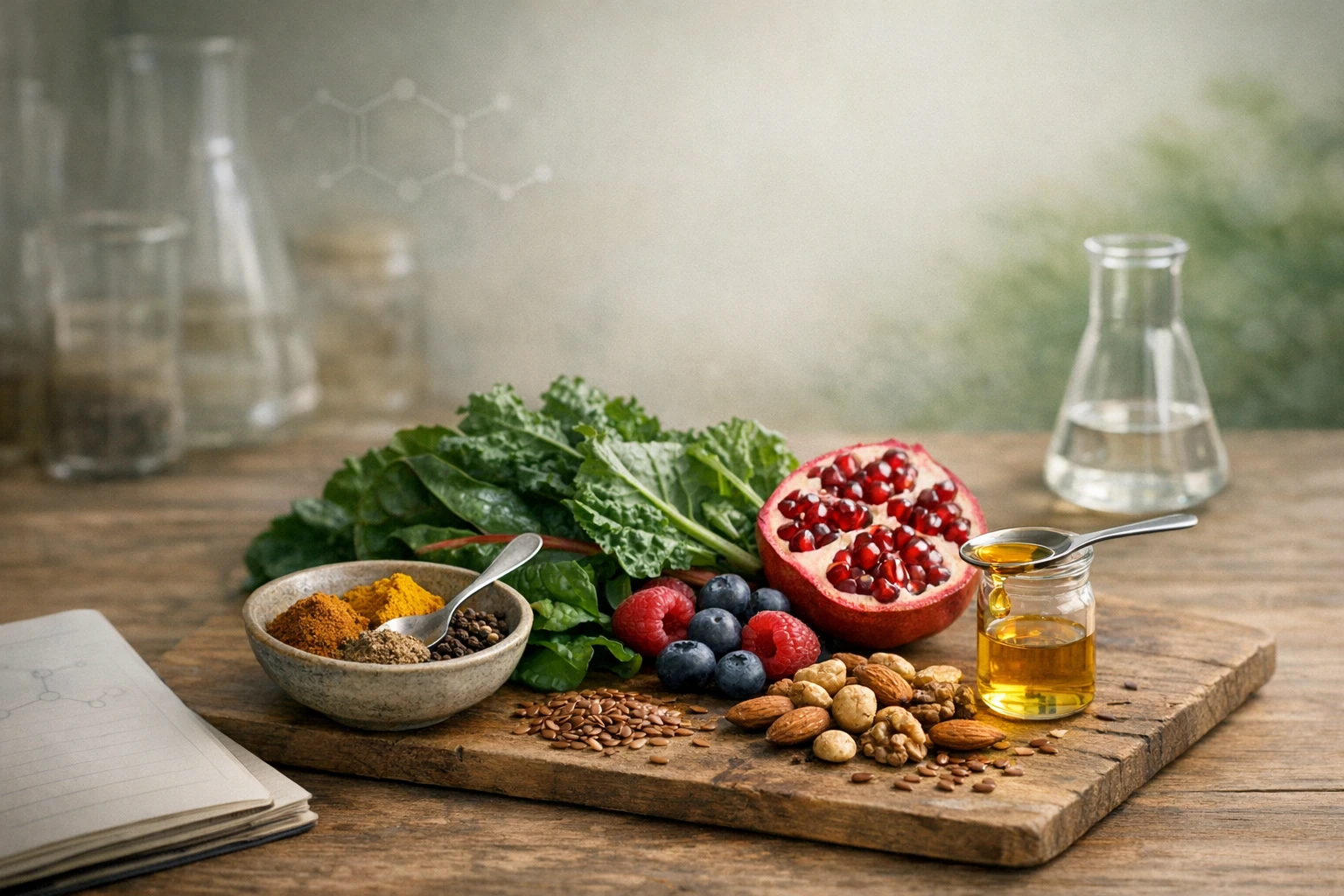
Several food groups exhibit biological mechanisms consistent with anti-inflammatory action at a cellular or systemic level. These include foods rich in polyphenols (berries, tea, spices), carotenoids (colorful vegetables), omega-3 fatty acids (fatty fish, seeds, nuts), and vitamins with antioxidant activity (vitamin C, E). Experimental and clinical evidence shows variable but repeatable effects on biomarkers such as C-reactive protein (CRP), interleukins, and other cytokines [3][4][5].
Spices and Plant Compounds
Spice blends commonly used in cooking contain molecules with antioxidant and anti-inflammatory properties. In controlled clinical studies, the addition of a spice blend to a high-fat, high-carbohydrate meal reduced postprandial pro-inflammatory responses compared to the meal without spices, suggesting an attenuating effect on the secretion of certain cytokines [2]. Extracts or supplements of polyphenolic compounds (e.g., anthocyanins) have also been associated with decreases in inflammatory markers in meta-analyses of clinical trials, with a greater effect at higher doses [7].
Healthy Fats and omega-3
omega-3 fatty acids (EPA, DHA) influence the synthesis of lipid mediators that modulate inflammation and platelet function. Clinical trials and meta-analyses show reductions in triglycerides and variable effects on cardiovascular outcomes; the clinical impact depends on doses, form (EPA vs DHA), and the population studied. Guidelines suggest regular fish consumption, while the use of supplements should be evaluated on a case-by-case basis [5].
Vitamins and Antioxidants
Vitamin C, D, and E play different roles in immune regulation and oxidative stress. Vitamin C participates in cellular processes that promote the elimination of pathogens and modulates neutrophil function; systematic reviews describe its immunomodulatory effects but also highlight limitations in clinical generalization [3]. Vitamin D modulates the maturation of dendritic cells and the T helper/regulatory balance, with implications for the immune response; however, the preventive effect on clinical outcomes requires further confirmation [4]. Vitamin E has shown reductions in inflammatory biomarkers in some trials, especially in selected contexts, but the results are not uniform and depend on the chemical form and dosage [6].
What it means in practice
For the general public, data suggests that adopting a consistent, varied diet rich in plant-based foods is more relevant than seeking out single "miracle foods." Prioritizing whole grains, legumes, colorful fruits and vegetables, sources of unsaturated fats (extra virgin olive oil, nuts, seeds), and fish rich in omega-3 can help maintain more favorable inflammatory profiles in the long term [1].
Some simple practical guidelines — to be interpreted as general orientations and not clinical prescriptions — include increasing overall vegetable consumption, limiting highly processed foods and sugary drinks, preferring cooking methods that preserve nutrients, and incorporating natural spices and herbs into meal preparation to improve nutritional quality and density. For those who exercise, attention to energy needs and antioxidant nutrients can support recovery and the modulation of oxidative stress associated with physical activity [2][5].
Key points to remember
- Overall dietary pattern is the primary nutritional determinant of inflammatory modulation.
- Foods rich in bioactive compounds (polyphenols, carotenoids), fish, and spices can reduce some inflammation markers.
- Benefits depend on dose, duration, and individual context; there are no absolute guarantees.
- The strongest evidence comes from short-to-medium-term randomized studies and long-term observational data; interpretive caution is needed.
- For individual choices, consult a healthcare professional when there are disease conditions or medication use.
Limitations of Evidence
It is important to distinguish between observed associations (epidemiological studies), results from in vitro or animal model experiments, and randomized clinical trials in humans. Many associations between foods and inflammation derive from observational studies that do not prove causality and can be influenced by confounding lifestyle factors. Meta-analyses of clinical trials show effects on biomarkers but with heterogeneity in protocol, dose, population, and duration, which limits clear generalizations [1].
Other limitations include the use of surrogate biomarkers (e.g., CRP) that do not always reflect concrete clinical outcomes, variability in dietary exposure measures (self-reporting), and the difficulty of isolating the effect of single compounds in the presence of complex diets. Finally, some interventions using high doses of nutrients can produce biological effects but may not be safe or appropriate as a general recommendation without medical supervision [1][6].
Editorial Conclusion
Current evidence supports the idea that a dietary pattern rich in plant-based foods, unsaturated fats, fish, and bioactive compounds can help reduce markers of inflammation associated with the risk of chronic diseases. However, the evidence does not justify absolute claims or the generalized use of pharmacological doses of single nutrients without clinical consultation. For most people, the most prudent and sustainable strategy remains the adoption of a balanced and lasting dietary pattern, integrated with an overall healthy lifestyle.
Editorial note
This update has been prepared to offer a clear and verifiable summary of available knowledge, with reference to reviews and clinical trials. Scientific sources are indicated in the "Scientific research" section. The content is for informational purposes only and does not replace personalized medical advice.
Scientific research
- Koelman L, et al. Effects of Dietary Patterns on Biomarkers of Inflammation and Immune Responses: A Systematic Review and Meta-Analysis of Randomized Controlled Trials. Adv Nutr. 2021. https://doi.org/10.1093/advances/nmab086
- Spices in a High-Saturated-Fat, High-Carbohydrate Meal Reduce Postprandial Proinflammatory Cytokine Secretion in Men with Overweight or Obesity: A 3-Period, Crossover, Randomized Controlled Trial. J Nutr. 2020. https://doi.org/10.1093/jn/nxaa063
- Vitamin C and Immune Function. Nutrients. 2017. https://doi.org/10.3390/nu9111211
- Vitamin effects on the immune system: vitamins A and D take centre stage. Nat Rev Immunol. 2008. https://doi.org/10.1038/nri2378
- Associations of Omega-3 Fatty Acid Supplement Use With Cardiovascular Disease Risks: Meta-analysis of 10 Trials. JAMA Cardiol. 2018. https://doi.org/10.1001/jamacardio.2017.5205
- The effect of vitamin E supplementation on selected inflammatory biomarkers in adults: a systematic review and meta-analysis of randomized clinical trials. Sci Rep. 2020. https://doi.org/10.1038/s41598-020-73741-6
- Impact of dietary anthocyanins on systemic and vascular inflammation: Systematic review and meta-analysis on randomised clinical trials. Food Chem Toxicol. 2020;135:110922. https://doi.org/10.1016/j.fct.2019.110922
- A diet high in carotenoid-rich vegetables and fruits favorably impacts inflammation status: a controlled feeding trial. Nutr Res. 2018. https://doi.org/10.1016/j.nutres.2018.02.005