Updated and contextualized version of an article originally published on May 31, 2021
The article retains its original focus by presenting it through a scholarly and accessible perspective, supported by verifiable references.
Authors
- Dr. A. Colonnese – Nutrition biologist
- Roberto Panzironi –Independent researcher
Note editoriali
- First publication: May 31, 2021
- Last update: April 18, 2026
- Version: 2026 narrative revision
Editorial note: This article was originally published in the past and has been updated according to scientific and informative criteria. Its purpose is informational: it does not replace medical advice. [Updated according to bibliographic reviews and institutional editorial guidelines]
IN BRIEF
- Dietary polyphenols are plant compounds studied for their possible antioxidant, anti-inflammatory, and microbiota-modulating effects, with experimental signals of neuronal protection.
- Preclinical experiments show that some polyphenol metabolites, such as gallic acid, can reach the brain and interact with nervous tissues [1].
- Animal models and microbiota studies suggest that gut flora can influence motor alterations and neuroinflammation related to Parkinson's [2].
- Observational epidemiological research indicates associations between higher flavonoid intake and lower risk of Parkinson's onset in some cohorts, but results are not uniform [3][4].
- Direct clinical evidence of the therapeutic efficacy of polyphenols in Parkinson's is still limited; biological properties show plausibility but not definitive causal proof [5][6][8].
Abstract: what does science say?
Polyphenols are plant molecules found in fruits, tea, cocoa, spices, and wine, studied for their ability to modulate oxidative stress, inflammation, and cellular metabolism. Metabolomics experiments indicate that some microbial metabolites derived from polyphenols can enter the circulatory system and accumulate in tissues, including the brain. In animal models, the balance of the gut microbiota affects α-synuclein aggregation, microglia, and motor functions; polyphenol-mediated microbiota modulation is therefore a plausible way to attenuate pro-inflammatory processes. Observational studies in large cohorts show inverse associations between flavonoid consumption and Parkinson's risk in some populations, but the results are heterogeneous. Clinical trials on specific extracts or dietary interventions are scarce or still preliminary. Overall, there is biological plausibility and robust preclinical signals; however, the proof that increasing polyphenol intake prevents or slows Parkinson's in humans remains uncertain and depends on dose, administration form, bioavailability, and individual context.
MAIN SECTION
Polyphenols: what they are and how they can influence the brain
Polyphenols are a vast family of compounds produced by plants: flavonoids (e.g., quercetin, epigallocatechin), stilbenes (e.g., resveratrol), simple phenols (e.g., gallic acid), and others. After ingestion, many polyphenols are transformed by the gut microbiota into smaller metabolites, which enter circulation and can reach distal organs. Metabolomics studies in experimental models have observed that some of these metabolites accumulate in the brain in measurable quantities, suggesting that nervous tissue can be a site of biological action [1]. This deposition does not in itself prove a therapeutic effect but provides a basis for hypotheses on possible biochemical interactions with processes of oxidative stress, protein aggregation, and local immune response.
Plausible mechanisms: oxidative stress, mitochondria, α-synuclein
The pathophysiology of Parkinson's disease involves several cellular processes: oxidative stress, mitochondrial dysfunction, α-synuclein protein aggregation, and neuro-immune inflammation. Many polyphenols show antioxidant activity and modulation of inflammatory and mitochondrial pathways in vitro and in vivo; for example, experimental work on epigallocatechin-3-gallate (EGCG) indicates multiple effects on apoptosis, inflammation, and protein aggregation [5]. These mechanisms support the biological plausibility of a neuroprotective effect, but translation into clinical benefit requires evidence from controlled human studies.
Gut microbiota: bridge between diet and brain
Changes in gut bacterial composition have been observed in Parkinson's patients, and in animal models, the presence or absence of microbiota can modulate the onset of motor deficits and neuroinflammation [2]. Polyphenols can alter the microbiota by favoring strains that produce beneficial metabolites (e.g., short-chain fatty acids) and reducing pro-inflammatory profiles; this modulation is a possible indirect mechanism through which diet affects the brain [8]. It should be noted, however, that the microbiota-disease correlation does not establish unique causality in humans and depends on environmental, genetic, and temporal factors.
Observational evidence and interpretation limits
Longitudinal epidemiological studies have reported associations between higher flavonoid consumption and reduced risk of Parkinson's in some cohorts, especially in men [3]. Other studies, including large recent cohorts, have yielded more nuanced or null results, highlighting the importance of population variability, dietary assessment methods, and confounders (smoking, coffee, lifestyle) [4]. Observations do not allow us to state that polyphenol intake directly causes a reduction in risk: they may indicate a plausible association that requires experimental confirmation.
PRACTICAL SECTION
What it means in practice
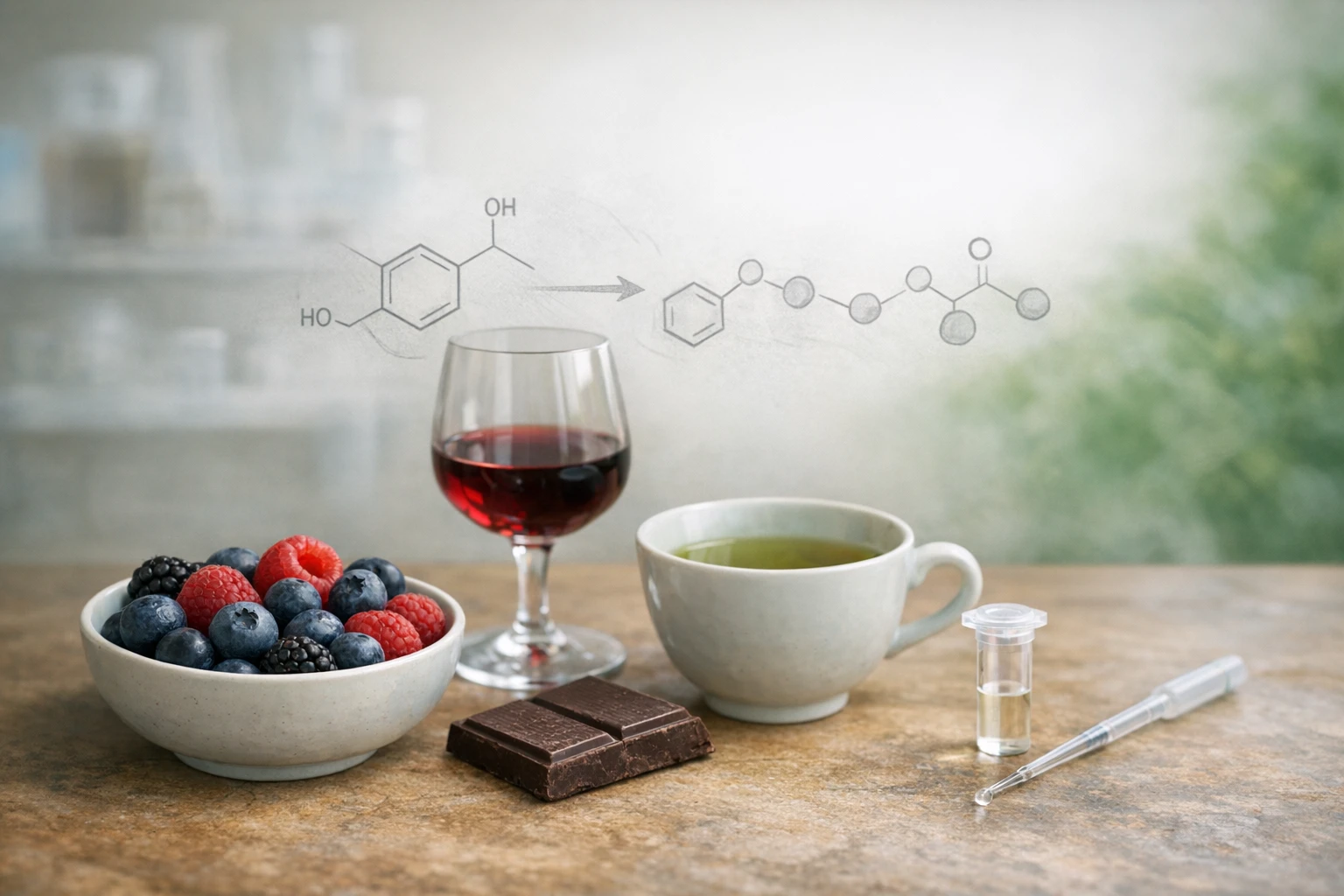
For the public: data suggest that a diet rich in plant-based foods and beverages such as berries, high-flavanol tea and cocoa, spices like turmeric, and an adequate variety of fruits and vegetables can contribute to a favorable nutritional profile for brain health. Such habits also align with general nutritional recommendations already established for cardiovascular and metabolic health. However, at present, there is no solid clinical evidence to support the use of supplements or specific doses of polyphenols as certified therapy or prevention for Parkinson's disease.
Considerations on dose, form, and bioavailability
The bioavailability of polyphenols is variable: many compounds present in foods are metabolized by the microbiota and hepatic pathways into forms with different activity and ability to cross the blood-brain barrier. Experimental studies often use concentrated doses and formulations not equivalent to daily dietary consumption; therefore, preclinical results are not directly transferable to dietary recommendations. Clinical interventions must evaluate form, dose, duration, and potential drug interactions [5][6].
Prudent use of supplements
High-concentration extracts or polyphenol supplements are not without risks: interactions with medications, effects on hepatic metabolism, and individual variability require caution. Any decision on supplementation should be discussed with a doctor, especially in people with chronic diseases or on drug therapy. Public recommendations remain focused on promoting a varied diet, rich in plant-based foods, and in line with national nutritional guidelines.
KEY POINTS TO REMEMBER
- Polyphenols show biological plausibility for antioxidant, anti-inflammatory, and microbiota-modulating activities, factors relevant to Parkinson's.
- Some microbial metabolites derived from polyphenols can accumulate in the brain in animal models [1].
- Animal models indicate a role of the microbiota in the progression of motor alterations and neuroinflammation [2].
- Observational studies suggest associations between flavonoid consumption and lower risk of Parkinson's in specific populations, but the results are not conclusive [3][4].
- Clinical evidence of therapeutic efficacy in Parkinson's patients is still insufficient: controlled, long-term trials are needed.
LIMITATIONS OF EVIDENCE
Difference between observational studies and causal evidence: epidemiological studies observe associations between food consumption and disease outcomes, but cannot prove causality. Even large cohorts are subject to imprecise dietary measurements (questionnaires), residual confounding, and selection bias. Preclinical methodological limitations: cellular and animal models provide mechanistic information, but often use doses not comparable to human dietary intake and do not reproduce the biological complexity of elderly patients with comorbidities. Context variability: individual genetics, microbiota status, concomitant medications, and nutritional status influence observable effects. Need for prudent interpretation: the sum of evidence is suggestive but not sufficient to recommend specific therapeutic interventions based on polyphenols; practical recommendations remain focused on balanced, plant-based diets rather than isolated supplementation [8].
Editorial conclusion
Research on polyphenols, microbiota, and Parkinson's disease has made significant progress: there is biological plausibility and interesting experimental signals, including evidence that some metabolites can reach the brain and that microbiota modulation affects Parkinson's-related phenotypes. However, in light of methodological limitations and non-uniform results from observational studies, the scientific community does not yet have robust evidence to state that a single food, extract, or supplement can prevent or certainly modify the progression of Parkinson's disease. For the public, the most reasonable approach remains a varied diet rich in plant-based foods, along with established medical-clinical management for those living with the disease. Well-designed clinical research evaluating doses, formulations, duration, and interactions remains a priority.
EDITORIAL NOTE
This article is an updated version of a previously published text. The update followed criteria for reviewing peer-reviewed scientific literature, DOI verification, and editorial objectivity. The content is for informational purposes only and does not replace the advice, diagnosis, or treatment of a medical doctor. For specific medical decisions, consult your healthcare professional.
SCIENTIFIC RESEARCH
- Gasperotti M, Vrhovsek U, et al. Fate of Microbial Metabolites of Dietary Polyphenols in Rats: Is the Brain Their Target Destination? ACS Chemical Neuroscience. 2015. https://doi.org/10.1021/acschemneuro.5b00051 [1]
- Sampson TR, Debelius JW, Thron T, et al. Gut Microbiota Regulate Motor Deficits and Neuroinflammation in a Model of Parkinson’s Disease. Cell. 2016;167(6):1469–1480.e12. https://doi.org/10.1016/j.cell.2016.11.018 [2]
- Gao X, Cassidy A, Schwarzschild MA, et al. Habitual intake of dietary flavonoids and risk of Parkinson disease. Neurology. 2012;78(15):1138–1145. https://doi.org/10.1212/WNL.0b013e31824f7fc4 [3]
- Hantikainen E, Trolle Lagerros Y, Ye W, et al. Dietary Antioxidants and the Risk of Parkinson Disease: The Swedish National March Cohort. Neurology. 2021. https://doi.org/10.1212/WNL.0000000000011373 [4]
- Wang Y, Wu S, Li Q, et al. Epigallocatechin‑3‑gallate: A phytochemical as a promising drug candidate for the treatment of Parkinson's disease. Frontiers in Pharmacology. 2022;13:977521. https://doi.org/10.3389/fphar.2022.977521 [5]
- Yurt Turer B, Sanlier N. Relationship of Curcumin with Aging and Alzheimer and Parkinson Disease: A Narrative Review. Nutrition Reviews. 2024;83(3):e1243–e1258. https://doi.org/10.1093/nutrit/nuae079 [6]
- Brickman AM, et al. Enhancing dentate gyrus function with dietary flavanols improves memory in older adults. Nature Neuroscience. 2014;17(12):1798–1803. https://doi.org/10.1038/nn.3850 [7]
- Aryal S, Skinner T, Bridges B, Weber JT. The Pathology of Parkinson’s Disease and Potential Benefit of Dietary Polyphenols. Molecules. 2020;25(19):4382. https://doi.org/10.3390/molecules25194382 [8]
- Role of Glutathione in Parkinson's Disease Pathophysiology and Therapeutic Potential of Polyphenols. Phytotherapy Research. 2024. https://doi.org/10.1002/ptr.8342 [9]