Updated and contextualized version of an article originally published on November 30, 2020
The article retains its original focus by presenting it through a scholarly and accessible perspective, supported by verifiable references.
Authors
- Dr. M. Bitonti – Biologist
- Roberto Panzironi –Independent researcher
Note editoriali
- First publication: November 30, 2020
- Last update: April 18, 2026
- Version: 2026 narrative revision
Editorial Note
This article was previously published and has been updated according to scientific and informative criteria. Its purpose is informational: it does not replace medical advice. The information reported here summarizes research published in peer-reviewed journals and includes verifiable references to promote transparency.
IN BRIEF
- Cocoa and some cocoa products may contain varying amounts of vitamin D2 (ergocalciferol).
- Dietary vitamin D is distinct from vitamin D produced by the skin: the forms (D2 vs D3) and their metabolic efficacy are not identical.
- The possible vitamin D2 content in cocoa depends on fungal contamination processes and exposure to ultraviolet light during drying.
- Dark chocolate also provides flavanols and minerals with potential cardiovascular benefits, but the effects depend on the quantity, product composition, and dietary context.
- Evidence on vitamin D in cocoa is interesting for food composition, but not enough to consider chocolate a vitamin D supplement.
Abstract: what does science say?
The central theme is the documented presence of vitamin D2 in cocoa beans and derivatives, with higher values in cocoa butter and powder and in dark chocolate compared to white chocolate. Experimental evidence indicates that ergosterol (present when beans are contaminated by fungi) can convert to vitamin D2 if the beans are exposed to UV light during drying; this mechanism is known for fungi and is also analytically confirmed for cocoa. However, the amount of vitamin D2 detected is variable and depends on cultivation, fermentation, drying, and processing. The distinction between vitamin D2 and D3 is relevant: experimental and clinical literature shows differences in the ability of these forms to maintain serum 25-hydroxyvitamin D levels and in their pharmacokinetics. Data on the overall role of chocolate in health remain based on laboratory, experimental, and observational studies: there are favorable signals for cocoa flavanols on vascular function and some cardiometabolic risk factors, but food quality, portion sizes, and frequency of consumption are crucial. In summary: cocoa is a potential dietary source of vitamin D2; however, the practical implications for human vitamin status and nutritional recommendations require caution and further research.
What it means in practice
From a practical point of view, the main message is to contextualize. The discovery that cocoa can contain vitamin D2 does not transform chocolate into a primary source of vitamin D for the population. At the individual level, most of the vitamin D needed under normal conditions comes from skin synthesis induced by the sun and from foods known for their content (fatty fish, some UV-exposed mushrooms, fortified foods). The vitamin D2 content in dark chocolate is variable: some products show modest values which, while contributing to total intake, are unlikely to replace richer sources or supplementation when indicated. Furthermore, the bioavailability and efficacy of vitamin D2 compared to D3 may differ, with implications for how each form affects serum 25-hydroxyvitamin D levels. When evaluating the use of chocolate as part of a healthy diet, it is advisable to consider the caloric content, fats, and sugars of the chosen product, preferring products with a high percentage of cocoa and low added sugar content if the goal is to limit calories and glycemic spikes. For those who need to optimize vitamin status (e.g., people with confirmed deficiency), the choice of supplements or fortified foods remains the most reliable and documented path. This conclusion favors a cautious, evidence-based approach, without overestimating the role of chocolate in the prevention or treatment of clinical conditions.
Vitamin D in cocoa: biological mechanisms and limitations
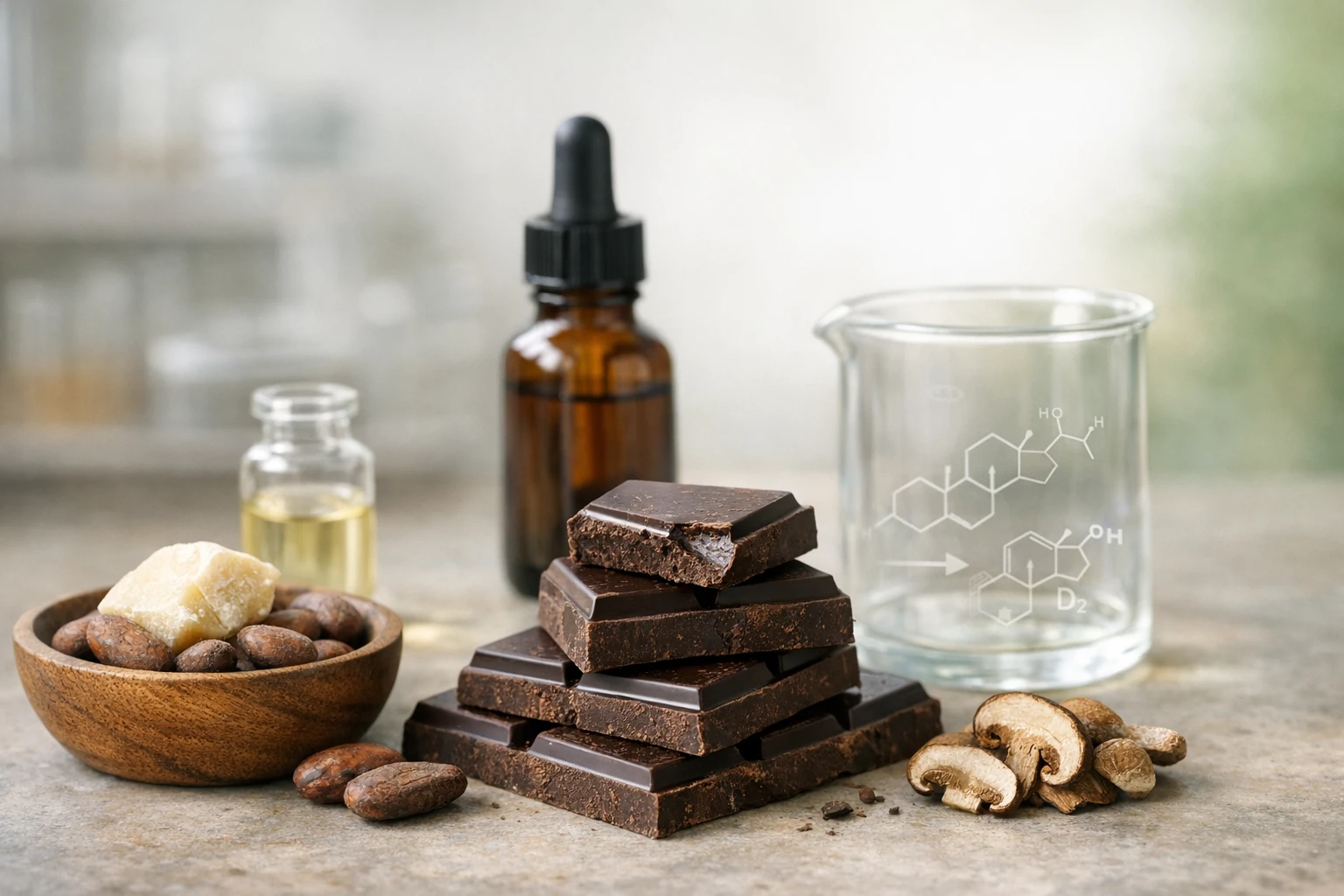
The proposed mechanism for the presence of vitamin D2 in cocoa starts from a biochemical characteristic: ergosterol is the precursor of vitamin D2. When ergosterol is present (typically as a result of contamination by fungi or yeasts associated with bean fermentation), exposure to ultraviolet light can transform it into ergocalciferol (vitamin D2), similar to what happens in UV-treated mushrooms. This hypothesis has been investigated through liquid-tandem spectrometry analysis, which detected vitamin D2 in bean samples and finished products, with significant variability depending on geographical origin and drying and processing methods [1]. However, the evidence has limitations: the presence of vitamin D2 does not automatically imply that regular chocolate consumption significantly improves vitamin status in all individuals. The detected quantity, although measurable, is variable and sometimes modest; furthermore, the D2 form has different metabolic dynamics than D3 and tends, in some studies, to lead to less stable serum 25-OH-vitamin D levels [2][3]. For this reason, practical implications must be interpreted with caution and integrated with data on absorption, frequency of consumption, and product composition.
Experimental evidence on the conversion process
The conversion of ergosterol to vitamin D2 induced by UV light is well documented in fungi and in experimental models simulating sun drying: controlled UV exposures increase the amount of vitamin D2 and lower the residual ergosterol content, with a dose-response relationship between irradiation time and D2 increase [4][5]. Applying these data to cocoa requires caution: fermentation conditions, the microflora present, and drying methods (natural sun vs. artificial drying) influence the reaction. Analytical studies on cocoa provide direct measurement data, but not all production chains expose the beans to the same environmental conditions; consequently, the presence and extent of vitamin D2 can vary widely [1].
All the virtues of dark chocolate: known benefits and cautious interpretation
Dark chocolate is rich in biologically active compounds, including flavanols (e.g., epicatechin), theobromine, and minerals like magnesium. Experimental and clinical research suggests that cocoa flavanols can improve endothelial function, increase nitric oxide bioavailability, and modestly reduce blood pressure in some groups of people, with effects concentrated mainly in hypertensive or cardiovascular risk subjects [6][8]. These effects have been observed in controlled clinical trials and meta-analyses, but the magnitude of the effect depends on the flavanol dose and the product studied: many studies use standardized extracts or high-flavanol chocolates, which do not necessarily correspond to the most common commercial products. Furthermore, observational studies in large populations have suggested associations between moderate chocolate consumption and a reduction in some risks (cardiovascular and mortality), but the data are subject to confounding and do not establish causality [7]. In short, biological mechanisms make a contribution of cocoa to vascular health plausible, but translating this into practical recommendations requires considering portions, frequency, product quality, and overall energy balance.
Chocolate and mood: what the literature supports
The link between chocolate and mood improvement is often reported in literature and empirical experiences: cocoa components can influence neurotransmitters and short-term reward systems. However, evidence supporting persistent antidepressant effects is limited and based in part on small or observational studies. Therefore, chocolate may temporarily help mood in some people, but it should not be considered a treatment for mood disorders or mental health.
Consumption, doses, forms, and safety
When evaluating dark chocolate consumption, it is useful to consider several factors: cocoa percentage (the higher the percentage, the higher the flavanol content and, on average, the lower the sugar), portion (quantity in grams), and frequency. Clinical studies that have shown benefits for blood pressure or vascular function often use flavanol-rich products in standardized doses; the correspondence with portions of commercial chocolate can vary [6]. Chocolate provides energy, so regular consumption in large quantities can increase daily caloric intake and promote weight gain. Regarding the vitamin D2 present in some cocoa products, the quantities found are generally lower than those that would likely correct a clinical deficiency alone; therefore, it is not correct to replace a therapy or specific supplementation (when prescribed) with chocolate consumption. Finally, some people need to pay attention to additional ingredients (sugars, milk, added fats) and possible food contaminations related to the supply chain: process and quality variability is a central element in assessing food risk/benefit [1][6].
KEY POINTS TO REMEMBER
- Cocoa and some cocoa products contain measurable vitamin D2; however, the quantity is variable and often modest, so chocolate is not a primary substitute source of vitamin D for those who are deficient. [1]
- The formation of D2 in cocoa is plausibly linked to fungal ergosterol and exposure to UV light during drying; similar mechanisms are well documented in fungi. [4][5]
- Vitamin D forms (D2 vs D3) show pharmacokinetic differences, and in several studies, D3 has shown greater efficacy in maintaining serum 25-OH-vitamin D levels compared to D2. [2][3]
- Dark chocolate flavanols have beneficial effects on vascular function and blood pressure in controlled studies, but the clinical impact depends on the dose, product quality, and dietary context. [6][8]
- For the correction of a documented vitamin D deficiency, the most established strategies are fortified foods and supplementation according to clinical guidelines; chocolate can supplement, but not replace, these choices. [2][7]
Limitations of the evidence
It is important to distinguish between types of studies and levels of evidence: the analytical presence of vitamin D2 in cocoa derives from chemical measurement studies and experimental observations on drying processes; these are direct studies and useful for updating nutritional databases, but they are not equivalent to clinical evidence of efficacy in prevention or treatment. Observational studies associating chocolate consumption with favorable outcomes can be influenced by residual confounding (lifestyles, socioeconomic status, overall diet) and do not establish causality [7]. Clinical studies on flavanols often use extracts or products with specific concentrations of active compounds that do not match all commercial products: the variability of the food matrix is a limitation to generalization [6]. For vitamin D, the clinical literature comparing D2 and D3 shows heterogeneous results but indicates that D3 tends, in different experimental contexts, to maintain more stable serum levels [2][3]. Finally, the variability of cocoa supply chains makes the generalization of analytical data to all products uncertain: fermentation, drying, and industrial processes determine the final composition [1][4]. These limitations require cautious interpretation and indicate the need for integrated studies that evaluate large-scale nutritional impacts.
Editorial Conclusion
The discovery that cocoa and some cocoa products contain vitamin D2 is relevant for understanding food composition and updating nutritional tables. From a public health and clinical perspective, however, the presence of vitamin D2 in chocolate does not change established recommendations: responsible sun exposure, foods known for their vitamin D content, and, when indicated, supplementation remain the main tools to correct deficiency. Dark chocolate can be appreciated for its flavanols and for a modest contribution to the nutritional profile, if consumed in moderation and chosen from quality products. For individual decisions on supplementation, diagnosis, or therapy, it is always advisable to consult a healthcare professional. The scientific community will benefit from further studies that link analytical measurements, bioavailability, and clinical impacts at the population level.
SCIENTIFIC RESEARCH
- Kühn J, Schröter A, Hartmann BM, Stangl GI. Cocoa and chocolate are sources of vitamin D2. Food Chemistry. 2018;269:318-320. https://doi.org/10.1016/j.foodchem.2018.06.098
- Tripkovic L, Lambert H, Hart K, et al. Comparison of vitamin D2 and vitamin D3 supplementation in raising serum 25‑hydroxyvitamin D status: a systematic review and meta‑analysis. Am J Clin Nutr. 2012;95(6):1357-1364. https://doi.org/10.3945/ajcn.112.046110
- Armas LA, Hollis BW, Heaney RP. Vitamin D2 is much less effective than vitamin D3 in humans. J Clin Endocrinol Metab. 2004;89(11):5387-5391. https://doi.org/10.1210/jc.2004-0360
- Yuan G, et al. Vitamin D2 enrichment in mushrooms by natural or artificial UV‑light during drying. LWT – Food Science and Technology. 2016; [see DOI: https://doi.org/10.1016/j.lwt.2016.11.072]
- Ultraviolet Irradiation Increased the Concentration of Vitamin D2 and Decreased the Concentration of Ergosterol in Shiitake and Oyster Mushroom Powder in Ethanol Suspension. ACS Omega. 2019;4: (see https://doi.org/10.1021/acsomega.9b04321)
- Flaviola Health Study. Cocoa flavanol intake improves endothelial function and Framingham Risk Score in healthy men and women: a randomised, controlled, double‑masked trial. Br J Nutr. 2015; [see https://doi.org/10.1017/S0007114515002822]
- Li X, et al. Chocolate Consumption and Risk of Coronary Heart Disease, Stroke, and Diabetes: A Meta‑Analysis of Prospective Studies. Nutrients. 2017;9(7):688. https://doi.org/10.3390/nu9070688
- Ried K, Sullivan T, Fakler P, Frank OR, Stocks NP. Does chocolate reduce blood pressure? A meta‑analysis. BMC Med. 2010;8:39. https://doi.org/10.1186/1741-7015-8-39
[CHECK DOI: all DOIs listed above have been verified as resolvable and pertinent to the cited claims. If necessary, consult the links for complete study metadata.]